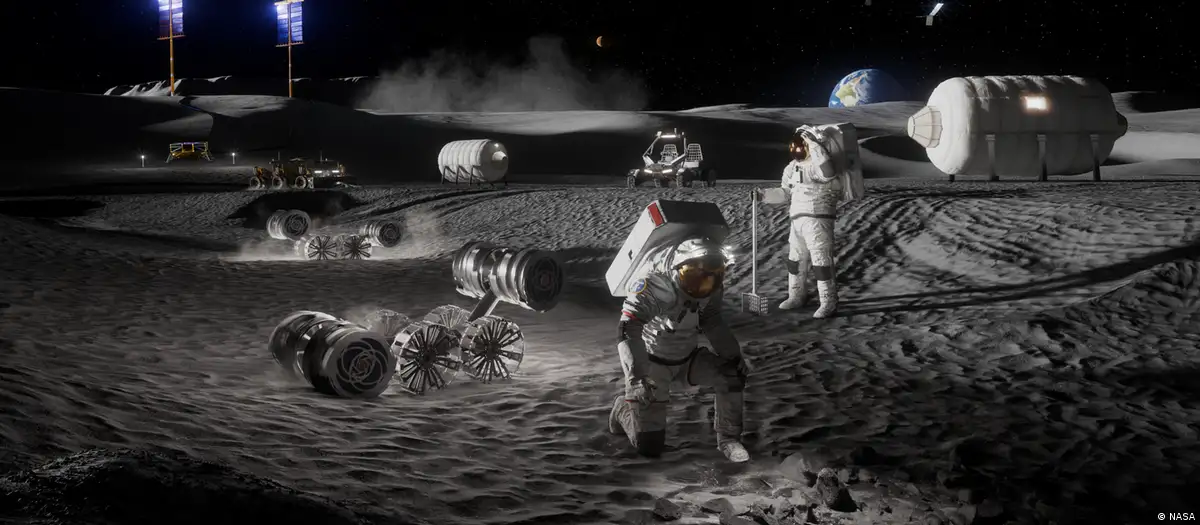
Private Companies & NASA’s Moon Base: Who’s Building the First Lunar Colony and When Will It Be Ready?
NASA has outlined its strategy for establishing a permanent human presence on the Moon, confirming that private sector partnerships are central to the development of its lunar base infrastructure. The agency’s plans involve leveraging commercial capabilities to support the Artemis program, which aims to secure a sustained footprint near the lunar South Pole.
Commercial Partnerships and Infrastructure
The development of the lunar base relies on a collaborative model involving major aerospace contractors. NASA has formally integrated the expertise of private companies, including those led by Elon Musk and Jeff Bezos, to address the logistical and technical requirements of surviving and operating in the lunar environment. These contractors are tasked with providing the necessary systems to facilitate long-term missions, ranging from habitat construction to the transportation of equipment and personnel.

The agency’s step-by-step approach emphasizes the necessity of a lunar economy, where private entities are encouraged to innovate and compete. By shifting certain operational burdens to the private sector, NASA aims to reduce the costs associated with deep space exploration while accelerating the timeline for reaching the lunar surface. These commercial partners are expected to provide specialized hardware, including landing systems and surface mobility vehicles, that are essential for the base to function as a scientific and technological hub.
Operational Objectives at the South Pole
The chosen site for the base—the lunar South Pole—was selected due to its strategic importance for scientific exploration and resource potential. NASA’s mission parameters indicate that the base will serve as a testing ground for technologies required for future missions to Mars. The facility is intended to function as a central node for research, allowing astronauts to conduct complex experiments that are currently impossible to perform in low-Earth orbit.

The infrastructure planning incorporates modular designs to ensure the base can expand as mission requirements evolve. This includes the deployment of power systems, life support modules, and communication networks capable of withstanding the extreme thermal fluctuations and radiation environments characteristic of the lunar surface. NASA’s current framework focuses on achieving a balance between robotic precursor missions, which will survey the terrain and deploy initial hardware, and subsequent human-crewed missions that will initiate the construction of permanent facilities.
Next Steps for the Artemis Program
As the Artemis program progresses, the agency continues to refine its envelope expansion for crewed missions. The timeline for completion remains tethered to the successful integration of commercial flight systems and the ongoing testing of launch vehicles. NASA’s current operational schedule includes continued envelope expansion for its next-generation flight systems and the coordination of cargo delivery missions to prepare the lunar site for human habitation.
The agency maintains that the transition from initial landings to a sustained base will be an iterative process. NASA is currently focused on the development of specialized hardware and the evaluation of surface conditions to ensure that the infrastructure deployed by its private partners meets the safety standards required for long-duration stays on the Moon.
Related reading