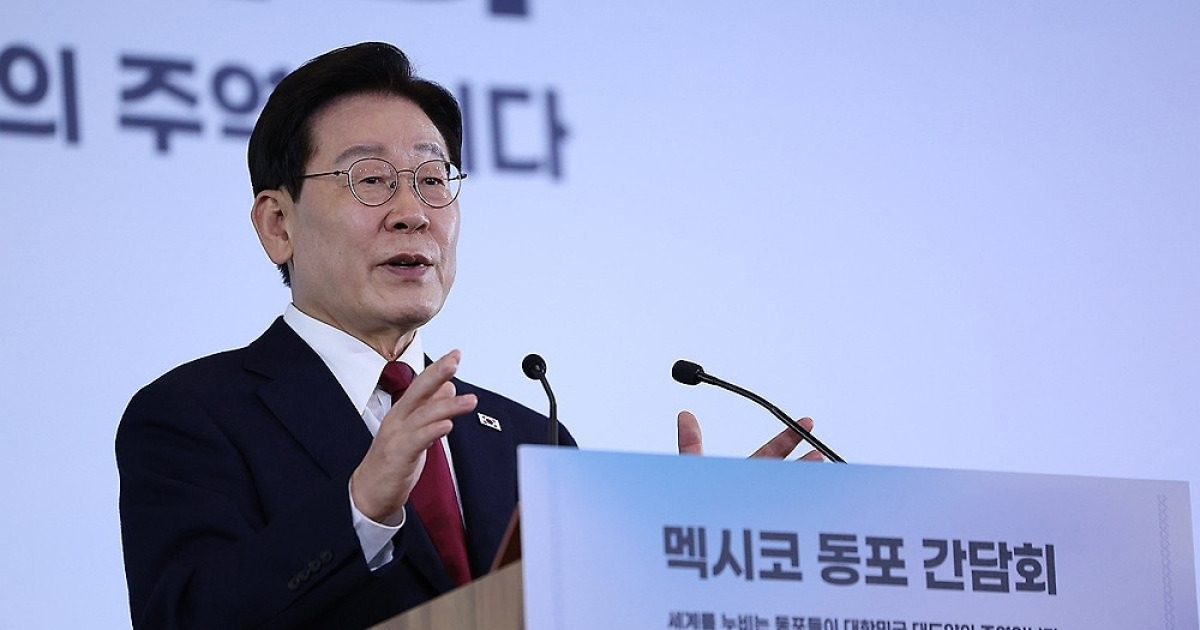
President Lee Jae-myung cautions against rapid reform in Mexico
South Korean President Lee Jae-myung, during a state visit to Mexico on September 24, 2026, cautioned against overly rapid or radical reform agendas, warning that aggressive pushes without moderation invite severe political backlash. Speaking at a dinner with overseas Koreans in Mexico City, Lee specifically pointed to historical debates surrounding the National Security Law during the Roh Moo-hyun administration, signaling that uncompromising stances often destroy opportunities for practical progress.
Evaluating Reform Pace and the Danger of Overreach
Addressing an audience of expatriates, President Lee outlined a philosophy of gradual and pragmatic governance. He argued that pushing reforms too quickly, too far, or too abruptly triggers immediate political friction. “When it is a revolutionary situation, people tend to go overboard,” Lee stated, reflecting on the historical parallels of the French Revolution and expressing a clear skepticism toward unyielding political hard-liners.
The president anchored his argument in a well-known legislative stalemate from the Roh Moo-hyun era. According to Lee, the ruling and opposition parties had nearly reached a consensus to eliminate several toxic clauses from the National Security Law. However, that potential compromise collapsed because someone insisted on a total, unconditional abolition of the statute. “The other side ended up opposing the abolition, and we couldn’t even eliminate the toxic clauses,” Lee noted. He added that those exact provisions remain active today, citing recent instances where police have conducted search and seizure operations under the pretext of individuals studying North Korea’s Juche ideology.
Political Fallout and Intra-Party Tensions
This commentary is widely interpreted as a direct rebuke of writer Yu Si-min, a prominent figure who historically championed the complete dismantling of the National Security Law. The timing of the president’s remarks underscores growing internal friction within South Korea’s ruling political camp. Just a day prior, the presidential office expressed open regret over recent remarks by Yu, accusing him of distorting the administration’s prosecutorial reform agenda.
Lee directly challenged the political utility of absolutist demands. “Even if it looks cool to display your purity through excessive claims, achieving good results in reality is not easy,” Lee said. He emphasized that while enacting sweeping, immediate, and noisy changes might feel satisfying, governance requires minimizing resistance and pursuing practical, tangible results. These comments directly address the ongoing friction between the presidential office and hard-line supporters over the scope and speed of prosecutorial and structural reforms.
Overcoming Institutional Resistance
Expanding on the mechanics of governance, the South Korean leader detailed the entrenched hurdles facing public administration. Comparing the difficulty of reform to funding an independence movement, Lee explained that entrenched beneficiaries of existing systems wield disproportionate influence despite their smaller numbers.

“They do not resist alone; they pull someone else to their side,” Lee explained, offering the example of real estate speculators who convince ordinary citizens that regulatory policies might harm them. To counter this negative power, the administration must engage in rigorous preparation and persuasive communication to prevent public frustration from boiling over into systemic crises.
Ultimately, Lee framed the challenge of modern governance as a balancing act between ideological ideals and practical execution. Without careful planning and broad coalition-building, sweeping policy ambitions risk repeating past legislative failures, leaving outdated statutes and systemic vulnerabilities firmly in place.