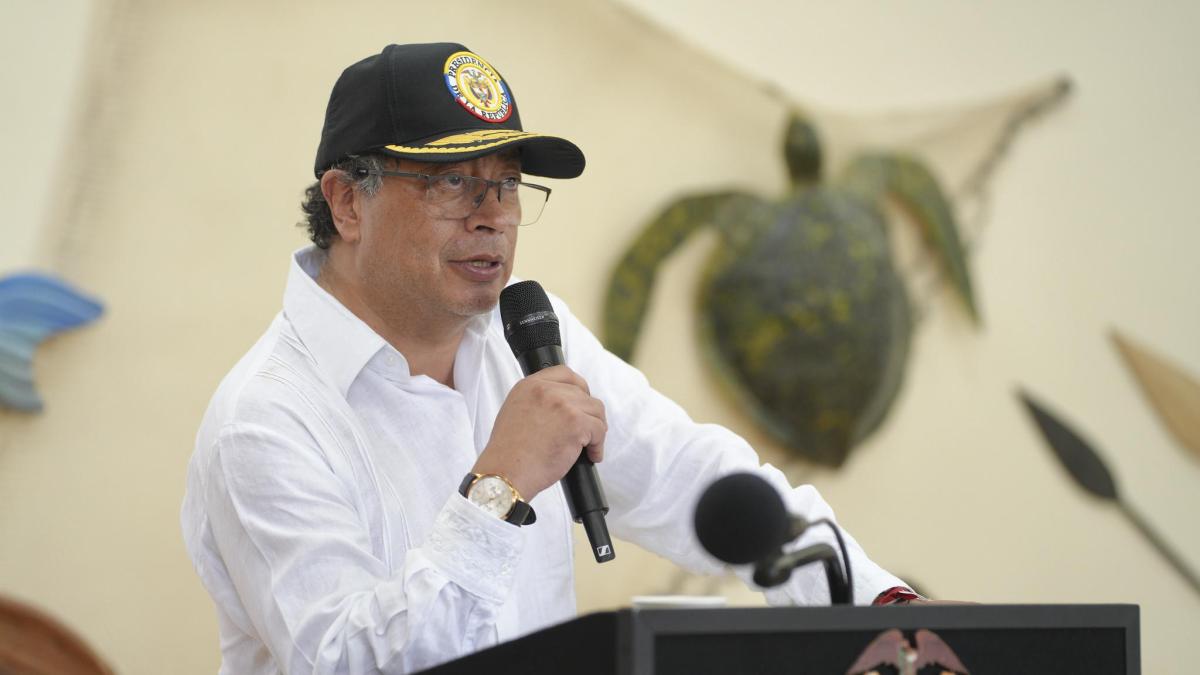
President Gustavo Petro Booed at Macrorrueda de las Américas 2026 in Bogotá
President Gustavo Petro faced intense public backlash and booing during his speech at the Macrorrueda de las Américas 2026 in Bogotá on April 14. Attended by entrepreneurs from 60 countries at Corferias, the event was marred by shouts of “Out with Petro,” highlighting deep political divisions within Colombia.
The atmosphere inside Corferias was supposed to be one of optimism and economic synergy. The event, branded as “Colombia, the Country of Beauty,” was designed to position Bogotá as the premier business hub of the Americas, bringing together thousands of national and international investors. Instead, the venue became a theater of political friction.
The tension peaked the moment the presenter announced the President’s intervention. Before Petro could fully engage the audience, a wave of whistles and jeers erupted. The chants of “Fuera Petro”—translated as “Out with Petro”—were not merely whispers in the back of the room; they were loud enough to be captured by the official Presidential transmission.
It was a jarring disconnect.
While a small group of attendees in the front rows remained attentive, a significant portion of the crowd expressed their disapproval through audible protests and visible gestures, including thumbs-down signs. The disruption was severe enough to force momentary pauses in the President’s delivery, turning a promotional trade event into a demonstration of public discontent.
Despite the hostile environment, Petro pushed forward with his agenda. He used the platform to claim that his administration had successfully met its targets regarding agricultural exports. More pointedly, he addressed one of the most contentious pillars of his platform: the energy transition. Petro asserted that he had fulfilled his campaign promise to conclude Colombia’s reliance on the production of oil, coal, and gas.
“We have achieved it,” Petro declared, referring to the transition away from fossil fuel dependence, even as the room remained divided.
This insistence on success in the face of open rejection underscores the growing chasm between the government’s internal metrics and the perception of the business community. For international entrepreneurs from 60 different nations, the sight of a head of state being booed at his own trade fair sends a complex signal about the stability of the investment climate. When political volatility spills over into trade diplomacy, the perceived risk for foreign capital increases.
Navigating this level of instability requires more than just diplomatic patience. Businesses operating in such volatile environments are increasingly relying on corporate legal counsel to safeguard their interests against sudden regulatory shifts and political upheaval.
A Landscape of Constant Confrontation
The incident at the Macrorrueda does not exist in a vacuum. It is the latest flashpoint in a broader pattern of aggressive political warfare defining the current Colombian administration. The friction extends beyond the business sector and deep into the legislative and personal realms.

Former President Álvaro Uribe has intensified his rhetoric, issuing a direct and high-stakes challenge to the current mandatary. The rivalry has moved beyond policy disagreements into a battle over truth, and legitimacy.
“If the lie is yours, resign from the Presidency; if it is mine, I resign from politics,” Uribe challenged Petro.
This “all-or-nothing” approach to political discourse mirrors the clashes occurring within the Senate. Recent reports highlight a fierce live confrontation between Paloma Valencia and Iván Cepeda, illustrating that the polarization seen at Corferias is mirrored in the halls of power. Even environmental policy has become a battlefield, with strong opposition emerging against the Ministry of Environment’s plan to sacrifice 80 of Pablo Escobar’s hippopotamuses.
For companies trying to establish a footprint in Bogotá, these disruptions are more than just headlines; they are operational risks. To mitigate these threats, many are turning to strategic risk management consultants to develop contingency plans that account for sudden shifts in executive leadership or legislative deadlock.
Economic Ambitions vs. Political Reality
The Macrorrueda de las Américas was intended to be a showcase of Colombian efficiency and beauty, aiming to attract over 4,800 entrepreneurs. By centering the event in Bogotá, the government sought to solidify the city’s status as a regional economic engine. However, the “Country of Beauty” branding struggled to mask the ugliness of the political divide.
The government’s focus on agricultural exports and the move away from extractive industries is a bold macroeconomic pivot. While environmentally ambitious, the transition creates immediate friction with sectors tied to oil and mining. This economic pivot, combined with accusations of “fascism” directed at financial institutions—such as Petro’s comments regarding the co-director of the Bank—further alienates the financial elite.
When the gap between official rhetoric and public sentiment becomes this wide, the brand of the country suffers. Managing this reputational damage requires specialized intervention. Many organizations are now seeking crisis management specialists to navigate the narrative surrounding their partnerships with the Colombian state.
The event’s official records, including those shared via Bogota.gov.co and reports from Revista Semana, confirm that the tension was not a momentary lapse but a sustained expression of rejection.
The images of a President speaking over the noise of a crowd demanding his exit serve as a potent metaphor for the current state of the nation. Petro may claim victory in the numbers—citing export growth and energy shifts—but the auditory evidence at Corferias suggests a different kind of deficit: a deficit of consensus.
As Colombia continues to push toward a post-carbon economy amidst a climate of intense polarization, the ability of the government to maintain a professional veneer during international trade events will be critical. If the “Country of Beauty” continues to be defined by public clashes and legislative warfare, the beauty of the investment opportunity may be overshadowed by the volatility of the political reality. For those navigating this storm, finding verified professionals through the World Today News Directory remains the only way to ensure that business stability survives the political noise.