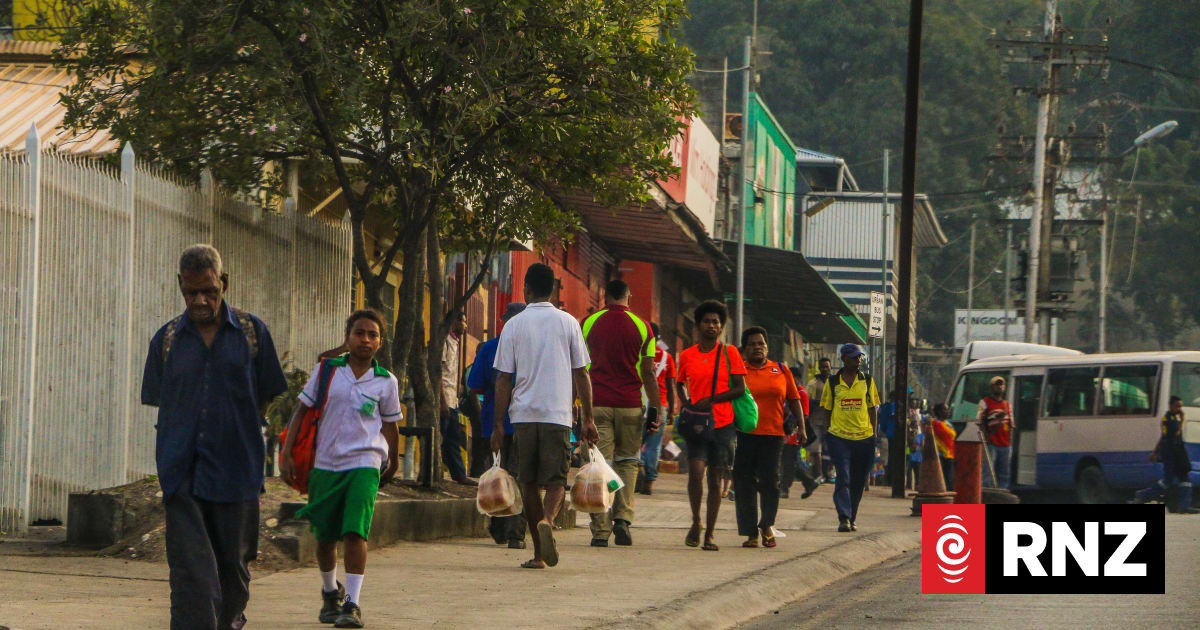
PNG Policy Aims to Limit Families to a Maximum of Three Children
Plans for a national family planning policy aimed at reducing the nation’s elevated birth rate by urging households to cap family size at three children were revealed this month by Papua New Guinea Prime Minister James Marape.
According to Marape, the objective of the policy is to limit household financial pressures, prevent unintended pregnancies, and check unchecked population growth. The 2024 census put the population at 10.18 million, although some reports estimate it is higher. According to the latest World Bank figures, the birth rate sits at approximately 2.4 percent annually.
Pointing to National Statistics Office data indicating annual population growth of 2.6 percent alongside an increase of 180,000 individuals each year, Marape said that public infrastructure, education, and health services were facing severe pressure. Public health specialists responded with mixed views to the government’s announcement.
Health experts warn of severe service strain
Professor Glen Mola, head of reproductive health and professor of obstetrics and gynaecology at the University of PNG, praised the government announcement while emphasizing the necessity of taking immediate and comprehensive action.
“We should have done what the prime minister is proposing a generation ago because now the age structure of our population is such that nothing can cope,” he told RNZ Pacific.
Dr Mola described the situation as an emergency that had been building for decades. “Society can’t cope. The government can’t cope. The health service can’t cope. The education systems can’t cope. Nothing can cope because 50 percent of our population is under the age of 18. Half of our population are children,” Mola told RNZ Pacific.
Warning that the policy would remain mere rhetoric without an execution strategy, Mola insisted that a nationwide consultation on the matter was essential. He noted a lack of political discourse on the matter from members of parliament.
“Lots of the politicians have more than one wife. Lots of them have five, six, seven, eight, nine, ten children. So I suppose they find it a bit of a challenge,” Mola told RNZ Pacific.
Diverse cultural settings require research
A social anthropologist and research fellow at the Institute of Medical Research in Papua New Guinea, Dr Nalisa Neuendorf, said more family planning work was needed first.
“In a country like PNG, I think it is also really important to remember that our different provincial settings also create an opportunity for a mixed approach,” Neuendorf told RNZ Pacific.
“So, really understanding at a provincial level what can be done might be a better way forward rather than looking at this objectively just from a kind of a one size fits all approach,” she said. Neuendorf added that given the huge diversity of cultural settings across the country, it is difficult to pinpoint social norms around family size as a standard national issue.
Neuendorf acknowledged the high unintended pregnancy rate amongst young people and said officials are working to improve adolescent pregnancy and family planning pathways. She said that young people are involved in the research process to better gauge appropriate family planning pathways and ensure informed decisions.
Mola warns urban drift and population growth threaten society
Mola warned that continuing to allow population growth and urban drift to run rampant could prove destructive for society. He said that urban areas are being flooded by mostly young men, driving high rates of sexual violence, while rural areas are being denuded of young people escaping village life.
While national programs to limit the number of children per family had mixed success in Asian countries including China and Vietnam, Mola suggested Papua New Guinea should look to how Indonesia achieved stabilization of its population through a two-child policy in the 1970s.
“We’re certainly in the sort of boat that the Indonesians found themselves in the 70s, and that’s what we need to do,” Mola told RNZ Pacific.
“First of all, there needs to be a national consultation to explain the issue, and then set up our version, the way we should do it in PNG,” he said.