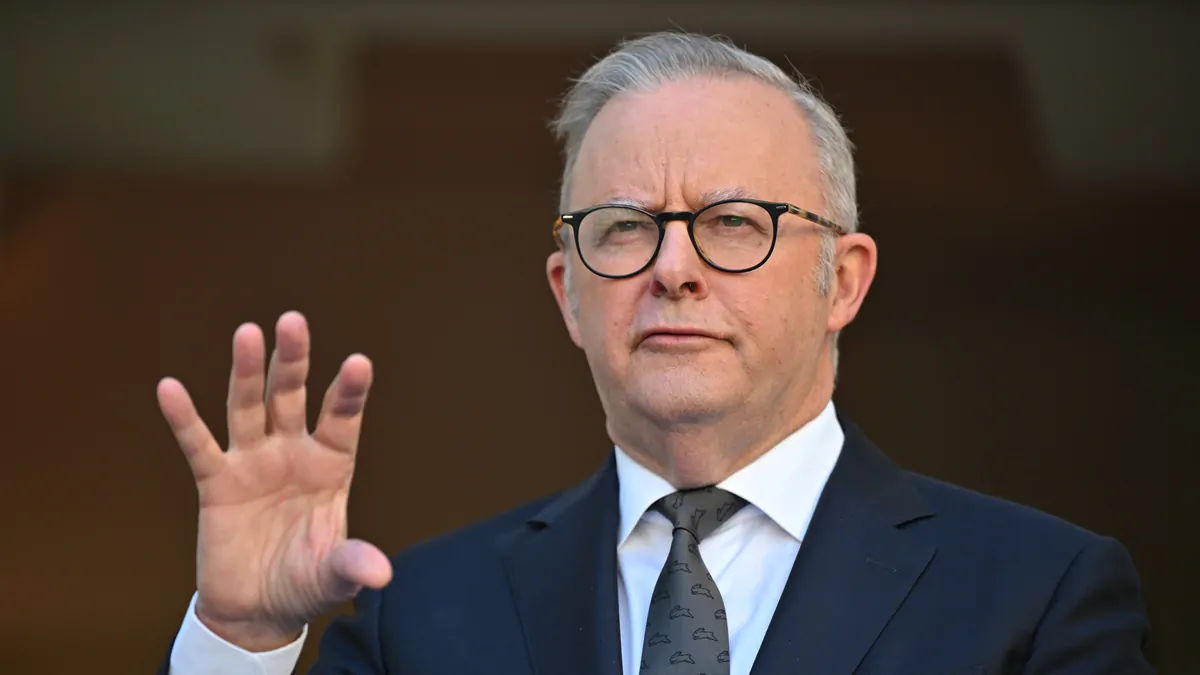
PM Anthony Albanese Visits Asia to Strengthen Australia’s Fuel Supply
Prime Minister Anthony Albanese is visiting Singapore and key Asian trading partners to secure critical fuel supply guarantees as the war in the Middle East and the closure of the Strait of Hormuz disrupt global oil markets. With Australia importing 90% of its refined fuel, the government is deploying new underwriting powers to prevent domestic shortages.
The vulnerability is stark. When the Strait of Hormuz closes, the heartbeat of global energy slows, and for a nation like Australia, the ripple effects are immediate and visceral. This isn’t merely a diplomatic exercise or a series of high-level meetings. It’s a scramble for national resilience in the face of a global energy chokehold.
Australia’s reliance on foreign refineries is an Achilles’ heel. Because the country imports the vast majority of its refined petrol and diesel, it remains precariously exposed whenever trading partners consider prioritizing their own domestic stocks during an emergency. To mitigate this, Albanese has focused heavily on Singapore, a linchpin of the region’s energy architecture that currently provides roughly 55% of Australia’s petrol imports and 15% of its diesel.
The stakes are too high for traditional procurement.
The Financial Shield: Underwriting the Risk
In a decisive move to stabilize the market, the federal government has introduced new fuel security powers. The core of this strategy involves Export Finance Australia, a government-backed financial institution. Rather than the state buying fuel directly—which could further distort global prices—the government will now underwrite fuel cargoes purchased by private companies.
Essentially, the government is acting as a financial guarantor. By covering the financial risk if a purchase goes wrong, Export Finance Australia gives private firms the confidence to bid aggressively and competitively for additional cargoes that they might otherwise avoid due to extreme price volatility. This mechanism extends beyond fuel; it also covers the purchase of fertiliser and other essential commodities critical to the agricultural sector.
For businesses struggling to navigate these volatile procurement landscapes, securing vetted supply chain specialists has become a necessity to ensure that operational continuity isn’t severed by a sudden lack of fuel or raw materials.
“The government is taking national action to help get the fuel restocked… New fuel security powers will enable the government to underwrite the purchase of fuel by the private sector.” — Prime Minister Anthony Albanese
These powers are designed to be proactive. Albanese has characterized the move as being “over prepared” rather than a reaction to an immediate collapse in supply, yet the urgency is evident in the speed of the rollout.
The Coordination Engine: The National Taskforce
Managing a crisis of this scale requires more than just funding; it requires a centralized command structure. To this finish, the government has established a national fuel supply taskforce. Leading this effort is Anthea Harris, the former chief of Australia’s energy regulator and former chief executive of the Climate Change Authority.

The taskforce operates under the Department of Prime Minister and Cabinet, serving as the connective tissue between federal objectives and state/territory implementation. Harris is tasked with driving coordination on fuel distribution and national resilience, providing the government with regular updates on supply outlooks.
Each state and territory has appointed a representative to function alongside Harris, ensuring that if regional shortages emerge, the response is synchronized rather than fragmented. This level of coordination is vital for municipal governments and regional councils who must manage local infrastructure and emergency services during period of scarcity.
The logistical complexity of this coordination often forces companies to seek guidance from commercial trade attorneys to ensure that new, emergency procurement contracts remain compliant with both domestic and international law.
The Economic Ripple and the Plea for Calm
While the government focuses on the macro-supply, the micro-impact is felt at the pump. Fuel prices are surging, and reports of ships cancelling deliveries have added to the atmosphere of uncertainty. This volatility has a direct line to the broader economy. The federal treasurer has warned that if the conflict in the Middle East is prolonged, domestic inflation could jump to above 5 per cent.
In a rare national address on April 1, Albanese pleaded with the public to remain calm. He stopped short of mandated rationing, instead urging Australians to apply “common sense” and avoid the impulse to stockpile, which would only accelerate the shortages the government is fighting to prevent.
The diplomatic front remains the primary line of defense. Assistant Foreign Minister Matt Thistlethwaite recently confirmed that ministers from Japan and South Korea have provided assurances that “normal supply” will continue. These assurances, combined with the joint statement signed with Singapore, form the bedrock of Australia’s current strategy.
| Key Partner | Strategic Role / Contribution | Current Status |
|---|---|---|
| Singapore | Supplies 55% of petrol, 15% of diesel | Joint statement signed on two-way trade |
| Japan & South Korea | Refined fuel supply guarantees | Assurances of “normal supply” provided |
| Malaysia | Critical fuel supply source | Government chasing supply guarantees |
The current crisis exposes a fundamental truth about modern geopolitics: economic security is inseparable from energy security. Australia’s dash to Asia is a recognition that in a world of closing straits and warring superpowers, a “normal supply” is not a guarantee, but something that must be actively negotiated and financially insured.
As the Middle East conflict continues to drive uncertainty, the ability of Australian businesses to pivot their energy sourcing and manage inflationary pressures will determine who survives the crunch. Those unable to adapt are increasingly relying on corporate financial planners to hedge against the rising cost of essentials and the instability of global trade routes.
The current measures—the taskforce, the underwriting, and the diplomatic missions—are designed to build a bridge over a very deep gap in national preparedness. Whether that bridge is strong enough to withstand a prolonged war remains the defining question for the Albanese government.
In times of systemic instability, the difference between collapse and continuity is often the quality of the professional network you can lean on. From logistics experts to legal counsel, finding verified professionals equipped to handle the fallout of global energy crises is the only way to move from a state of panic to a state of preparation. The World Today News Directory remains the primary resource for connecting with the experts capable of navigating this new, volatile reality.