
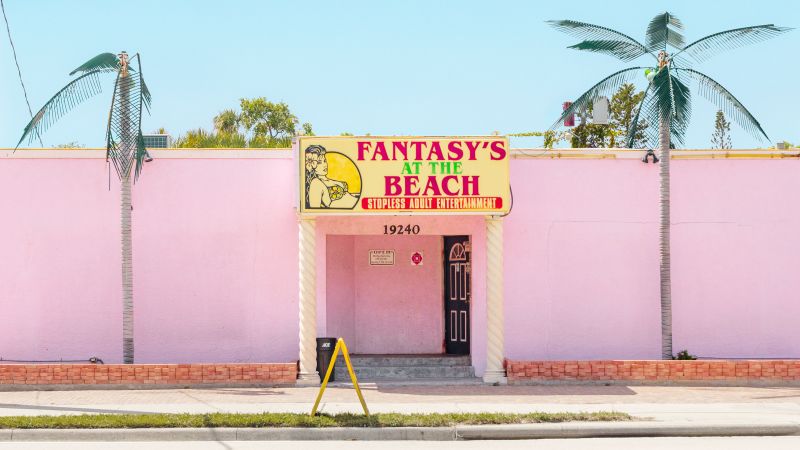
Across more than 6,000 miles of American highway, French photographer François Prost documented a landscape often hidden in plain sight: the facades of strip clubs. His recently published book, “Gentlemen’s Club,” presents a collection of nearly 150 photographs, capturing the architecture of these establishments from Miami to Los Angeles.
Prost’s project, begun in 2019, deliberately avoids images of the dancers or interiors of the clubs. Instead, he focused exclusively on the buildings themselves, noting the often-vibrant and sometimes deliberately understated exteriors. The resulting images reveal a surprising diversity in architectural styles and marketing approaches.
“I’d divide these venues into two types: One is incredibly integrated into the public landscape and one is a bit more hidden and dodgy,” Prost told CNN. He observed that some clubs are situated alongside familiar American commercial staples – amusement parks, quick food restaurants, and shopping malls – while others are more discreet, blending into strip malls or appearing incongruous in conservative areas.
The photographer was particularly interested in the contrast between the presence of strip clubs and the social conservatism of the “Bible Belt” in the American South. He noted the apparent contradiction in a region often characterized by “conservatism and extreme puritanism.”
Prost’s approach was documentary in nature. He visited the clubs during daylight hours, seeking permission to photograph the facades and explaining his artistic intentions. He found that most establishments were amenable, with managers often eager to receive copies of the finished photographs. “Most of the time, people were OK – 99% of them would say yes to a facade picture,” he said.
The project evolved from Prost’s earlier series, “After Party,” which documented the exteriors of nightclubs in France. He explained that comments on the French nightclubs’ distinctly American aesthetic sparked his interest in exploring the American equivalent. He was struck by the willingness of American strip clubs to openly advertise their services, a contrast to the more subtle approach often found in Europe.
The photographs reveal a range of visual styles, from the pastel colors of a Florida club dubbed “Club Pink Pussycat” to establishments that appear unremarkable amidst the desert landscape. In Las Vegas, Prost noted, strip club signage is as prominent as that of casinos and fast-food restaurants. Miami clubs often feature vivid, Wes Anderson-esque color schemes.
Prost’s work also highlights the often-humorous and suggestive language used in the clubs’ advertising. Signs display jokes and puns, such as “My sex life is like the Sahara, 2 palms, no dates,” and names like “Booby Trap” and “Bottoms Up.”
The book’s title, “Gentlemen’s Club,” is itself a recurring phrase on the signs Prost photographed, reflecting the commodification of women within these spaces. Prost’s deliberate exclusion of images of the dancers emphasizes this point, focusing instead on the architectural representation of desire and consumption. He observed that the establishments market women as objects to be consumed, evidenced by food-themed names and advertisements like “1,000’s of gorgeous girls & three ugly ones.”
Prost’s next project will focus on love hotels in Japan, establishments that, like strip clubs in the US, occupy a unique space within a conservative society. Though, he believes the American strip clubs offer a distinct insight into the country’s culture, suggesting that commercial success is prioritized regardless of the nature of the business. “As long as you’re successful in terms of business, (it doesn’t matter) if your activity deals with sex,” he said.
“Gentlemen’s Club” is currently being exhibited at Agnes b. Galerie Boutique in Tokyo, Japan, running from March 17 to April 15, 2023. The book is published by Fisheye Editions and is available for purchase now.
