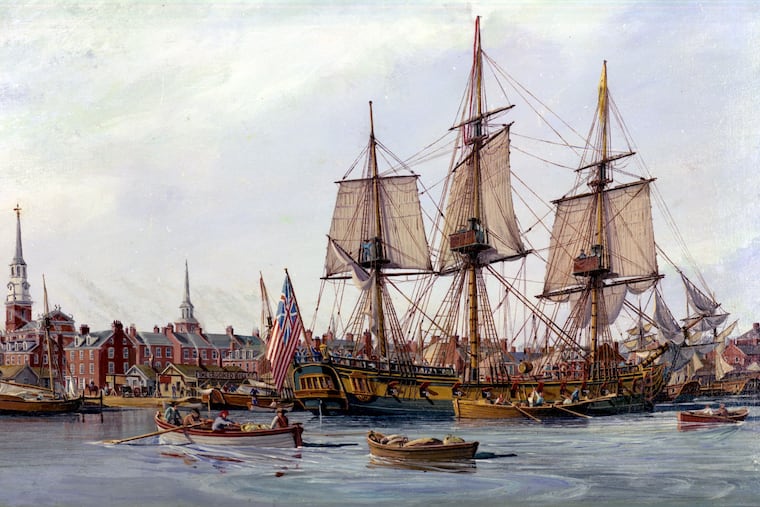
Philadelphia played key role in establishing US Navy and Marines
In the summer of 1775, Rhode Island delegates arrived at Independence Hall in Philadelphia to request a fleet capable of defending the vulnerable coastline against British warships. That petition set in motion a legislative vote on Oct. 13 that authorized merchant vessels for a search-and-destroy mission, establishing the origins of the United States Navy.
Delegates Bring Naval Defense Demands to Philadelphia
Four months into the Revolutionary War, Rhode Island faced a severe threat from British naval forces due to its location along Narragansett Bay. The colony lacked the heavy armaments required to match the world’s largest navy, prompting delegates to travel to Philadelphia in August 1775. They asked the Second Continental Congress to establish a protective naval force.
Congress responded by voting to grant merchant vessels to Rhode Island and Connecticut. Lawmakers also supplied General George Washington with an armed schooner and sloop to intercept British supplies. These tactical authorizations formed the administrative bedrock of American sea power.
Marines Mobilize Under Quaker Leadership
Troops needed the capability to match British Royal Marines upon landing. On Nov. 10, the Continental Congress established two battalions of Continental Marines.
Massachusetts delegate John Hancock appointed Philadelphia Quaker Samuel Nicholas as the first commissioned officer of the Marines on Nov. 28. In March 1776, Nicholas led a strategic mission aboard a ship outfitted by fellow Philadelphia Quaker Joshua Humphreys. The force raided New Providence in the British-controlled Bahamas, capturing 88 cannons, 15 mortars, and a massive supply of gunpowder to fuel the continental campaign.
Philadelphia Historic District Honors Naval Origins
The role of Philadelphia in establishing America’s maritime military forces takes center stage on Saturday, Oct. 17, from 11 a.m. to 1 p.m. at the Arch Street Meeting House located at 320 Arch Street. The event forms part of the Philadelphia Historic District’s yearlong weekly celebration honoring foundational American institutions.

The creation of an American naval force was a key strategy to winning the war,
said Sean Connolly, executive director of the Arch Street Meeting House Preservation Trust, as noted by the Philadelphia Inquirer. It also proved to other European nations like the French, the Dutch, and the Spanish that we were to be taken seriously, that we were just like other world powers.
Connolly noted that while Quakers maintained strict pacifist beliefs, their commercial and mechanical contributions played a direct role in the military logistics of the revolution. Joshua Humphreys later designed the first six frigates for the modern U.S. Navy authorized by Congress on March 27, 1794, to protect American shipping from Mediterranean pirates. One of those vessels, the USS Constitution, remains an active training vessel.
President John Adams signed the act organizing the U.S. Marine Corps as part of the Department of the Navy on July 11, 1798. Saturday’s festival at the Arch Street Meeting House highlights these enduring municipal and national milestones.