
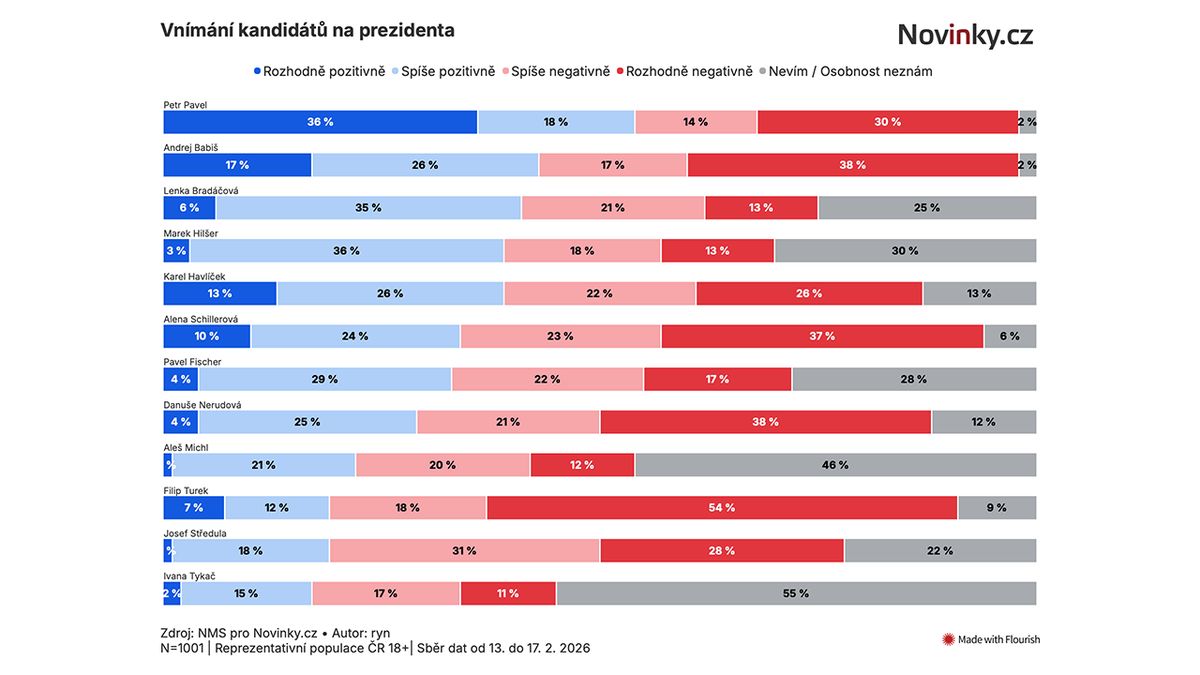
Prague – Current Czech President Petr Pavel maintains a strong position as he potentially seeks re-election, according to a new survey by NMS Market Research. The poll, conducted in mid-February, found that 36 percent of respondents view Pavel favorably, with an additional 18 percent leaning positively. Conversely, 14 percent view him unfavorably, while 30 percent hold a decidedly negative opinion.
Pavel’s current term is set to expire on March 9, 2028, with the first round of the next presidential election anticipated in January of that year. The NMS research indicates a significant divide in voter perception based on political affiliation. Four out of five opposition voters view the president favorably, while three out of five voters aligned with the current government hold a decidedly negative view.
While Pavel appears well-positioned, Andrej Babiš, the former Prime Minister and leader of the ANO party, ranks second in potential candidate popularity. Babiš receives a positive assessment from 17 percent of respondents, with a further 26 percent leaning positively. However, Babiš, who lost to Pavel in the 2023 presidential election, has stated he will not run again, announcing his decision on Instagram earlier this year.
Other figures within ANO demonstrate lower levels of support. First Deputy Chairman and Minister of Industry, Karel Havlíček, is viewed positively by 39 percent of those surveyed, while Deputy Chairman and Finance Minister Alena Schillerová receives positive ratings from 34 percent. “The governing coalition will certainly seek to put forward its own candidate, but the chances of the main trio of ANO politicians are little,” said Tereza Friedrichová, a political analyst at NMS. “If they want to defeat Petr Pavel, they should consider supporting a non-partisan candidate.”
Speculation has emerged regarding potential candidates beyond Pavel and the ANO leadership. Ivan Tykač, whose husband Pavel recently acquired a stake in the Mafra publishing house and sponsors the Václav Klaus Institute, has been mentioned as a possible contender. Tykač is politically close to the SPD party, with Marek Prchal, a former ANO advisor, serving as her media consultant. The NMS poll shows 17 percent of Czechs view Tykač positively, 28 percent negatively, and a substantial 55 percent remain undecided or unfamiliar with her.
In comparison, Supreme State Prosecutor Lenka Bradáčová enjoys a more established public profile, with 41 percent viewing her positively and 34 percent negatively. However, Bradáčová has indicated she is not currently considering a run for the presidency, though a source within Novinky suggests she might consider a bid after the conclusion of Pavel’s potential second term.
Filip Turek, whose nomination as Minister of the Environment was rejected by Pavel, faces the highest level of negative public perception among potential candidates. 54 percent of respondents view Turek decidedly negatively, with an additional 18 percent leaning negatively. Only 7 percent view him positively.
The NMS survey, which included 1001 respondents, also gauged support for Pavel seeking a second term. 39 percent of Czechs believe he should definitely run again, with an additional 13 percent expressing support. This brings total support for another Pavel run to approximately 52 percent. However, nearly 40 percent are either decidedly or somewhat opposed to his re-election.
Friedrichová noted that Pavel benefited from partial support from voters within the current governing coalition during the 2023 election, including a majority of voters for the Motorist party. She added that public support is now more polarized, but that Pavel still has the potential to appeal to up to a fifth of the governing coalition’s voters, suggesting his chances of re-election remain significant.
