
New Survey Reveals Parents Increasingly Encounter Vaccine Data Online, But Impact on Decision-Making Remains Limited
A new survey from KFF and The Washington Post reveals a significant portion of parents are exposed to information about childhood vaccines online, particularly on social media, though this exposure doesn’t appear to be substantially shifting their vaccine decisions. The survey, released today, highlights varying levels of exposure across demographic groups and political affiliations.
60% of parents report having ever seen information about children’s vaccines online. This figure rises to 76% among parents under age 35 and 73% among parents who support the “Make America Healthy Again” (MAHA) movement. 38% of parents under age 35 and 37% of parents who support MAHA have seen such information.
The content parents encounter is often mixed. 19% of parents say they see vaccine content that is a “mix of both” pro- and anti-vaccine perspectives,while 8% see content that is “mostly pro-vaccine” and 7% see content that is “mostly anti-vaccine.” Among parents who have skipped or delayed vaccines for their children, the shares seeing mostly anti-vaccine (12%) and mostly pro-vaccine (10%) content are similar, with 24% reporting a mix of both.
Political divides are also apparent. Democratic parents (13%) are more likely to report seeing pro-vaccine content than Republican parents (7%), while shares reporting mostly anti-vaccine content are similar (7% and 8% respectively). 15% of Democratic parents, compared to 20% of Republican and independent parents, report seeing a mix of both perspectives.
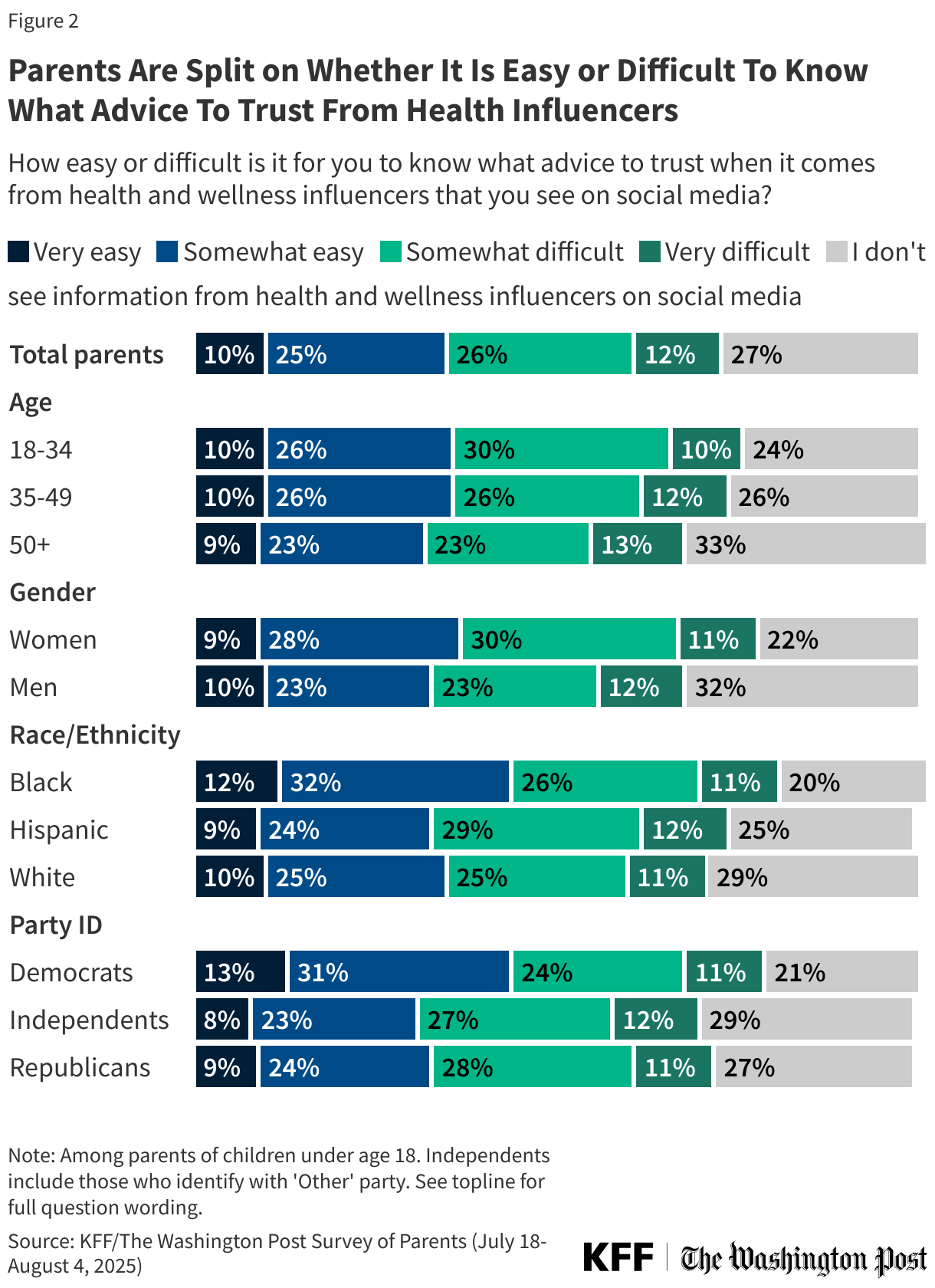
Despite widespread exposure, the survey indicates limited impact on parental decision-making. Only 4% of parents say exposure to online content has made it easier to make vaccine decisions,and another 4% say it has made it harder. A quarter (26%) report that the information hasn’t made a difference. These trends hold consistent across age, partisanship, race, and ethnicity.Among parents who have skipped or delayed vaccinations, 9% say social media content has made their decisions easier, 7% say it has made it harder, and 30% report no significant impact.
The findings come as trust in health and wellness influencers remains low and public confusion about online information is high.
