Parayathkaavu Police Controversy and Malayidanthuruth Eviction Crisis Updates
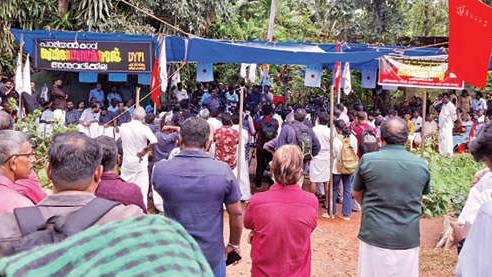
In Parayathkaavu, Kerala, a legal stalemate persists as a scheduled lawyer commission failed to arrive at the site, stalling a contentious eviction drive at Malayidamthuruthu. The delay highlights deepening tensions between residents and state authorities, with the Kerala government now seeking a stay from the High Court to facilitate further negotiations.
The failure of the commission to reach the location on May 23, 2026, has left the community in a state of precarious limbo. For the residents of Malayidamthuruthu, the physical presence of legal oversight represents their primary shield against immediate displacement. When that oversight fails to manifest, the vacuum is filled by uncertainty and public friction.
The Anatomy of a Land Dispute
At the heart of the crisis is a fundamental clash between administrative enforcement and local habitation rights. The ongoing situation has prompted intense public scrutiny regarding the methods employed by law enforcement during previous attempts to clear the land. Residents have raised pointed questions regarding the authorization of force and the alleged heavy-handedness of police, asking, “Who granted the police the power to assault and drag people?”
This is not merely a local housing issue; it is a symptom of broader systemic challenges in land tenure and administrative transparency. When local residents face the threat of sudden eviction, the necessity for robust legal advocacy becomes immediate. Navigating these complex municipal and state regulations requires specialized knowledge that many displaced families lack.
Those caught in the crosshairs of such disputes often find themselves needing immediate assistance from experienced real estate and property rights attorneys who can challenge eviction orders and ensure due process is followed. Without such counsel, individuals are at a severe disadvantage when facing state-backed enforcement actions.
Government Intervention and Judicial Timelines
Following the outcry, the state government has shifted its strategy. Minister Roji M. John has been tasked with opening a dialogue with the affected community, signaling a departure from the purely confrontational approach seen in earlier days. The government is now preparing a petition for the High Court, scheduled to be heard this coming Monday, to seek additional time for a resolution.

The High Court’s stance remains the decisive factor in this timeline. The court’s intervention serves as the ultimate arbiter, potentially granting the breathing room necessary for the minister’s proposed discussions to bear fruit. However, the reliance on judicial intervention underscores a broader inefficiency: when local administrative bodies and citizens cannot reach a consensus, the burden of governance shifts entirely to the judiciary.
The Escalation Matrix
To understand the gravity of the situation, consider the following sequence of events currently influencing the trajectory of the Malayidamthuruthu dispute:
- Initial Enforcement: Police attempts to execute eviction orders led to active resistance from residents and local support groups.
- Legal Stasis: The failed arrival of the lawyer commission on May 23 created a temporary procedural void, preventing the escalation of physical removals.
- Administrative Pivot: The appointment of Minister Roji M. John represents a tactical retreat by the state, shifting from enforcement to negotiation.
- Judicial Review: The upcoming Monday hearing serves as the final gatekeeper for the eviction process.
For community leaders and neighborhood associations, the current environment necessitates a proactive approach to collective defense. Organizations that provide civic rights advocacy and community legal support are essential in these moments to organize witness documentation and ensure that the rights of displaced persons are upheld under the law.
The Broader Implications of Property Rights
The Malayidamthuruthu incident serves as a stark reminder of the fragile balance between infrastructure development and individual property rights. In regions across India, the rapid pace of development frequently outstrips the legal frameworks intended to protect the vulnerable. According to guidelines set forth by the Department of Labor and various national land administration standards, the processes for relocation and compensation are intended to be rigorous and transparent.

When these processes are circumvented, the result is the kind of social volatility witnessed this week. The need for transparency is not merely a procedural requirement; it is a safeguard against the erosion of public trust in local governance. If the state intends to maintain order while pursuing regional development, it must prioritize the mediation of these disputes through established, verifiable channels rather than relying on rapid, forceful evictions.
For those managing property assets or operating in regions subject to eminent domain, the risk of litigation and operational disruption is significant. Consultations with land use and urban planning consultants are often the most effective way to preempt these conflicts before they reach the stage of court-ordered intervention.
As the residents of Parayathkaavu await the outcome of Monday’s court proceedings, the silence left by the absent commission remains heavy. The government’s move to negotiate suggests an acknowledgment that the path of forceful eviction is increasingly untenable in a modern, rights-conscious society. Yet, the history of land disputes in the region warns us that temporary stays are not permanent solutions. The true test will be whether the upcoming dialogue can produce a settlement that respects the dignity of the residents while addressing the state’s objectives. Until then, the community remains in a state of watchfulness, knowing that the law is their only buffer against an uncertain future. In times of such profound institutional strain, the importance of engaging with vetted legal and advocacy professionals cannot be overstated—they are the final line of defense when the machinery of the state fails to provide the clarity and justice its citizens deserve.