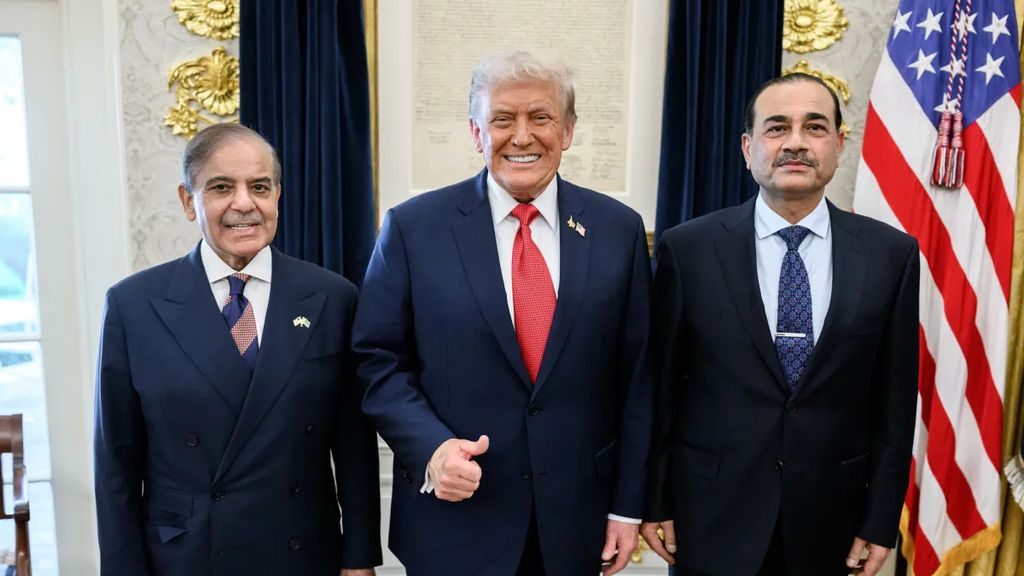
Pakistan to Host US Iran Peace Talks in Bid to End War
Representatives from the United States and Iran are convening in Islamabad this week to negotiate a cessation of hostilities, mediated unexpectedly by Pakistan. This diplomatic pivot, confirmed by German Foreign Minister Johann Wadephul at the G7 summit, signals a potential de-escalation in the Strait of Hormuz, aiming to stabilize global energy supply chains and reduce the geopolitical risk premium currently inflating crude oil futures by nearly 15%.
The market reacts violently to uncertainty, but capital flows even faster toward resolution. As Washington and Tehran prepare to sit across the table in Pakistan’s capital, the immediate implication for global equities is a compression of the volatility index (VIX) related to Middle Eastern exposure. For institutional investors, the question is no longer about the probability of conflict, but the velocity of the peace dividend. This isn’t just diplomacy. This proves a macroeconomic correction in the making.
The Geopolitical Arbitrage of Islamabad
Pakistan’s emergence as the primary broker defies conventional diplomatic gravity. Historically sidelined in complex Middle Eastern conflicts and lacking formal ties with Israel, Islamabad has leveraged its unique position as a nuclear-armed state with deep historical channels to both Washington and Tehran. The logic is fiscal as much as it is strategic. Pakistan imports a significant portion of its energy from the Gulf; a prolonged conflict threatens its balance of payments and sovereign credit rating.
Prime Minister Sharif’s administration is operating under severe fiscal constraints. Domestic fuel prices have surged 20% year-over-year, crushing consumer discretionary spending and inflating the cost of goods sold for local manufacturers. By facilitating these talks, Pakistan is effectively hedging its own national balance sheet against an energy shock. The alternative—being dragged into a security pact with Saudi Arabia against Iran—would expose Pakistani defense expenditures to unsustainable levels, widening the fiscal deficit beyond the 6% threshold watched closely by the IMF.
Army Chief Munir, widely regarded as the true power center in Islamabad, has cultivated a direct line to the White House. President Trump has publicly referred to Munir as his “favorite field marshal,” a testament to the military-to-military rapport that often bypasses civilian bureaucratic friction. This relationship is critical. When the U.S. Vice President JD Vance and Iranian Parliament Speaker Mohammad Ghalibaf arrive in Islamabad, they are not just meeting diplomats; they are engaging with a security apparatus that guarantees the safety of the negotiation table.
Three Market Shifts Driven by the Islamabad Accords
The potential success of these negotiations triggers a cascade of adjustments across emerging market portfolios. We are looking at a structural repricing of risk in the region.
- Energy Security and Supply Chain Normalization: A de-escalation removes the immediate threat to the Strait of Hormuz, through which 20% of the world’s oil passes. For logistics firms and energy traders, this reduces the need for expensive war-risk insurance premiums. Companies relying on just-in-time delivery through the region can begin to normalize inventory levels, freeing up working capital previously tied to safety stock.
- Defense Spending Reallocation: Pakistan’s commitment to a security pact with Saudi Arabia is contingent on regional stability. If the Iran conflict cools, Islamabad can pivot defense budgets toward domestic infrastructure or debt servicing. This shift alters the outlook for international defense contractors who had priced in increased munitions orders from the Pakistani military.
- Sovereign Debt Liquidity: Pakistan’s Eurobonds have traded at distressed levels due to political instability. A successful mediation enhances the country’s international standing, potentially narrowing credit default swap (CDS) spreads. For fixed-income investors, this represents a classic distressed debt opportunity, provided the political risk is mitigated by the new diplomatic framework.
The Corporate Risk Mitigation Imperative
While heads of state shake hands, the private sector must navigate the aftermath. The transition from conflict to peace is rarely linear; it is fraught with regulatory changes, sanctions lifting, and complex compliance hurdles. Multinational corporations operating in South Asia and the Middle East face a dual challenge: capitalizing on new market access while ensuring adherence to evolving U.S. And international sanctions regimes.
This is where the role of specialized enterprise risk management firms becomes non-negotiable. As the U.S. Treasury potentially adjusts its sanctions list regarding Iranian entities, compliance departments must update their screening protocols in real-time. A single oversight can result in massive fines that erase quarterly gains. Companies looking to re-enter the Iranian market or expand Pakistani operations will require robust international corporate law counsel to navigate the intricate web of bilateral agreements and local joint-venture requirements.
“The Islamabad track offers a rare off-ramp for escalation, but the economic reconstruction will require capital deployment on a scale not seen since the post-2001 era. We are advising clients to position for infrastructure play, not just energy.”
— Elena Rostova, Chief Investment Officer, Meridian Global Macro Fund
The involvement of the “Trump Peace Council” adds another layer of complexity. This initiative, aimed at Gaza and broader regional stability, suggests a coordinated approach to reconstruction financing. However, the absence of Israel from the initial Islamabad talks remains a critical variable. If Tel Aviv feels sidelined, market confidence could fracture again. Investors must monitor the State Department’s official briefings for any indications of Israeli buy-in.
Strategic Outlook for Q2 2026
The fiscal quarters ahead will define the region’s trajectory. If the talks hold, we expect a rotation out of defensive utilities and into emerging market equities, particularly in the industrial and materials sectors. Pakistan’s government, eager to showcase the economic benefits of peace, will likely offer tax incentives for foreign direct investment (FDI) in energy and transport.
However, the “fog of peace” can be as disorienting as the fog of war. Rapid policy shifts create arbitrage opportunities but similarly execution risks. Corporations must engage M&A advisory firms with on-the-ground intelligence to identify undervalued assets before the broader market prices in the stability. The window between the ceasefire announcement and the full normalization of trade is where alpha is generated.
For the World Today News Directory, this development underscores the critical need for businesses to have access to vetted, high-level strategic partners. Whether it is securing supply chains against residual volatility or structuring cross-border deals in a post-sanction environment, the right B2B infrastructure is the difference between exposure and opportunity. As the dust settles in Islamabad, the smart money is already moving to secure the legal and operational frameworks required to build what comes next.