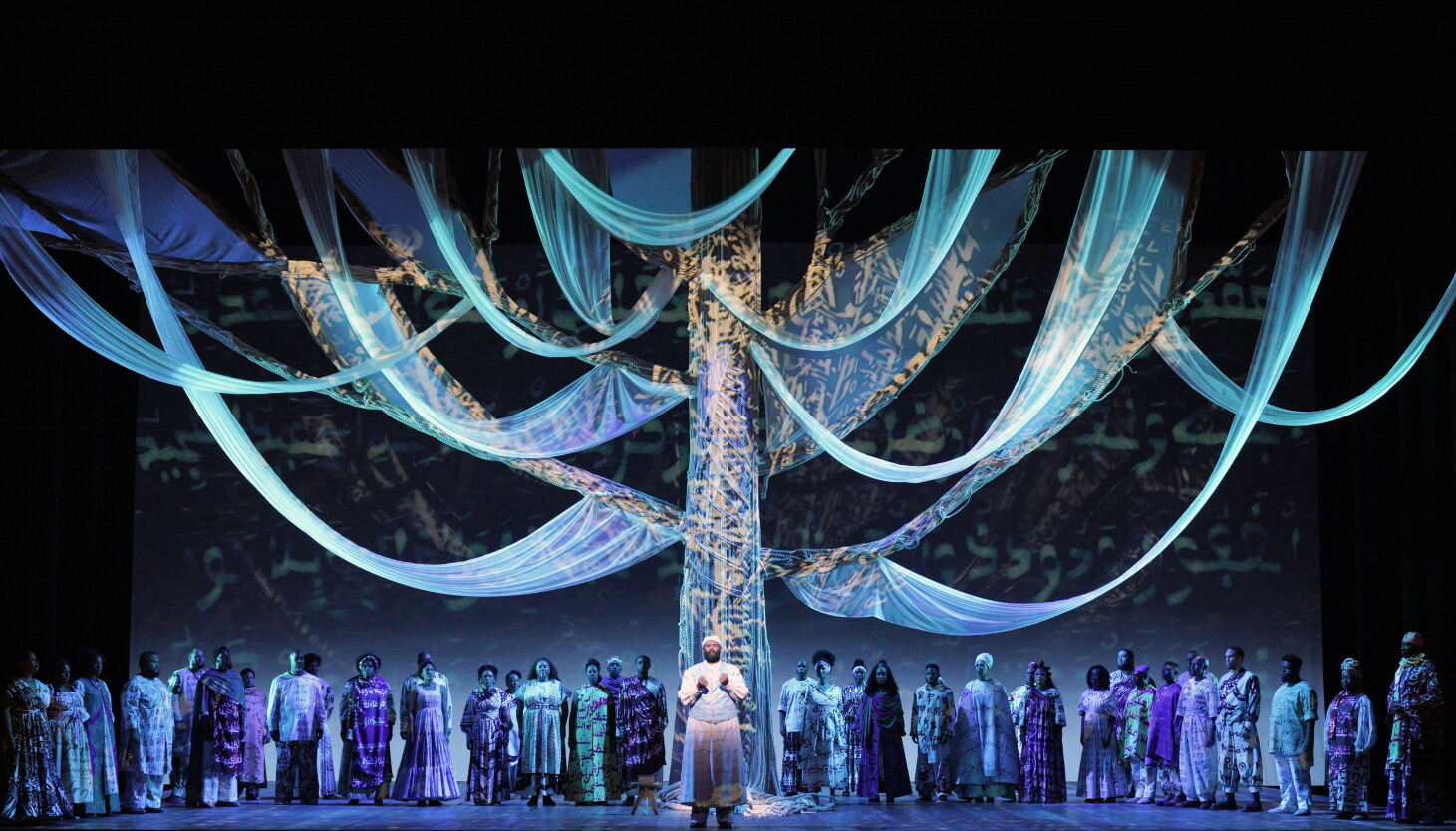
Opera Omar Makes Midwest Debut at Lyric Opera of Chicago
The Pulitzer Prize-winning opera Omar, composed by Michael Abels and co-created by Rhiannon Giddens, makes its Midwest debut this week at the Lyric Opera. The production tells the life story of Omar ibn Said, an enslaved West African Muslim scholar who authored a rare Arabic-language autobiography in 1830s North Carolina.
A Long-Awaited Chicago Arrival
After successful runs in Los Angeles, San Francisco, and Boston, Omar arrives at the Lyric Opera as part of the company’s current season. WBEZ reported that the Lyric is a co-commissioner of the work and has scheduled only three performances. This is a contrast to the eight performances slated for the company’s season-opening production of Don Giovanni. Lyric President and CEO John Mangum stated that the programming decision reflects lower demand for contemporary titles in recent seasons, though he noted that Omar is selling well.
The opera features tenor Issachah Savage in the title role, joined by soprano Kearstin Piper Brown and mezzo-soprano Zoie Reams. All three performers are appearing in the show for the first time. The creative team began the project in 2018 after being approached by South Carolina’s Spoleto Festival USA, despite the fact that neither Giddens nor Abels had previous knowledge of ibn Said’s history.
Confronting American History Through Performance
The narrative of the opera draws directly from the manuscript held by the Library of Congress, which was purchased in 2017 following decades in private collections. The text serves as the primary witness to ibn Said’s life, detailing his capture in West Africa and his subsequent enslavement. According to WBEZ, the Newberry Library maintains approximately 200 narratives from enslaved individuals, but notes that ibn Said’s account is distinct because it was written while he was still enslaved, rather than after gaining freedom.
For the production’s leadership, the timing of the Chicago premiere aligns with a broader national reflection. “I feel like there’s a bit of a paradox, but there’s no better way to celebrate the history of our country than by confronting it honestly,” Mangum said. “And I think this is a work of art that confronts the history of our country and the impact of slavery.”
Orchestration Replaces the Banjo in Omar
While Rhiannon Giddens is widely recognized for her work in folk music and her use of the banjo, the instrument is entirely absent from the score of Omar. Instead, Abels noted that the orchestration itself functions as the primary instrumental voice. “Rhiannon likes to say the orchestra is the banjo, and that is actually a lot of how the orchestration works,” Abels said. The score incorporates a variety of musical traditions to reflect American history, blending styles that are often categorized separately.
The opera also addresses the limitations of the primary source material. Because ibn Said’s autobiography was written under the oversight of his enslaver, James Owen, the text contains omissions and maintains a cautious tone. “The autobiography is very telling in the things it doesn’t say,” Abels observed. He added that the work is “not a juicy tell-all in any way,” reflecting the reality of an individual writing under the constant threat of violence. Despite these constraints, the creative team views the work as a necessary exploration of the human experience.
Lyric Opera Promotes Research into Original Manuscript
The Lyric Opera has coordinated with local museums and universities to encourage audiences to engage with the original manuscript, which is available for public viewing via the Library of Congress website. Will Hansen of the Newberry Library noted that the manuscript challenges common perceptions of 19th-century American demographics. “Many people don’t think about practicing Muslims living in North Carolina in the first half of the 19th century, but they are there, and Omar proves that,” Hansen said.
As the production concludes its Chicago run, the creative team continues to emphasize the resonance of the story nearly two centuries later.
“Omar walks among us, and there are people whose stories, in the tiny details, are different than Omar’s, but overall are exactly Omar’s story today,” Abels said. “Now more than ever, this story needs to be told.”
Disclaimer: The views and cultural analyses presented in this article are for informational and entertainment purposes only. Information regarding legal disputes or financial data is based on available public records.