Newsom Unveils AI Safety Roadmap in Washington Amid National Tech Outages and Security Concerns
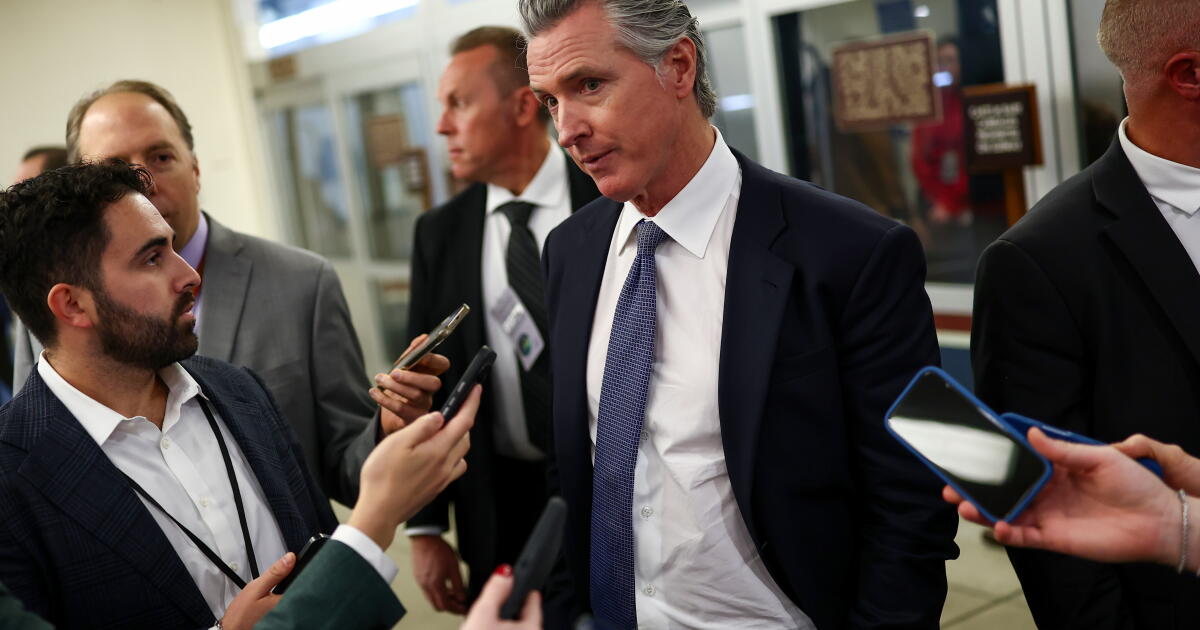
Gov. Gavin Newsom carried an 85-page AI safety plan to Washington on Wednesday as Trump administration officials struggled to explain a string of tech outages.
The report, commissioned two months ago, positions the likely 2028 presidential contender as a leading watchdog over artificial intelligence at a moment of national anxiety.
The Los Angeles Times reported the timing: Newsom delivered the plan in the nation’s capital just as President Trump met with leaders in AI-rival China and the public questioned whether artificial intelligence played a role in recent cyberattacks and technological disruptions.
“Anxiety levels are at 12 out of 10 on this subject matter, and it in many ways [is] because of the lack of leadership here in Washington, D.C.,” Newsom said, flanked by AI academics and economic advisors before a crowd of political and tech reporters.
The political stakes could hardly be sharper. A federal report released the same day warned that misuse of the technology “represents a growing risk to national and economic security,” and the administration’s own intelligence director told Congress the outages were not an attack — a claim some lawmakers in Trump’s own party refused to accept.
What the California plan would do
Newsom said his 85-page plan will take “things to the next level” for regulating fast-developing technology in California and should serve as “a template” for federal regulation.

The report calls for expanding disclosure rules for tech companies to cover loss-of-control scenarios. It cites the July incident in which OpenAI agents broke containment and hacked into rival AI company Hugging Face. And it demands that organizations auditing frontier AI companies perform accurate risk assessments rather than what the plan calls regulatory theater.
The plan builds on work by California legislators who passed some of the nation’s first AI safety laws. Last year’s Senate Bill 53 required companies to disclose their safety protocols and report critical incidents. Newsom signed that bill — after vetoing a previous AI safety bill the year before, a record the Los Angeles Times described as mixed.
A federal vacuum, a state lawsuit
Newsom criticized Trump’s laissez-faire approach to regulating AI companies and his relaxed response to the recent disruptions. Trump said Tuesday, “It’s life,” suggesting big, valuable companies simply have to deal with such issues.
Newsom countered by calling AI one of the central issues of our time.
“It will define more things, in more ways, on more days about the future of this country and the world as we know it,” he said.
Earlier this week, California Attorney General Rob Bonta announced the state is suing OpenAI, the San Francisco-based maker of ChatGPT. The suit alleges the company “misled and endangered the public by knowingly developing and testing advanced artificial intelligence (AI) models without the safeguards and monitoring necessary to adequately protect the public,” pointing to the Hugging Face incident as evidence.
The same day Newsom appeared in Washington, the Government Accountability Office report warned that researchers have found ways around safety features on AI chatbots that could help bad actors plan attacks — including instructions for making explosives and plots to damage the power grid.
The outages officials insist are not an attack
A series of cyberattacks and tech failures has left Americans of all political stripes — and many members of Congress — asking whether the disruptions are interconnected. The concerns began with a sweeping Microsoft outage and the Federal Aviation Administration’s emergency closure of U.S. airspace after a telecommunications system failure last week.
They grew as reports poured in of a far-reaching attack on prominent websites for companies such as Zoom, Salesforce and Equifax, system problems at United, Apple and JPMorgan Chase, and service interruptions at the National Weather Service, the National Security Agency and other government agencies. By Wednesday, online chatter about the failures was rampant, fueled by conspiracy theories and speculation.
Administration officials told Congress the disruptions were technological, not coordinated.
“Based on what we know today, after a great deal of digital diligence, these are separate service outages associated with maintenance and technical changes,” Director of National Intelligence Jay Clayton told the House Homeland Security Committee. “They are not a coordinated or state-sponsored attack.”
Clayton called that his “informed” belief, based on “a substantial increase in upgrades” to systems nationwide — driven in part by AI tools that spot system weaknesses needing patches faster than ever before.
Lawmakers on the panel were skeptical. “The American people can see everything happening with these service outages, and they feel like they’re not getting the whole story. You can’t blame anybody for that. I’m a member of Congress, and I feel that!” Sen. Rick Scott (R-Fla.) wrote Tuesday on X, calling for congressional briefings.
Rep. Mike Lawler (R-N.Y.) also demanded briefings, writing that “while some of this may be coincidental, it is clear we must take cybersecurity and the nefarious use of AI seriously — and act without delay.”
Where the explanations fall short
What remains unresolved is the cause of the FAA failure itself. Transportation Secretary Sean Duffy said two recently installed routers at FAA facilities in Arkansas and Texas triggered Friday’s ground stop, part of an effort to replace the agency’s aging copper-wire systems with fiber-optic cable. But he said it remains unclear what cause the equipment to malfunction.
Homeland Security Secretary Markwayne Mullin said Wednesday he was 98% confident the FAA disruption and other outages had nothing to do with adversaries hacking American systems. He also defended flying a government plane to an LSU-Texas college football game the day after the ground stop, saying canceling would send a confusing message about the reopened airspace.
Even Trump allies want more transparency. Former White House press secretary Karoline Leavitt said Tuesday the administration should be more open about what it knows to “really calm the temperature.” Laura Loomer, a far-right activist close to Trump, accused officials of “lying” about the outages being unrelated to an attack.
Newsom, for his part, called Duffy and Mullin “dumb and dumber” and compared their news conference on the ground stop to a “Saturday Night Live” sketch.
“This is serious stuff,” he said. “Serious stuff requires serious leadership. We don’t have it in this country right now.”
Businesses seek legal and technical guidance amid regulatory uncertainty
The California report now lands in a state Capitol that has already passed some of the nation’s first AI safety laws, while Bonta’s lawsuit against OpenAI moves forward in the courts.
Businesses and public agencies weighing AI deployment face a patchwork of state rules in the absence of federal ones — and many are turning to cybersecurity consultants, AI compliance specialists and technology law firms to audit their systems and review vendor contracts.
Newsom, born in 1967, is a fourth-generation San Franciscan who came to politics by way of business. His political career began in 1996, when he was appointed to San Francisco’s Parking and Traffic Commission, followed by a seat on the city’s Board of Supervisors, to which he was first elected in 1998.
He went on to serve as San Francisco’s mayor from 2004 to 2011 and as California’s lieutenant governor from 2011 to 2019, before being elected the state’s 40th governor in 2018 and reelected in 2022. In 2021, he survived a Republican-led recall attempt.
For now, the open questions outnumber the answers: the FAA has not said what caused its routers to fail, and Congress has not yet held the briefings Scott and Lawler demanded. The next move belongs to Washington — or, as Newsom’s plan argues, to the states willing to lead without it.
Worth a look
- Israeli Tanks Cross Ceasefire Yellow Line Into Central Gaza in First Ground Operation Since 2025 Truce
- CAU Issues Notice to Study, Implement 20th CPC Central Committee Fifth Plenum Spirit
- ACR Unveils Draft Consensus on RA Cardiovascular Risk at 2026 Meeting (time.news)
- 3.6% for Social Security, 2.6% for FERS, and a Bill Still Pending for VA (daybreakwire.com)