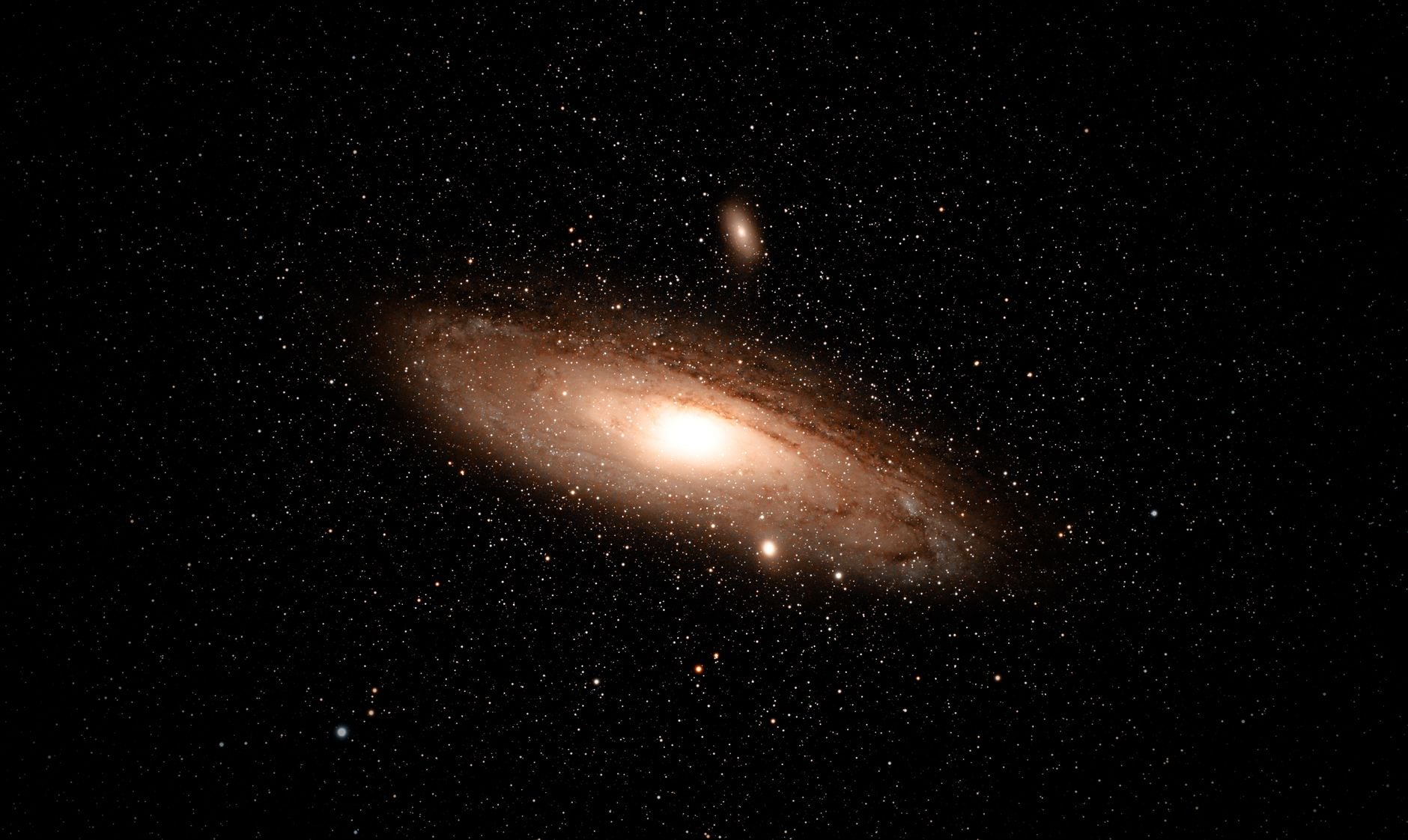
New Study Reveals 50-50 Chance of Milky Way and Andromeda Collision
Milky Way and Andromeda Collision Probability Revised in Nature Astronomy Study
Astronomers long expected the Milky Way and Andromeda to collide in about 4.5 billion years, but a study published in Nature Astronomy using Hubble and Gaia data estimated only a roughly 50-50 chance of the galaxies merging within the next 10 billion years, according to Space Daily reporting.
The Tech TL;DR:
- Collision Odds: New numerical integrations from Nature Astronomy put the Milky Way-Andromeda merger probability at roughly 50-50 over a 10-billion-year horizon, upending the previous 4.5-billion-year timeline.
- Data Pipeline: Researchers processed Monte Carlo samples of observational data from the Hubble Space Telescope and Gaia satellite to simulate galactic orbits.
Rethinking Local Group Kinematics Through Monte Carlo Simulation
Groundwork laid by studies such as those published in The Astrophysical Journal by Sangmo Tony Sohn, Jay Anderson, and Roeland P. van der Marel tracked the sideways motion of Andromeda using the Hubble Space Telescope between 2002 and 2010. Those historical observations determined that Andromeda was moving toward the Milky Way at approximately 110 kilometers per hour, establishing a gravitational pull that made a eventual encounter appear inevitable.
The study incorporated updated proper-motion data and expanded the dynamical models. Rather than relying on deterministic trajectories, the researchers generated Monte Carlo samples of 20 observational variables, including halo masses for the Milky Way, Andromeda (M31), M33, and the Large Magellanic Cloud (LMC), alongside halo concentration parameters, distance moduli, proper motions, and line-of-sight velocities. According to the study’s methodology, sampling directly in the space of observables minimizes the distortion caused by derived Cartesian correlations.
Numerical Integration Architecture and Reproducibility Constraints
To evaluate these probabilistic trajectories, the team executed numerical integrations using a symplectic leapfrog algorithm in the center-of-mass frame. The pipeline utilized a step size of 1 megayear, matching the time required for a galaxy moving at 100 kilometers per second to travel 0.1 kiloparsec, which represents 1/200th of the defined merger threshold. To maintain strict provenance and allow reproduction across different parameter sets, the analysis code was designed to be flexible and public, re-initializing pseudorandom number generators with consistent seed values for every Monte Carlo batch.
The fiducial model incorporated the Milky Way, M31, M33, and the LMC, explicitly treating dynamical friction and galaxy mergers to ensure conservative predictions.
Evaluating the Divergence in Galactic Fate Predictions
While historical investigations focused on determining whether Andromeda’s transverse velocity pointed toward a major merger, glancing blow, or near-miss, the newer analysis frames the encounter as an open statistical question. The inclusion of the Large Magellanic Cloud and M33 introduces additional gravitational perturbations that widen the distribution of possible orbital outcomes.

Where older literature asserted a definitive timeline for the displacement of the Solar System from its current position 26,000 light-years from the galactic center to over 160,000 light-years away, the 2025 Nature Astronomy data demonstrates that a non-merger scenario remains a statistically viable outcome within a 10-billion-year window.