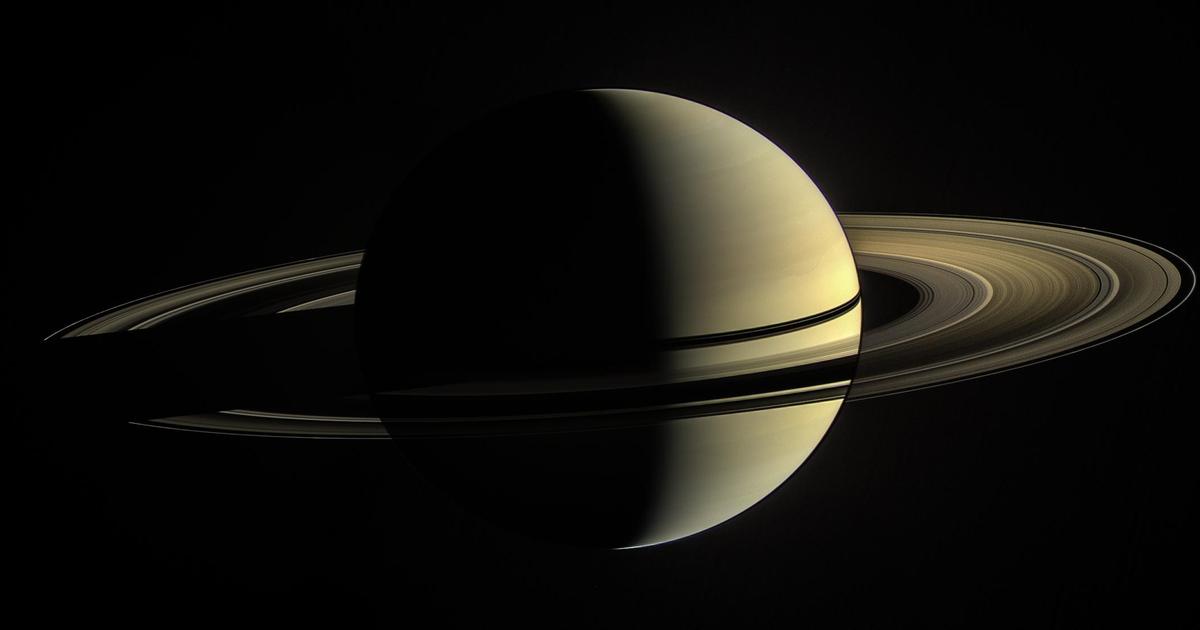
Hubble Telescope Discovers Giant Ten-Sided Atmospheric Structure at Saturn’s South Pole
Astronomers using the Hubble Space Telescope have discovered a giant ten-sided atmospheric structure surrounding the southern pole of Saturn. According to reports from Aktualne.cz, 100+1 zahraniční zajímavost, and Veda.cz, the newly identified decagon spans the planet’s southern latitudes and marks a surprising structural contrast to the famous hexagon located at Saturn’s northern pole.
Discovery of the Southern Decagon
Because of the tilt of Saturn’s rotational axis, the planet’s southern hemisphere remained unobservable from Earth between 2012 and 2023, leaving this region hidden until recent observation windows opened.
The average wavelength along the parallel measures 16 782 kilometrů (±1 100 km). This metric defines the spacing of individual wave crests along the atmospheric current rather than the overall diameter of the entire formation. Sanchez-Lavega and his colleagues noted that prior to examining the 2023 images, researchers had repeatedly searched older archives for a southern counterpart to the northern hexagon without success.
Atmospheric Dynamics at the Poles
The presence of distinct polygonal formations on opposite poles provides researchers with a rare opportunity to study how atmospheric currents behave under varying conditions of sunlight and temperature, as reported by Veda.cz. While the northern pole’s six-sided pattern has been monitored for decades and is maintained by eastern winds moving along curved paths near the pole, the southern ten-sided structure represents a younger and less understood phenomenon.

Scientists cited by Veda.cz explain that these geometric patterns are linked to atmospheric airflow in different layers and to jet streams circulating the polar regions. The differing number of sides between the northern hexagon and the southern decagon suggests that the underlying physical processes are highly sensitive to minor variations in wind speed and thermal gradients.
Astronomers are continuing to analyze data from Hubble’s long-term planetary monitoring program to determine whether the southern decagon is a stable long-term feature comparable to its northern counterpart or a transient meteorological event.