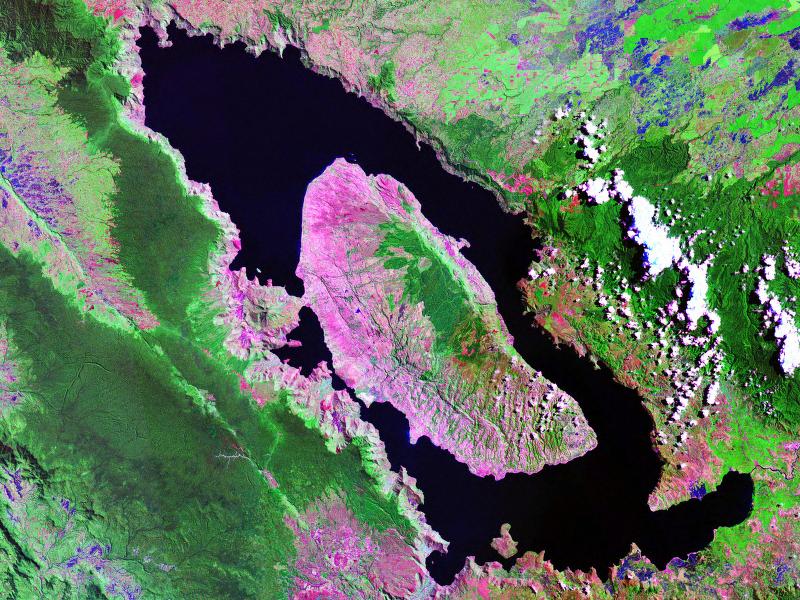
New Study Debunks Mount Toba Human Extinction Myth
<>
Mount Toba, historically documented as the largest volcanic eruption of the past 2.6 million years, may not have threatened human survival as severely as long assumed, according to recent research from geoscientists studying lake sediment records. Around 74,000 years ago, a caldera located in modern-day Sumatra emptied thousands of cubic kilometers of magma over a two-week period, expelling roughly a thousand times more material than Mount Pinatubo’s 1991 eruption.
The Tech TL;DR:
- Volcanic Magnitude Limits: Massive eruptions do not scale infinitely in atmospheric cooling because heavier sulfate aerosols settle quickly out of the stratosphere.
- Sediment Core Findings: Mud samples from a crater lake on the Kenya-Tanzania border demonstrate that Toba’s climatic disruption lasted less than two years.
- Temperature Revision: Empirical data now points to approximately half a degree of global cooling rather than a prolonged volcanic winter.
Reassessing the Toba Catastrophe Hypothesis
For decades, paleoanthropologists and geologists debated whether the Toba supervolcano initiated a near-extinction bottleneck for early human populations. The hypothesis relied on the massive volume of sulfur dioxide injected into the stratosphere. According to standard atmospheric models, this gas transforms into a haze of droplets that reflect solar radiation back into space, driving down surface temperatures across the globe.
However, empirical field data collected by researchers challenge the severity of that fallout. Jinheum Park, a geoscientist at Johannes Gutenberg University in Mainz, Germany, and his colleagues examined mud archives retrieved from the bottom of a small crater lake situated on the Kenya-Tanzania border. Rather than finding multi-decadal layers of severe climatic distress, the team discovered that the tangible environmental effects of the Mount Toba eruption persisted for under two years, culminating in roughly half a degree of cooling.
Atmospheric Mechanics and Aerosol Fallout
The discrepancy between historical modeling and the physical sediment record lies in the fluid dynamics of massive sulfate injections. When volcanoes erupt on an ultra-large scale, the total volume of ejected material increases exponentially, but the efficiency of the resulting aerosol shield drops. As Park explains, bigger sulfate aerosols settle quickly because they are heavier, rendering them far less effective at scattering incoming solar radiation over extended periods.
This physical limitation prevents runaway volcanic winters from persisting indefinitely.
# Sample CLI script for parsing sediment core particulate data
import numpy as np

def calculate_settling_rate(radius, density, viscosity):
    # Stokes' law calculation for particulate fall velocity
    g = 9.81
    velocity = (2 * (radius ** 2) * density * g) / (9 * viscosity)
    return velocity

# Example execution for standard sulfate aerosol dimensions
print(f"Settling Velocity: {calculate_settling_rate(1e-6, 1800, 1.81e-5)} m/s")
Operationalizing Paleoclimate Data Repositories
*Disclaimer: The technical analyses and security protocols detailed in this article are for informational purposes only. Always consult with certified IT and cybersecurity professionals before altering enterprise networks or handling sensitive data.*