Performance and Capabilities of FDA-Cleared Type III Home Sleep Apnea Testing Devices
A recent narrative review examines the performance, signal ensembles, and concurrent cardiac rhythm assessment capabilities of 13 FDA-cleared Type III home sleep apnea testing devices marketed in the United States as of August 1, 2026.
Thirteen Sleep Apnea Devices Vary by Features
- Evaluation Scope: Thirteen CMS-classified Type III home sleep apnea testing devices were reviewed using data from the FDA 510(k) CDRH database and peer-reviewed validation studies.
- Scoring Standard: All comparisons utilized American Academy of Sleep Medicine Rule 1B, requiring a minimum four percent oxygen desaturation threshold for hypopneas.
- Feature Divergence: Systems vary significantly in their signal ensembles, multi-night testing capabilities, and whether they capture electrocardiography for cardiac rhythm and atrial fibrillation monitoring.
Home Testing Replaces in-Lab Polysomnography for Medicare
Sleep-disordered breathing, which encompasses both obstructive and central sleep apnea, remains widely underdiagnosed despite its established health consequences and links to cardiovascular morbidity. While in-laboratory polysomnography serves as the clinical standard, financial barriers, logistical constraints, and patient discomfort in unfamiliar environments limit its utilization. Consequently, home sleep apnea testing has progressively displaced in-lab polysomnography as the predominant diagnostic modality among Medicare beneficiaries.
To establish the current state of unattended diagnostic technology, researchers conducted a query of the U.S. Food and Drug Administration 510(k) CDRH database utilizing primary product code MNR, which denotes ventilatory effort recorders intended for unattended assessment. The search captured traditional clearances granted within the preceding 10 years since August 1, 2016, or cleared prior to that date and released for sale subsequently. Out of 68 total devices identified under product code MNR, the screening process excluded systems classified by CMS as Type II or Type IV, devices requiring attended monitoring or physician supervision, and products no longer marketed in the United States. This filtering left 13 devices that met all inclusion criteria, including CMS Type III classification recording four to seven signals, published sensitivity and specificity data against polysomnography, and apnea-hypopnea event detection scored using American Academy of Sleep Medicine Rule 1B.
Comparative Analysis of Signal Ensembles and Accuracy Metrics
Type III home sleep apnea testing systems strike a operational balance by recording between four and seven physiological signals. This reduction in sensors improves portability and patient comfort during unsupervised overnight studies compared to comprehensive polysomnography, though it introduces inherent tradeoffs in diagnostic performance and sleep apnea severity classification. Published performance is typically evaluated by comparing home-derived apnea-hypopnea index values against reference standard polysomnography across mild, moderate, and severe thresholds.
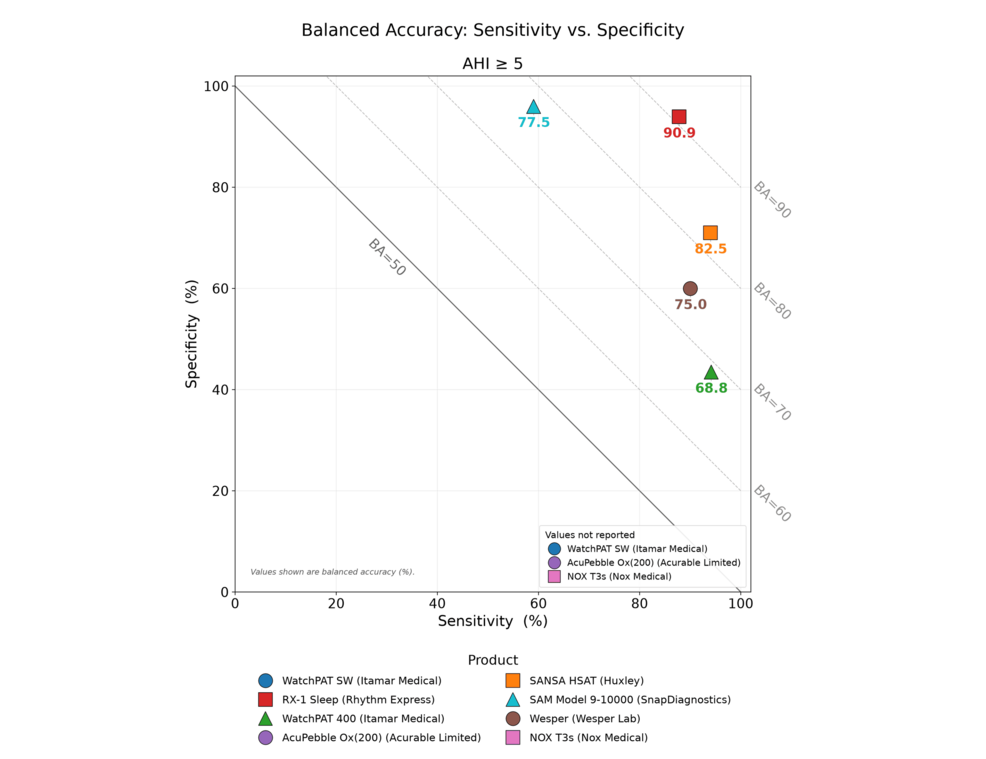
Hypopnea scoring methodology dictates reported accuracy, as the American Academy of Sleep Medicine accepts either a three percent oxygen desaturation threshold from baseline or a stricter four percent threshold. Because performance metrics fluctuate based on the active scoring rule, the review standardized all device comparisons around Rule 1B data. Devices lacking consistent Rule 1B metrics, or those relying on non-standard thresholds, manual scoring only, or conference abstracts, were retained in background tables for informational visibility but excluded from direct balanced accuracy comparisons.
Integration of Electrocardiography and Cardiac Rhythm Monitoring
A critical architectural distinction among the evaluated home sleep apnea testing devices involves the inclusion of electrocardiography. While standard polysomnography utilizes electroencephalography and electrooculography to determine total sleep time and sleep stages, most home devices lack these neurophysiological signals. Instead, they estimate sleep parameters through peripheral arterial tone, oxygen saturation, body movement, and heart rate.
Incorporating electrocardiography into a home testing device provides a direct physiological channel for heart rate, rhythm, and cardiovascular disturbances occurring during sleep. Because sleep-disordered breathing exhibits a strong epidemiological association with cardiac arrhythmias—particularly atrial fibrillation—concurrent rhythm monitoring identifies clinically relevant disturbances that warrant independent cardiovascular evaluation. Electrocardiography supplies beat-to-beat heart rate variability data, allowing algorithms to detect autonomic responses and cyclic heart rate changes associated with respiratory events.
Multi-Night Testing Addresses Sleep Apnea Variability
Sleep-disordered breathing severity varies significantly from night to night, a physiological fluctuation that clinical literature has linked directly to atrial fibrillation burden. To address this variability, selected manufacturers have introduced multi-night testing capabilities into their hardware and software pipelines, allowing devices to record across multiple consecutive evenings.
The 13 evaluated devices diverge substantially in their labeled capabilities, ranging from single-night disposable configurations to multi-night reusable architectures equipped with automated synchronization software. Devices that support multi-night recording provide a longitudinal dataset that helps mitigate the risk of misclassification driven by single-night biological variance, though differences in sensor application and adherence must be factored into deployment planning.