
Astronomers Discover Potential Dwarf Planet at Solar System’s Farthest Reaches
May 22,2025 – astronomers have announced the finding of a distant object orbiting the Sun,perhaps a dwarf planet,located far beyond neptune. Designated 2017 OF201, the object’s unusual orbit and estimated size are challenging existing understandings of the outer solar system.
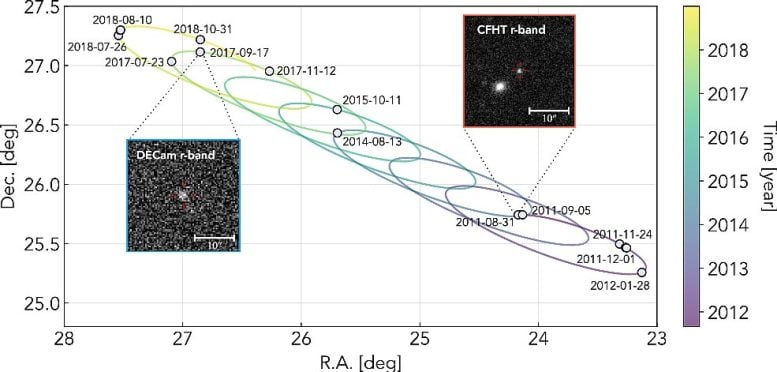
The discovery, made by Sihao Cheng and Jiaxuan Li, along with Eritas Yang, stems from an ongoing research project to identify Trans-Neptunian Objects (TNOs) and possible new planets. They pinpointed 2017 OF201 by analyzing data from the Victor M. Blanco Telescope and Canada France Hawaii Telescope (CFHT), identifying bright spots across 19 exposures captured over seven years. A computationally efficient algorithm developed by Cheng aided in connecting these spots to a single moving object.Researchers estimate 2017 OF201 to be approximately 700 km in diameter, making it the second-largest object discovered with such an extended orbit - substantially smaller than Pluto‘s 2,377 km diameter.Further observations, potentially using radio telescopes, are planned to refine the size estimate.
The object’s location, beyond the Kuiper Belt, was previously thought to be largely empty. Cheng suggests the presence of 2017 OF201 indicates a potentially larger population of similar objects. ”2017 OF201 spends onyl 1% of its orbital time close enough to us to be detectable. The presence of this single object suggests that there could be another hundred or so other objects with similar orbit and size; they are just too far away to be detectable now,” Cheng stated.Li emphasized the role of open science in the discovery. “All the data we used to identify and characterize this object are archival data that are available to anyone, not only professional astronomers,” she said. “This means that groundbreaking discoveries aren’t limited to those with access to the world’s largest telescopes.”
The findings are detailed in a paper titled “Discovery of a dwarf planet candidate in an extremely wide orbit: 2017 OF201,” available on arXiv: https://doi.org/10.48550/arXiv.2505.15806. The discovery underscores the vastness of our solar system and the potential for further exploration and understanding of its distant reaches.
