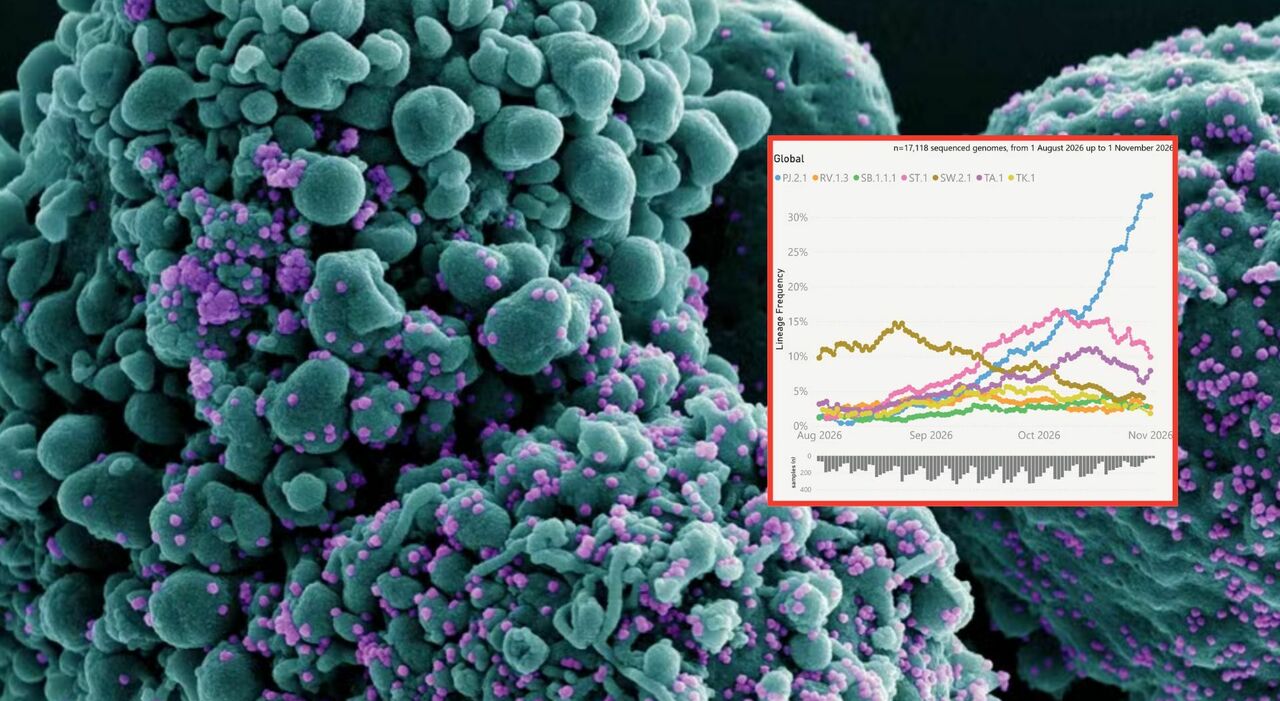
New Covid Variant PJ.2.1 Spreading Globally With Low Public Health Risk, WHO Says
A new SARS-CoV-2 lineage, PJ.2.1, is spreading globally after first emerging in Canada in May 2026, according to reports from Stato Quotidiano.
The first available sequence of PJ.2.1 dates to May 25, 2026, and Canada remains one of the countries most affected by its identification, alongside the United States and Brazil, Stato Quotidiano reported. While health authorities are monitoring the variant, the World Health Organization currently assesses the additional risk to public health as low, RIFday reported.
The WHO designated PJ.2.1 as a Variant Under Monitoring on November 19, 2026, because its prevalence is increasing globally, driven mainly by detections in the Region of the Americas, particularly in Canada and the United States, according to RIFday.
The variant is a descendant of JN.1 and shows significant genetic evolution, with 24 amino acid differences in the Spike protein alone, as noted by RIFday. Despite this mutation, laboratory tests indicate that sera from individuals who received vaccines adapted against previous variants, such as LP.8.1 and XFG, remain capable of neutralizing PJ.2.1.
WHO experts reported that as of November 8, 2026, 722 sequences of PJ.2.1 from 18 countries had been submitted to the GISAID database, RIFday reported. The studies considered do not provide a direct estimate of vaccine effectiveness, RIFday added.
Data from the World Health Organization shows the variant’s presence in global sequences rose from 1% in mid-August to 11.6% by the second week of October, according to RIFday. European trends mirror this growth, with the prevalence in the WHO European Region increasing from 1% in late August to 6.1% in the same October window.
In France, the share of PJ.2.1 reached 13.5% in epidemiological week 41, RIFday reported. Several other countries, such as Ireland, reported higher percentages, although based on very small numbers of sequences analysed, RIFday added. The analyses take into account the sequences submitted and do not themselves allow quantification of any relative growth advantage, RIFday reported.
In Italy, health officials are tracking the virus as it continues to circulate, Il Messaggero reported. Data from the Ministry of Health for the week of November 5–11, 2026, indicated an incidence of approximately one diagnosed case per 100,000 inhabitants, a slight increase over the prior week, according to Stato Quotidiano.
Preliminary Italian data available for October 2026 indicated a predominance of XFG, although the limited number of sequences available urges caution in interpreting the results, Stato Quotidiano reported.
| Region/Country | Period | Prevalence |
|---|---|---|
| WHO European Region | Aug 17–23, 2026 | 1% |
| WHO European Region | Oct 5–11, 2026 | 6.1% |
| France | Oct 5–11, 2026 | 13.5% |
Clinical data currently remains insufficient to determine if PJ.2.1 causes more severe disease than previous strains, RIFday reported. “The comparative clinical data are insufficient – the experts write – to determine whether PJ.2.1 is associated with greater disease severity,” RIFday reported. Symptoms include muscle and joint pain, and occasional gastrointestinal issues, though these vary among individuals, Stato Quotidiano reports.
Symptom severity varies among individuals; the infection may be mild or require medical evaluation, particularly with frailty conditions, Stato Quotidiano reported. It is not possible to identify PJ.2.1 solely through symptoms; laboratory analysis and genomic sequencing are required for certain identification, Stato Quotidiano added.

"The virus is running even in Italy," Pregliasco told Il Messaggero. Current Italian data showed only 0.8% of medical beds and 0.2% of intensive care capacity occupied by COVID-19 patients, Stato Quotidiano reported. In the same period, hospital bed occupancy in medical wards stood at 0.8%, with 495 patients hospitalised, while intensive care occupancy was 0.2%, corresponding to 14 people, Stato Quotidiano reported.