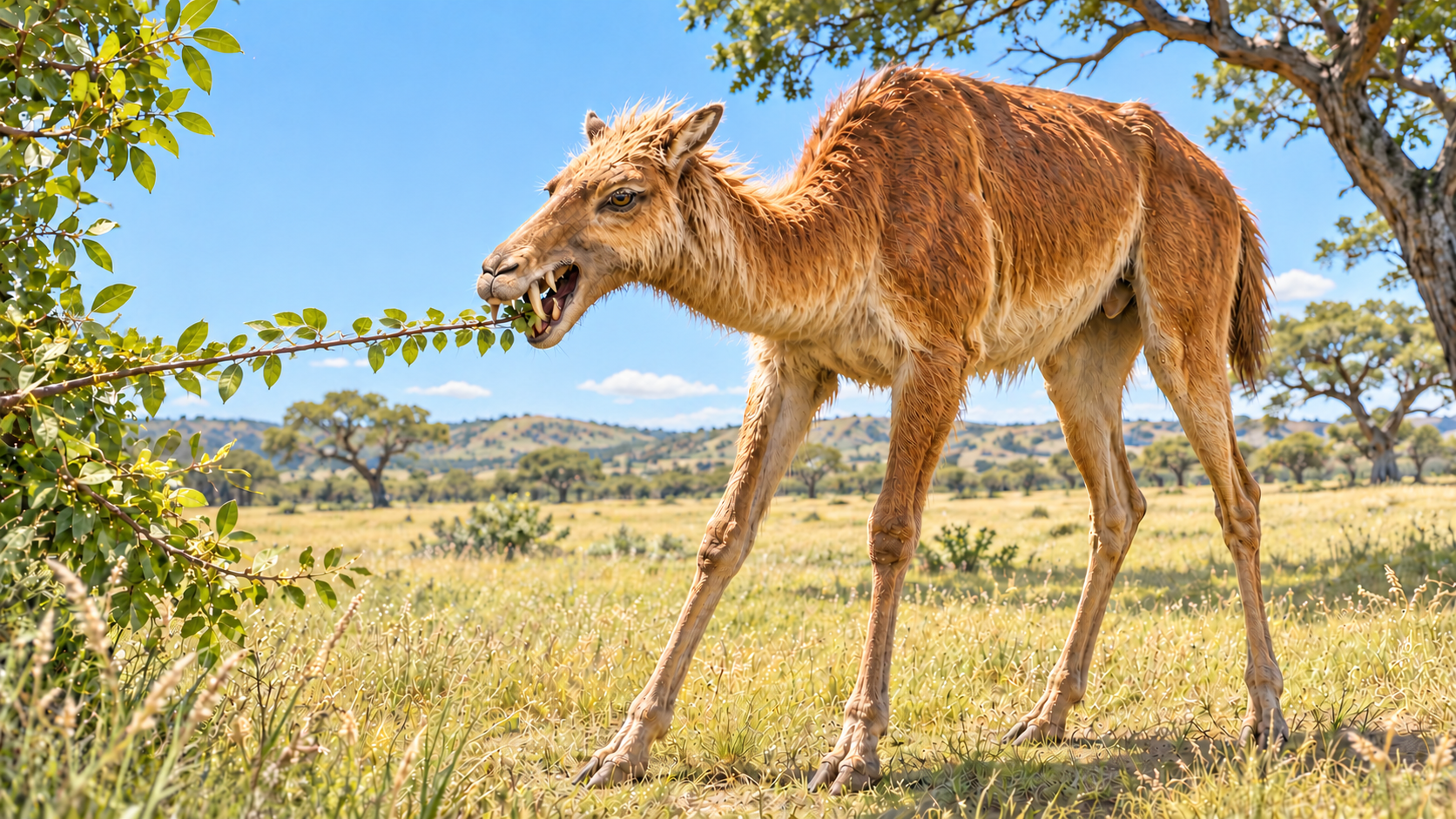
New Camel Genus Vampyrocamelus Identified From Museum Fossils
Fangs measuring about 40 millimeters long distinguished a newly identified North American camel genus that roamed the southern Great Plains approximately 13 million years ago, Around Prague reported based on recent paleontological research.
The Tech TL;DR:
- The Discovery: Researchers reanalyzed tens of thousands of camelid specimens in the Childs Frick collection at the American Museum of Natural History, identifying a new genus and species named Vampyrocamelus welshi.
- Physical Traits: Despite its moniker and enlarged canine teeth, the animal was a plant-eater that shared giraffe-like proportions and stilt-like legs reaching up to 3 meters in height.
- Archival Significance: The findings demonstrate that major evolutionary discoveries remain hidden inside historical museum collections waiting for detailed specimen reexamination.
Paleontologists reevaluated tens of thousands of fossilized camelid specimens collected by Childs Frick, a researcher who personally funded early 20th-century digs for the American Museum of Natural History, according to ScienceAlert. The newly established genus, Vampyrocamelus, lived roughly 10 to 13 million years ago. Its fossil remains turn up commonly in Texas and Oklahoma, and occasionally in Nebraska, as detailed by ScienceAlert.
While the skull resembles other known camelids, the defining feature of the animal is its enormous canine teeth. The upper canines measure about 40 millimeters, or roughly 1.6 inches, in length, featuring a long, recurved tip ending in a sharp point. According to The Brighter Side of News, the largest canines approach 5 centimeters, or about 2 inches, and are flattened enough to resemble blades rather than standard pointed teeth.
The rest of the skeleton remains largely undocumented, though broken limb and foot bones suggest similarities to the related genus Aepycamelus. That genus stood on stilt-like legs and possessed a neck reaching up to 3 meters, or 10 feet, off the ground to graze treetops, ScienceAlert noted.
| Feature | Vampyrocamelus | Aepycamelus |
|---|---|---|
| Geological Age | 10 to 13 million years ago | Miocene epoch |
| Diet | Herbivorous (plants) | Herbivorous (tree foliage) |
| Geographic Range | Texas, Oklahoma, Nebraska | North America |
Researchers attribute the oversized upper canines and first premolars to male competition rather than predatory hunting. “The canines are enormous compared to any other known camelid,” the study authors wrote.

“They may have been using [the fangs] to attract females, because the female animals did not have these,” Katherine Marriott, paleontologist at the American Museum of Natural History, told Science.
Many isolated bones previously attributed over the decades to Aepycamelus may actually belong to Vampyrocamelus, given that isolated teeth represent the primary distinguishing feature between the two groups. This taxonomic overlap indicates that other unrecognized prehistoric animals likely sit inside unexamined museum drawers.
Extinct ‘vampire camel’ once stalked North American plains | Science | AAAS https://t.co/nNZNNlsmNZ New fossil survey shines light on this mysterious creature, as well as ancient camels’ ecological importance
“The dagger-toothed camel shows how even a well-known collection can still change that picture when researchers compare its specimens in detail,” The Brighter Side of News reported.
The American Museum of Natural History, founded in 1869 and opened in 1871, holds about 32 million specimens across 21 interconnected buildings. Its Childs Frick collection, assembled through personally funded early 20th-century expeditions, contains tens of thousands of fossil camelids that had never been fully reexamined until this study identified the new genus Vampyrocamelus.
Finding further intact specimens remains necessary to fully resolve the skeletal structure and behavioral patterns of the species. “Finding further specimens could help shed more light on what Vampyrocamelus actually looked like, and how it behaved,” ScienceAlert said.