AWS Lambda Now Supports GPU-Accelerated Workloads on Managed Instances
AWS Lambda now supports GPU-accelerated workloads on Lambda Managed Instances (LMI), enabling developers to execute machine learning inference, media processing, and scientific computing tasks without managing underlying server clusters.
Announced on Wednesday this update allows users to deploy containerized applications that leverage Amazon EC2 G-series hardware while maintaining the operational simplicity of the serverless event-driven model.
The Tech TL;DR:
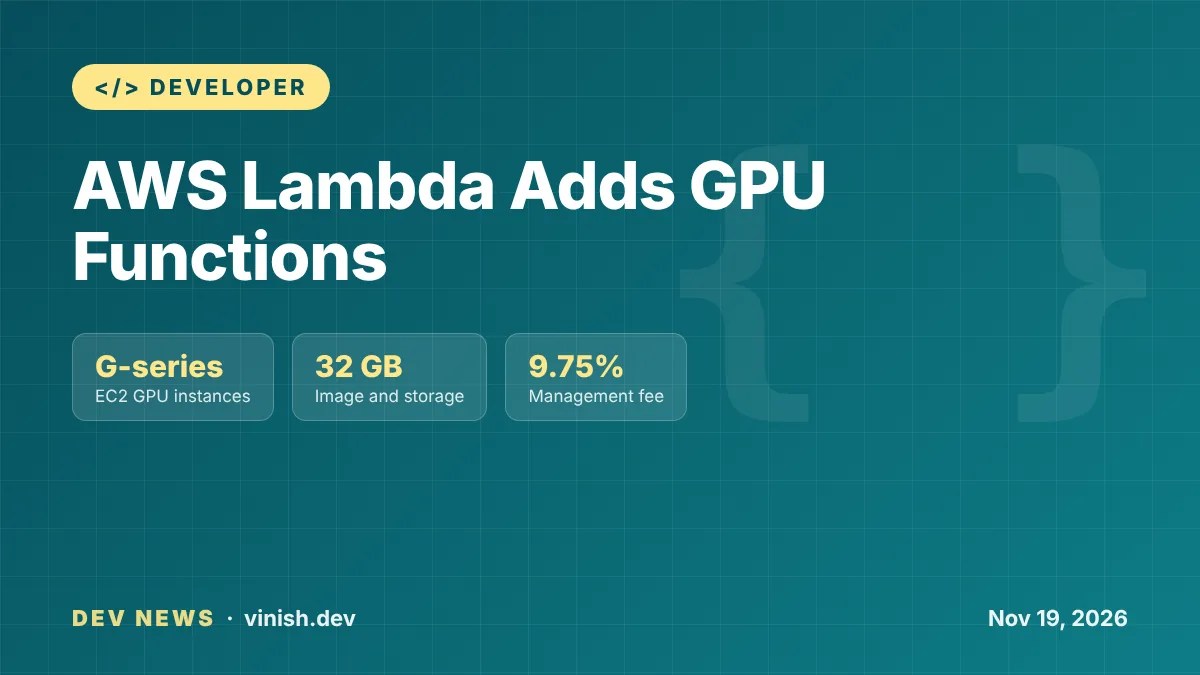
- Serverless GPU access is now generally available for G-series instances, including G4dn, G5, and G6 families.
- Deployment relies on OCI-compliant container images, eliminating the need for manual CUDA driver or AMI management.
- Pricing follows a model of underlying EC2 instance fees plus a 9.75% management surcharge and standard request costs.
Previously, running GPU-accelerated code necessitated manual provisioning of instances, the synchronization of CUDA libraries and drivers, and the development of custom scaling logic. By integrating GPU support into the Lambda Managed Instances framework, AWS aims to bridge the gap between specialized compute requirements and serverless event integration, according to official AWS developer documentation.
The implementation supports a range of NVIDIA-backed instances, providing varying levels of memory and compute density. According to reporting by vinish.dev, these include the G4dn series with NVIDIA T4 (16 GB per GPU), the G5 series with NVIDIA A10G (24 GB), and the G6 series with NVIDIA L4.

| Feature | Specification |
|---|---|
| Max Container Image Size | 32 GB |
| Ephemeral Storage (/tmp) | 32 GB |
| Accelerator Memory | 3 to 48 GB |
| Concurrent Requests per Environment | Up to 48 |
The architecture allows for high-density execution by consolidating multiple concurrent requests onto a single GPU. This approach is designed to mitigate the cost inefficiencies often associated with underutilized GPU hardware, as AWS allows functions to scale to zero when not in active use.
Developers deploy these functions by creating a capacity provider and pointing it toward supported G-series instance types. The process uses OCI images, which can be built using curated base images that bundle the CUDA toolkit, PyTorch, and inference servers like vLLM. To initiate a GPU-enabled function, users define the required accelerator memory using `AcceleratorConfig`.
aws --region us-east-2
 lambda create-capacity-provider
 --cli-input-json file://cli-skeletons/create-capacity-provider_gpu.json
As noted by aws-news.com, the infrastructure handles health checks, driver patching, and fleet scaling automatically. Users must ensure that their EC2 On-Demand quota for accelerated instances is increased from the default of zero before attempting deployment, as failure to do so will result in provisioning errors.
These functions integrate with standard AWS event sources, including Amazon S3, Amazon SQS, and Amazon API Gateway. This allows for complex workflows, such as triggering a video transcoding job or a speech-to-text inference pass immediately upon file upload.
For production environments, AWS recommends streaming model weights directly from Amazon S3 into memory using `VLLM_LOAD_FORMAT=runai_streamer` to reduce initialization latency. While this feature simplifies the deployment of custom and mid-sized models, AWS maintains that for foundation model training or large-scale lifecycle management, users should continue to utilize Amazon SageMaker AI or Amazon Bedrock.