
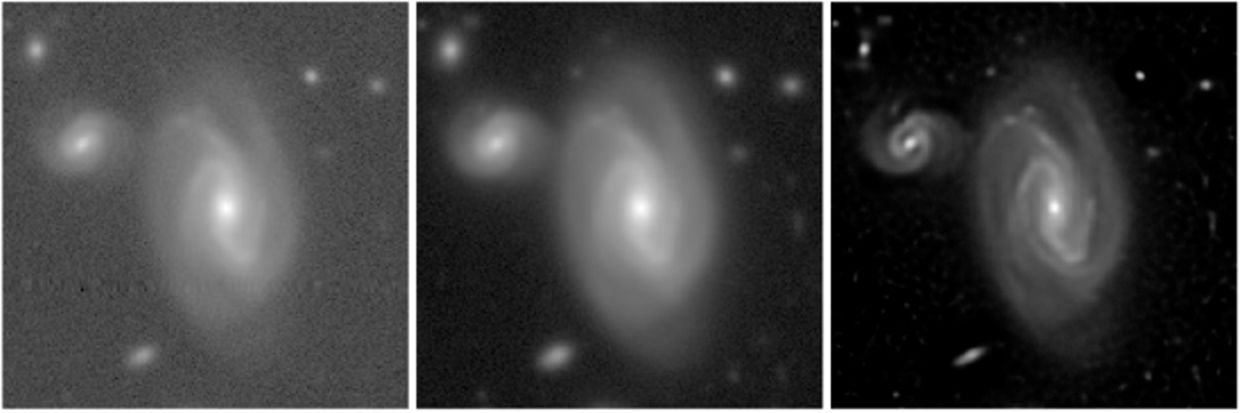
New AI Technique Could Boost Ground-Based Telescope Images to Rival Space-Based Views
Chile – Images from teh forthcoming Vera C. Rubin Observatory in Chile may soon rival those captured by space telescopes like Hubble and James webb, thanks to a new image-sharpening technique called ImageMM. Developed by a team at the University of Edinburgh, ImageMM promises to substantially enhance the clarity of Rubin’s observations, particularly crucial for its mission to map the distribution of dark matter across the universe.
The Rubin Observatory,currently under construction,is designed to conduct a 10-year survey of the sky,generating an unprecedented volume of data.A key objective of this survey is to understand dark matter – the invisible substance that makes up the majority of the universe’s mass – by precisely measuring how its gravity subtly distorts the images of distant galaxies through a phenomenon known as weak gravitational lensing.This effect is subtle, requiring exceptionally clear images to detect accurately.
ImageMM works by refining the already impressive images produced by Rubin, allowing for more precise measurements of weak lensing. While space telescopes offer superior image quality, they have limited fields of view. Rubin, however, boasts a much wider field of view – 3.5 degrees, equivalent to seven full moons – making ImageMM’s sharpening capabilities particularly valuable.
“When it comes to billion-dollar ground-based observatories, gaining even just a small degree of depth and quality enhancement from these observations can be huge,” explained Tamás Budavári of Johns Hopkins University.
The developers believe ImageMM represents a significant step forward for ground-based astronomy. “we’ll never have ground truth, but we think this is as close as it currently gets to perfect [for ground-based telescopes],” said Sukurdeep, a member of the development team.
Details of the ImageMM technique and its testing results were published on September 29 in The Astronomical journal.
