
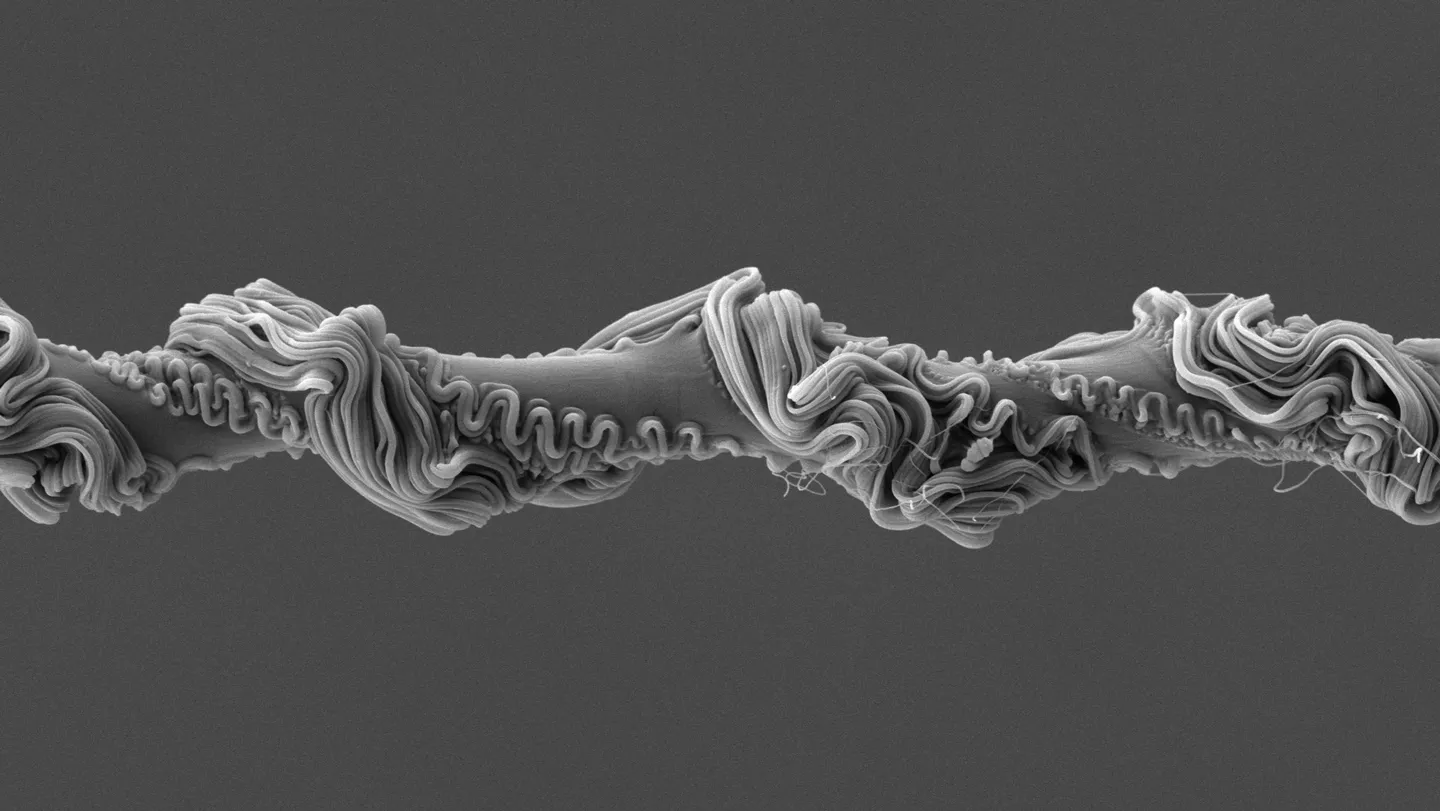
An extreme close-up of the silk spun by the Australian net-casting spider, Asianopis subrufa, has been awarded top prize in the Royal Society Publishing Photography Competition 2025. The winning image, captured by arachnologist Martín Ramírez, reveals the intricate structure of the spider’s unique silk, which allows it to effectively ensnare prey.
The photograph, taken using a scanning electron microscope (SEM), depicts a section of silk just 50 microns in width – approximately 0.05 millimeters. Ramírez, a research scientist at the Bernardino Rivadavia Natural Sciences Argentine Museum in Buenos Aires, prepared the sample by coating it with a thin layer of gold and palladium to enhance visibility under the high vacuum conditions of the microscope. The image showcases the elastic core of the silk, surrounded by strengthening fibers.
Unlike orb-weaver spiders that rely on sticky, poisonous droplets, the net-casting spider employs elasticity to capture its meals. The spider constructs a small, postage stamp-sized net from cribellate silk, produced by an organ called a cribellum, which contains thousands of tiny holes. Individual silk fibers, each nanoscale in thickness, are drawn from these holes and woven together to create a strong, woolly net.
“Just from observing the behaviour, we knew something spectacular was going to be there,” Ramírez said. “The web is incredibly stretchy; no normal silk can extend in that way to then return to its original form.” Ramírez and collaborator Jonas Wolff, from Greifswald University, have been studying the tension and stretchiness of the silk, conducting dissections to measure its elastic properties.
The net-casting spider holds the web between its front legs and throws it over approaching insects. The ability of the silk to stretch significantly during the cast and then return to its original shape, is crucial to the spider’s hunting success. The SEM image provides a detailed view of the structural elements that enable this unique elasticity.
The Royal Society Publishing Photography Competition aims to highlight the wonders of scientific phenomena through visual imagery. The winning photograph serves as a reminder of the intricate details often hidden from the naked eye, requiring specialized tools like the electron microscope to reveal them.
