
Cosmic Visitor Captured: Asteroid 2025 OW Safely Imaged as It Approaches Earth
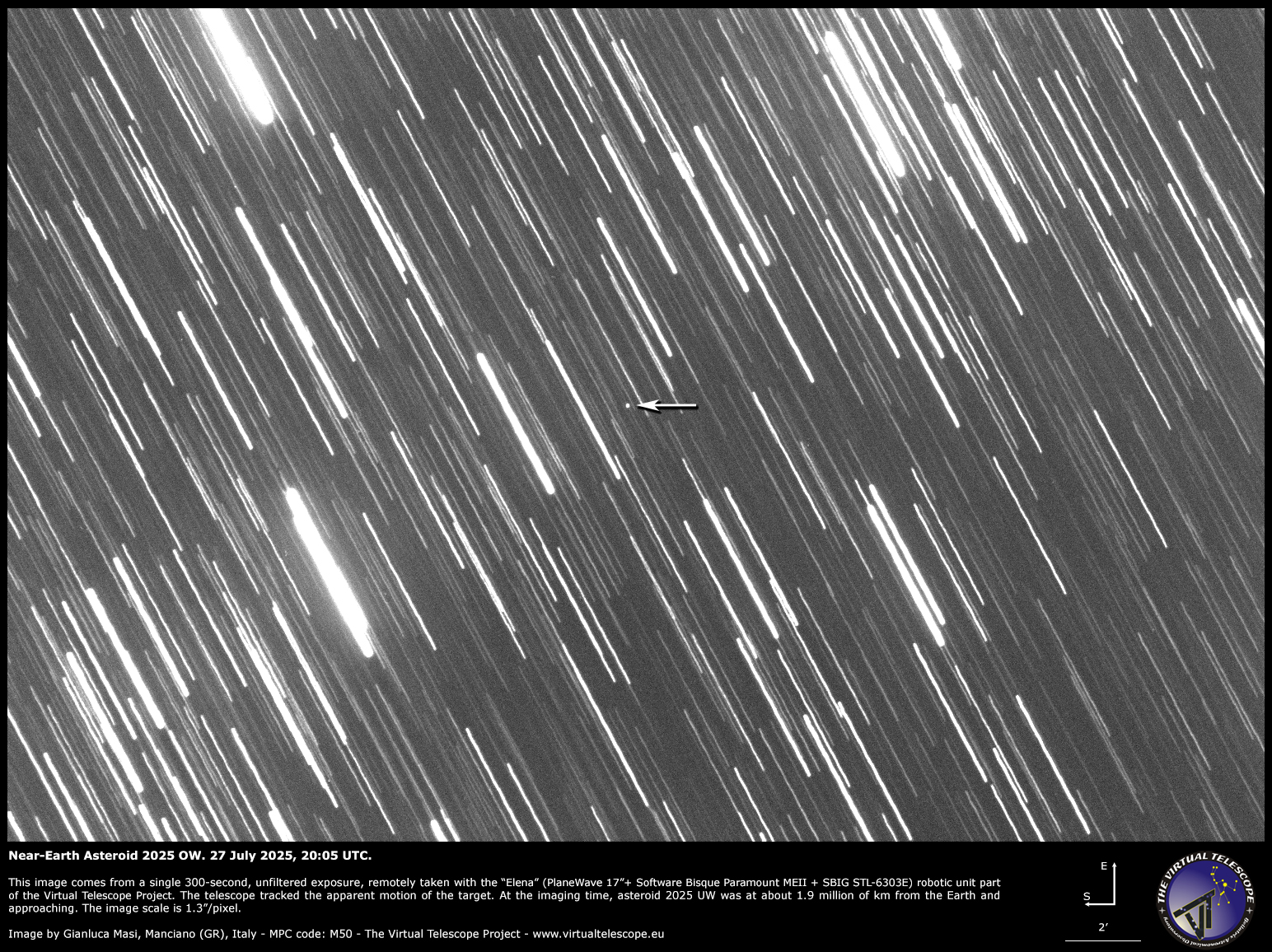
near-Earth Asteroid 2025 OW: Captured on 27 July 2025.
Astronomers have successfully captured images of near-Earth asteroid 2025 OW as it makes its way towards a close flyby of our planet. The celestial body, estimated to be between 51 and 110 meters in diameter, is on a trajectory that will bring it within approximately 633,000 kilometers of Earth’s centre on July 28, 2025, at 19:44 UTC. This distance is roughly 1.6 times the average distance between the Earth and the Moon, ensuring no risk to our planet.
The striking image was obtained through a single 300-second exposure using the remotely operated “Elena” robotic unit. This advanced telescope, a PlaneWave 17″ equipped with a Paramount MEII mount and SBIG STL-6303E camera, is part of the Virtual telescope Project.Situated in Manciano, Italy, under exceptionally dark skies, the telescope precisely tracked the asteroid’s rapid apparent motion. This meticulous tracking resulted in the asteroid appearing as a sharp point of light at the center of the image, clearly marked by an arrow, while the background stars are rendered as elongated streaks.
At the time of observation, asteroid 2025 OW was approximately 1.9 million kilometers from the Virtual Telescope Project‘s observation point, continuing its safe approach to Earth. This event highlights the ongoing efforts in asteroid monitoring and the capabilities of advanced astronomical technology in capturing these transient cosmic visitors.
Support The Virtual Telescope Project!
Your support is vital for continuing these astronomical endeavors. By donating, you can receive an exclusive image of the stunning Comet C/2023 Tsuchinshan-ATLAS and much more, specially created for our valued supporters.

