Neanderthal Genetic Variant Linked to Smaller Occipital Lobe and Lower Schizophrenia Risk
A genetic variant inherited from Neanderthals is linked to a nearly 10 percent lower risk of schizophrenia in people carrying two copies, a study published Monday found.
The same variant slightly shrinks a visual-processing region of the brain.
- People with two copies of a Neanderthal-derived variant near the DAAM1 gene showed almost 10 percent lower schizophrenia risk, with no measurable effect on intelligence.
- Each copy of the variant is associated with an occipital lobe about 0.85 cubic centimeters smaller — the opposite of what Neanderthals’ large skulls would suggest.
- Roughly 20 percent of people with European ancestry carry at least one copy, according to the study.
The findings appear in the Proceedings of the National Academy of Sciences, published November 16, from evolutionary geneticists Hugo Zeberg of the Karolinska Institutet and Svante Pääbo of the Max Planck Institute for Evolutionary Anthropology in Leipzig, Germany. Pääbo won the 2022 Nobel Prize in Physiology or Medicine.
Most people not of sub-Saharan ancestry carry about 2 percent Neanderthal DNA, the legacy of interbreeding tens of thousands of years ago. Modern people outside Africa have roughly 1 to 4 percent Neanderthal ancestry, Euronews reported. Pääbo told Scientific American that today’s Neanderthal contribution appears to trace back largely to a single interbreeding event around 47,000 years ago.
A variant that shrinks the occipital lobe
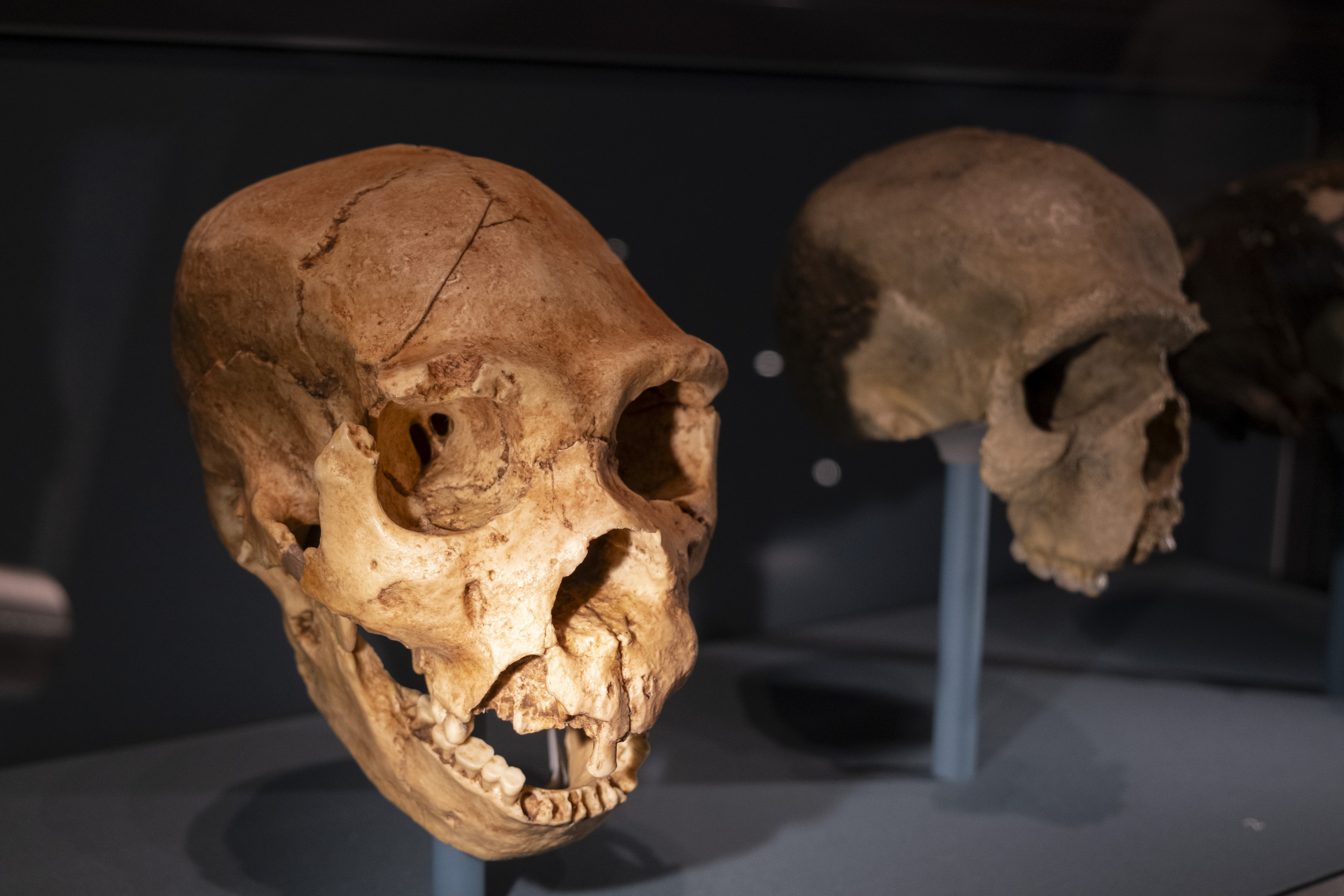
Neanderthal skulls were larger and more elongated than those of modern humans, and their occipital lobe — the back of the brain, which houses the visual cortex — was relatively larger. The researchers therefore expected Neanderthal variants to enlarge that region in modern carriers. The data ran the other way.

Using UK Biobank genetic data from about half a million participants, the team found that each copy of the variant reduces occipital lobe volume by about 0.85 cubic centimeters, Smithsonian Magazine reported; two copies double the shrinkage to roughly 1.7 cubic centimeters. The variant sits in predicted transcription-factor motifs near DAAM1, a gene tied to brain development in a 2019 study.
This Neandertal-derived variant is linked to altered brain anatomy in present-day humans and lower schizophrenia risk while having little or no association with general cognitive ability, as Hugo Zeberg and Svante Pääbo wrote in the paper.
The cognitive effect, where any exists, is small: at most two weeks of education per allele against an average of about 15 years, according to the study’s abstract.
Why the paradox may not be one
Tony Capra, an evolutionary geneticist at the University of California, San Francisco, told Live Science that the effect is the opposite of what experts expected given Neanderthals’ large skulls. He cautioned that this single variant “does not reflect the full set of variations that might have been present in Neanderthals that might have affected the shape and size of their brain structures.”
The variant appears in all five available complete Neanderthal genomes but was absent from the two Denisovan genomes tested, Smithsonian Magazine reported. It is found only in modern humans outside Africa.
Two Neanderthal copies reduce schizophrenia odds
Having two copies — one from each parent — was associated with a nearly 10 percent reduction in schizophrenia odds. Neanderthal ancestry as a whole does not show this protective tendency; the effect appears specific to this variant.
The mechanism remains unknown. Schizophrenia can involve altered perceptions such as visual hallucinations and impaired visual-signal processing, which makes a connection to the visual cortex “tempting to speculate,” Zeberg told Live Science — but no evidence for such a link exists yet. “The honest answer is we don’t understand the mechanism,” he told Science, as quoted by Smithsonian Magazine, noting that animal or brain-organoid research could clarify it.
“A Neanderthal variant can have a relatively strong effect on brain anatomy without affecting intelligence, while also reducing schizophrenia risk,” Hugo Zeberg told Live Science.
Davide Marnetto, a computational biologist at the University of Turin not involved in the work, called it “a very important variant” whose effect is “really one of the most beautiful and strong that I’ve ever seen,” according to Nature’s coverage cited by Smithsonian Magazine.
What this means for patients and genetics care
The findings refine how inherited variants are interpreted in psychiatric risk. A brain-region volume difference carries no cognitive penalty here, a caution the authors state explicitly against equating structure size with ability.
Zeberg and Pääbo have a track record in this field: they previously identified a Neanderthal gene cluster on chromosome 3 that raises the risk of severe COVID-19, which later research found protects against HIV, Euronews reported. More Neanderthal variants are under study.
You might hear from us again, Hugo Zeberg told Scientific American.