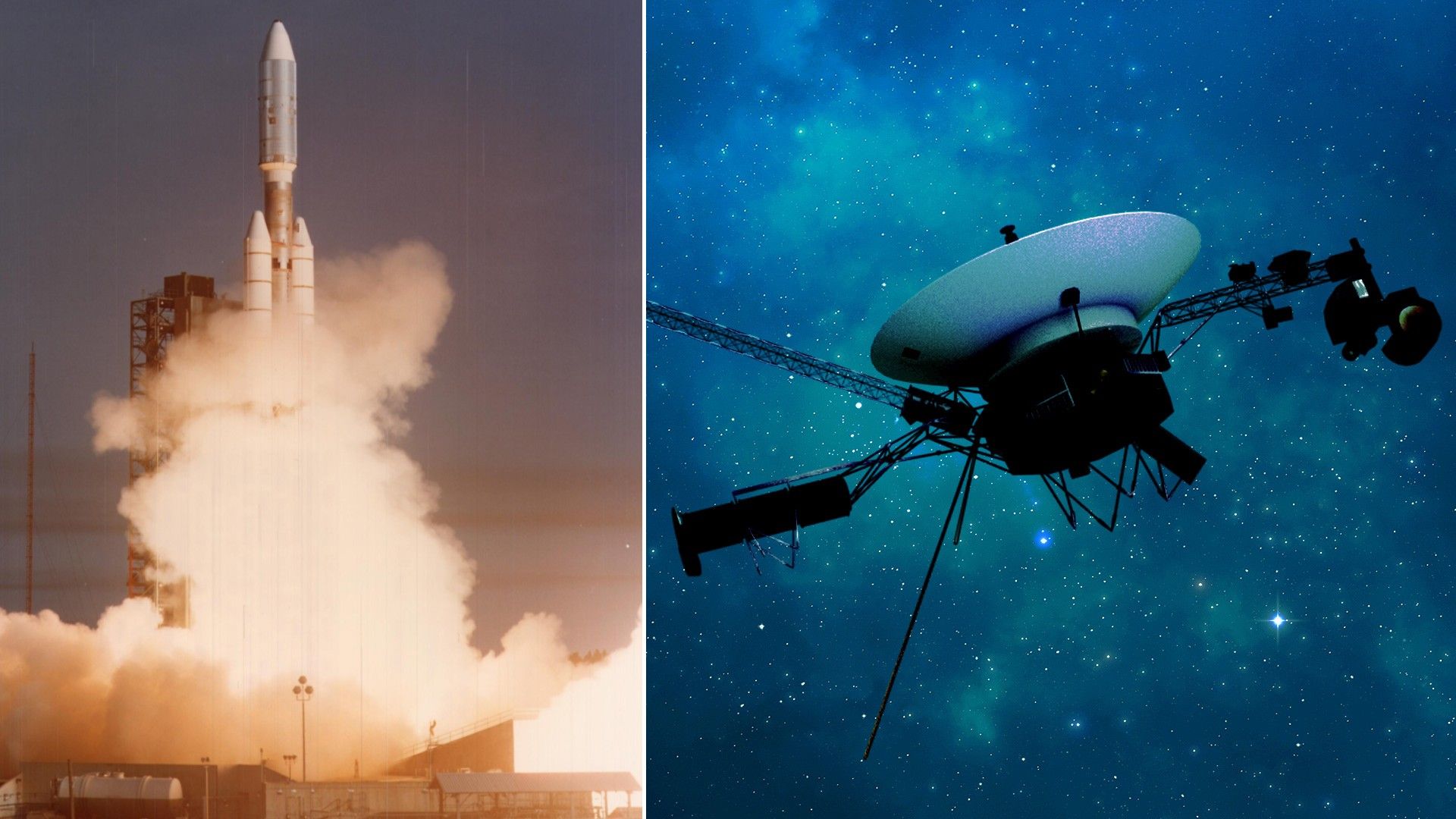
NASA’s Voyager 1 Reaches One Light-Day From Earth
NASA’s Voyager 1 crossed one light-day from Earth on Wednesday at 5:16 a.m.
The Tech TL;DR:
- Voyager 1 is now 16 billion miles out; a radio signal takes 24 hours one-way, 48 hours round-trip, through NASA’s Deep Space Network.
- Only two instruments — the magnetometer and plasma wave subsystem — remain powered, drawing down roughly four watts per year.
- JPL engineers say power-saving measures could keep contact alive three to four more years; Voyager 2 won’t hit this milestone until about 2035.
Why a 48-hour round-trip changes mission operations
The milestone is less ceremonial than operational. Every commanding session at the Jet Propulsion Laboratory is now a two-day conversation: an uplink travels at light speed for 24 hours, the probe executes, and confirmation takes another 24 to come home. Any fault — like the temporary loss of communication in late October that CNN reported resolved itself after 48 hours — costs two days of blind flight before engineers even know about it.
For teams running long-latency systems, that constraint is familiar territory. There is no interactive debugging at 16 billion miles. Everything is batched, queued, and fault-tolerant by design.
After nearly 50 years, Voyager 1 has traveled more than one light-day from Earth. Hear about what the Voyager mission has taught us about our solar system—and beyond—in the newest episode of our Curious Universe podcast: https://t.co/myZespHoPz pic.twitter.com/bRi1iaSWCs
The latency math is simple enough to run yourself:
# One-way light time to Voyager 1, Nov 18, 2026
distance_km = 25_902_068_356          # Space.com figure
c_kms = 299_792.458                   # speed of light, km/s

olt_seconds = distance_km / c_kms
print(f"One-way light time: {olt_seconds/3600:.2f} hours")
print(f"Round-trip commanding cycle: {2*olt_seconds/3600:.1f} hours")
# One-way light time: 23.99 hours
# Round-trip commanding cycle: 48.0 hours
The power budget is the real story
Voyager 1 launched in 1977 and holds the farthest-object title since 1998, when it passed Pioneer 10, CNN reported. It crossed the heliopause into interstellar space in 2012; its twin, Voyager 2, launched two weeks earlier but entered interstellar space in 2018 and sits at a slower 3.1 astronomical units per year versus Voyager 1’s 3.5, according to Space.com.
Happy #LightDay, Earthlings! This morning, Voyager 1 became the first spacecraft to travel one light-day away from home. How did Voyager 1 manage that, you may ask? A little thing called #nuclear science ⚛️😌👇https://t.co/t2hiw3MYEA pic.twitter.com/cgUmllrkkh
The engineering reality underneath the celebration is a declining radioisotope power supply. Two of its original ten science instruments remain operational: the magnetometer and the plasma wave subsystem. Live Science reported scientists expect full power depletion in the 2030s.
“I think of it like pirates trying to avoid the laws of the land,” Kareem Badaruddin, Voyager mission manager at NASA’s Jet Propulsion Laboratory, told CNN. “We try to avoid the laws of physics as we continue our journey.”
Video: @NASAWatch editor @KeithCowing spoke with @DeutscheWelle about the #OneLightDay milestone that #interstellar starship Voyager 1 has achieved. https://t.co/FFF4HmuhbG
The improvisation has limits. In late October, weeks after what CNN described as a daring instrument swap, Voyager 1 went silent temporarily — an incident Badaruddin’s team rode out, but one that showed how little margin remains. “I call it pulling a rabbit out of a hat,” he told CNN. “So now we’ve got our arm deep in the hat and we’re looking around for another rabbit.”
What the last two instruments are still measuring
The science return hasn’t stopped. Per DD News, project manager Suzanne Dodd said Voyager 1 sends back continuous measurements of magnetic fields, cosmic rays, and plasma waves whenever the Deep Space Network points its antennas at the probe. The data has already overturned expectations: the magnetic field direction did not rotate into the interstellar direction after the heliopause crossing.

“After the heliopause crossing, the magnetic field direction did not rotate into the interstellar direction as expected, but has maintained the direction it had when both Voyagers crossed the heliopause, a direction governed by our sun,” Dodd said. “We are watching to see when that rotation might occur.”
The probes are also tracking solar weather at unprecedented range. Coronal mass ejections generate shocks and pressure fronts that reach Voyager 1 and beyond, Dodd said — in-situ readings of solar storm propagation that no other platform can collect.
Early this morning (Nov. 18, 5:16 a.m. ET), the Voyager 1 spacecraft officially traveled one light-day from Earth! Learn what Voyager is revealing about our corner of the universe and how NASA keeps a nearly 50-year-old mission running >> https://t.co/tJaepd1aGO pic.twitter.com/TJMkcl4HA2
How a 1977 launch beat its own twin
The nine-year gap to Voyager 2’s own light-day moment traces to trajectory engineering. Voyager 1 launched second in 1977 but took a faster path, arriving at Jupiter on March 5, 1979 — four months ahead of Voyager 2’s July 9 arrival, Space.com reported. Gravity assists at each flyby built speed, with one exception: Voyager 2’s detour to fly by Triton at Neptune cost it velocity. Both spacecraft escaped the solar system, but on different clocks.
| Spacecraft | Interstellar crossing | Light-day milestone | Speed |
|---|---|---|---|
| Voyager 1 | 2012 | Nov 18, 2026 | ~38,000 mph |
| Voyager 2 | 2018 | ~2035 | 3.1 AU/year |
The countdown to silence
A JPL representative told DD News that recent power-saving measures could sustain communication for three to four more years, with enough power to run the current instrument suite through the 50th launch anniversary next year. “Beyond that is hard to predict, and of course these are nearly 50-year-old spacecraft, and there are always things the team cannot anticipate that might happen,” the representative said.
“Reaching one light-day is an astounding feat, one that I never expected to see,” Dodd said. JPL has scheduled an event for Thursday to mark the milestone, a day after the probe’s confirmation signal was due back on Earth.
Researchers are racing the clock on the open question the mission exists to answer. “Where does the sun’s influence end and pristine interstellar space begin?” Dodd said. “Perhaps Voyager may last long enough to answer that question.” Voyager 1’s closest approach to the star Gliese 445 — within about 1.7 light-years — is roughly 40,000 years out, CNN reported.
More on Earth
Shining bright across the solar system! On Nov. 18, the Voyager 1 spacecraft will pass an extraordinary milestone, a distance reached by no other human-made object: one light-day away from Earth. And we're celebrating with a special message for the spacecraft! pic.twitter.com/CHgYMKrbhL