NASA’s Nancy Grace Roman Space Telescope Arrives in Florida for Final Launch Preparations
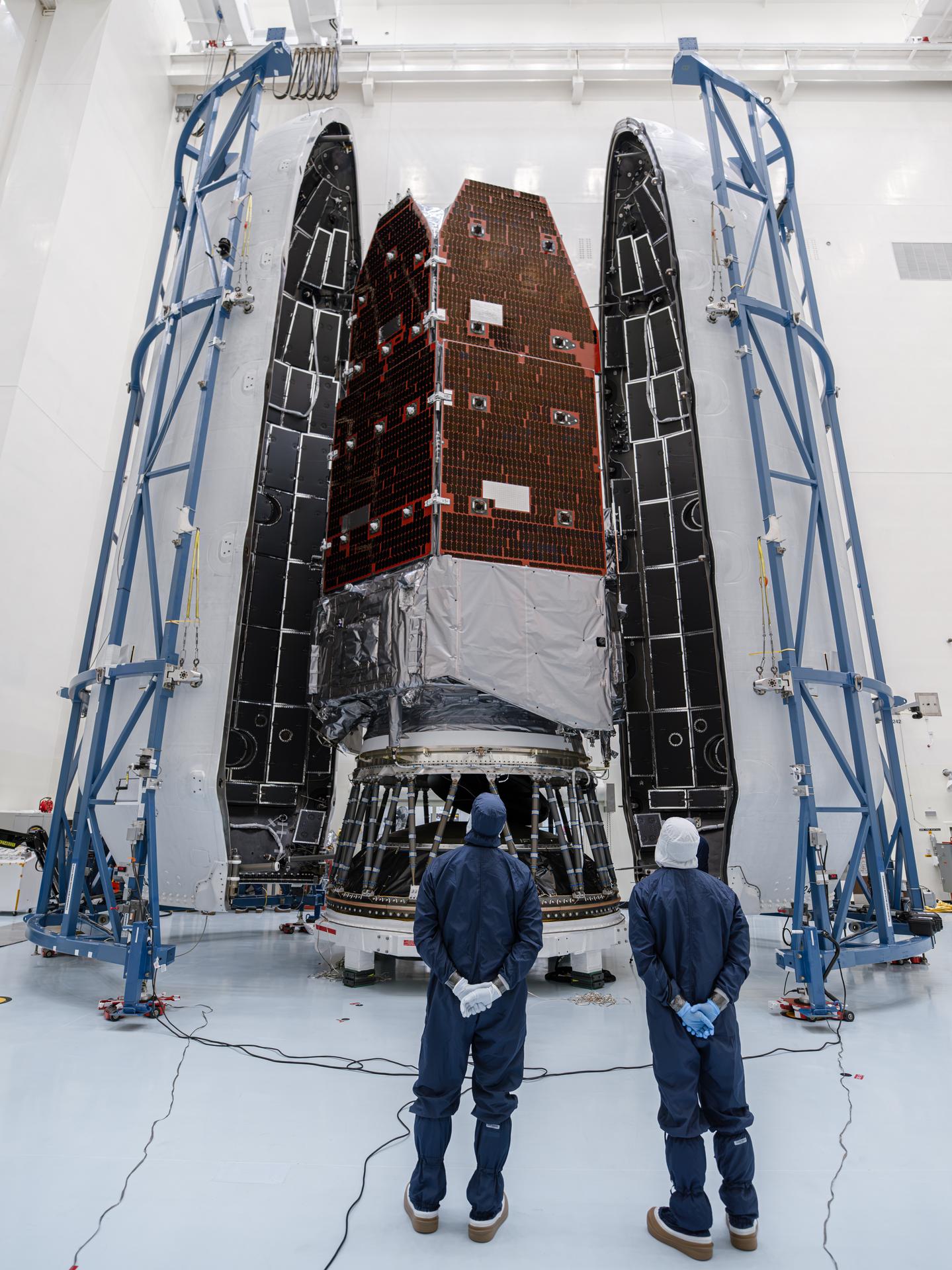
NASA’s Nancy Grace Roman Space Telescope is securely encapsulated within its payload fairing at the Kennedy Space Center in Florida, as teams prepare for an August 30, 2026 liftoff aboard a SpaceX Falcon Heavy rocket from Launch Complex 39A.
Payload Preparation at Kennedy Space Center
The roughly 18,000-pound spacecraft arrived at the Florida spaceport via the agency’s Pegasus barge, traveling from NASA’s Goddard Space Flight Center in Maryland. Technicians moved the telescope into the Payload Hazardous Servicing Facility clean room. Inside the facility’s high bay, engineers utilize a specialized work platform known as “the Pantheon” to conduct final checkouts.
Preparations at the Kennedy facility include thorough evaluations of the observatory’s six solar panels, thermal insulation, and heat management components. Ground teams are also tasked with loading approximately 290 gallons of hypergolic hydrazine fuel into the vehicle. This propellant will power the thrusters responsible for guiding the satellite toward its operational station.
Timeline Acceleration and Launch Logistics
The upcoming flight arrives eight weeks ahead of its original schedule, positioning the agency for a liftoff on August 30, 2026, at 07:26 a.m. EDT. NASA’s Launch Services Program at Kennedy manages the launch vehicle program management of the SpaceX launch service. The Roman Space Telescope project itself is managed by the Goddard Space Flight Center.

When the Falcon Heavy clears the pad at Launch Complex 39A, it will carry an observatory designed to address fundamental questions regarding the structure of the cosmos.
Destination and Scientific Objectives
Once deployed, the observatory will travel to Sun-Earth Lagrange point two, a gravitational station-keeping point located approximately one million miles beyond Earth on the side opposite the sun. At this location, the spacecraft can maintain its position without expending continuous fuel.

Equipped with a 7.9-foot-wide primary mirror, a 300-megapixel camera, and a coronagraph, the mission aims to chart billions of galaxies and discover hundreds of thousands of new exoplanets. The observatory will gather vast daily volumes of data designed to help astronomers untangle the mysteries of dark energy and the accelerating expansion of the universe.
As final checkouts proceed inside the Kennedy Space Center clean room, the aerospace community turns its gaze toward the Space Coast.