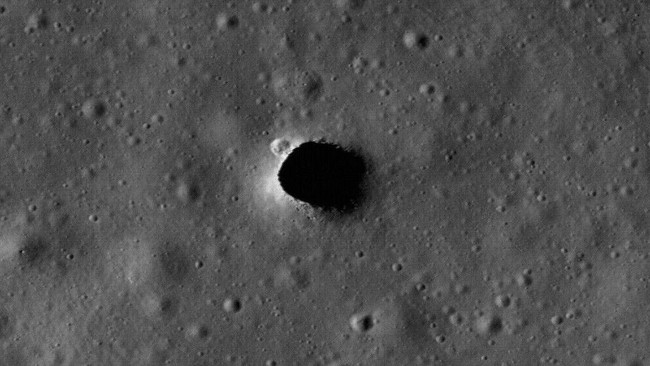
NASA’s GIMLI Mission to Explore Moon’s Marius Hills Pit for Future Human Base
A massive hole measuring roughly 65 by 90 meters on the Moon’s surface has become the target of a dedicated NASA investigation to determine whether it opens into an underground cave system capable of housing future astronauts, CNBC Indonesia reported.
The feature, known as the Marius Hills Pit, sits at a depth of 34 to 45 meters, according to details reported by Qoo Media and detikInet. Scientists believe the opening is a collapsed skylight that drops down into an ancient lava tube formed during a period of intense lunar volcanism between 3.8 and 3 billion years ago.
NASA Selects Partners and Instruments for GIMLI Mission
To peer beneath the lunar regolith without sending humans underground yet, NASA has selected a project named GIMLI, which stands for Geophysical Instruments for Marius Lunar pit Investigation, as reported by Media Indonesia.
The Planetary Science Institute is leading the project, partnering with Honeybee Robotics, Blue Origin, and the Norwegian Space Agency to assemble the required hardware, according to Qoo Media and detikInet. The mission will deploy a lander and a rover equipped with ground-penetrating radar, gravimeters, seismic sensors, and high-resolution cameras.
Data from these instruments will allow researchers to map subsurface voids and examine the exposed walls of the pit.
“Penggabungan metode-metode ini akan memungkinkan kita memperoleh pemahaman yang jauh lebih baik mengenai karakteristik bawah permukaan, termasuk mendeteksi keberadaan tabung lava yang diperkirakan membentang dari lubang Marius Hills,” Than Putzig, senior scientist on the project, told Qoo Media and detikInet, referring to how the combined methods will reveal subsurface characteristics and confirm lava tubes extending from the pit.
NASA just picked 3 science payloads for Moon Base:LEMS-SP — South Pole hazard station (quakes, micrometeoroids, volatiles)GIMLI — hunt lava tubes at Marius Hills for natural sheltersDISCO — find hidden ice + how the surface really behavesScience first. Then we stay. 🇺🇸 pic.twitter.com/DSmfehDYwT
Strategic Value for Future Astronaut Bases
Researchers are targeting the Marius Hills Pit because underground lava tubes could offer critical survival advantages for crewed missions.
Surface conditions on the Moon expose equipment and potential habitats to extreme temperature swings, cosmic radiation, and micrometeorites. Subsurface caves provide natural insulation and shielding against these environmental hazards, making them prime candidates for long-term research bases.

Nicky Fox, Associate Administrator for the Science Mission Directorate at NASA, emphasized the agency’s focus on gathering necessary survival data in a statement reported by Media Indonesia.
“NASA Science sedang membangun panduan bertahan hidup antarplanet terbaik untuk memastikan bahwa sains menjadi yang utama di permukaan Bulan. Hal ini dilakukan guna menyediakan informasi vital, sumber daya, dan tindakan pencegahan keselamatan yang dibutuhkan kru astronaut masa depan sebelum mereka bertahan hidup melewati malam di Bulan,” Fox stated, highlighting the priority of putting science first to secure vital resources and safety protocols for crews.
Marius Hills Lava Tubes Reveal Lunar Volcanic History
Located on the Earth-facing side of the Moon, the Marius Hills region is surrounded by remnants of ancient basaltic lava flows. Confirming the continuity of the underground cavities will help scientists connect terrestrial volcanic knowledge to lunar history.
“Bila keberadaan tabung lava berukuran besar berhasil dikonfirmasi, itu akan memberi kita wawasan tentang bagaimana proses vulkanisme beroperasi di Bulan,” Gareth Morgan, senior scientist at the Planetary Science Institute and deputy principal investigator for GIMLI, told Independent, as cited by detikInet and CNBC Indonesia.
Morgan added that identifying basaltic lava tubes on the Moon allows researchers to use terrestrial cave systems as a comparative model for lunar geology.
More on Marius Hills Pit
JUST IN: NASA has selected a mission to investigate whether a giant cave on the Moon opens into an underground lava tube that could one day shelter astronauts from radiation and extreme temperatures.The GIMLI project will study the Marius Hills Pit, an opening roughly 90 meters… pic.twitter.com/kwSqkRDSWS
.@NASA has selected a project to investigate whether the Marius Hills pit on the Moon connects to a large underground lava tube. Called GIMLI, short for Geophysical Instruments for Marius Lunar pit Investigation.It was selected through NASA’s PRISM programme, which supports… pic.twitter.com/F77USX6Hg6