
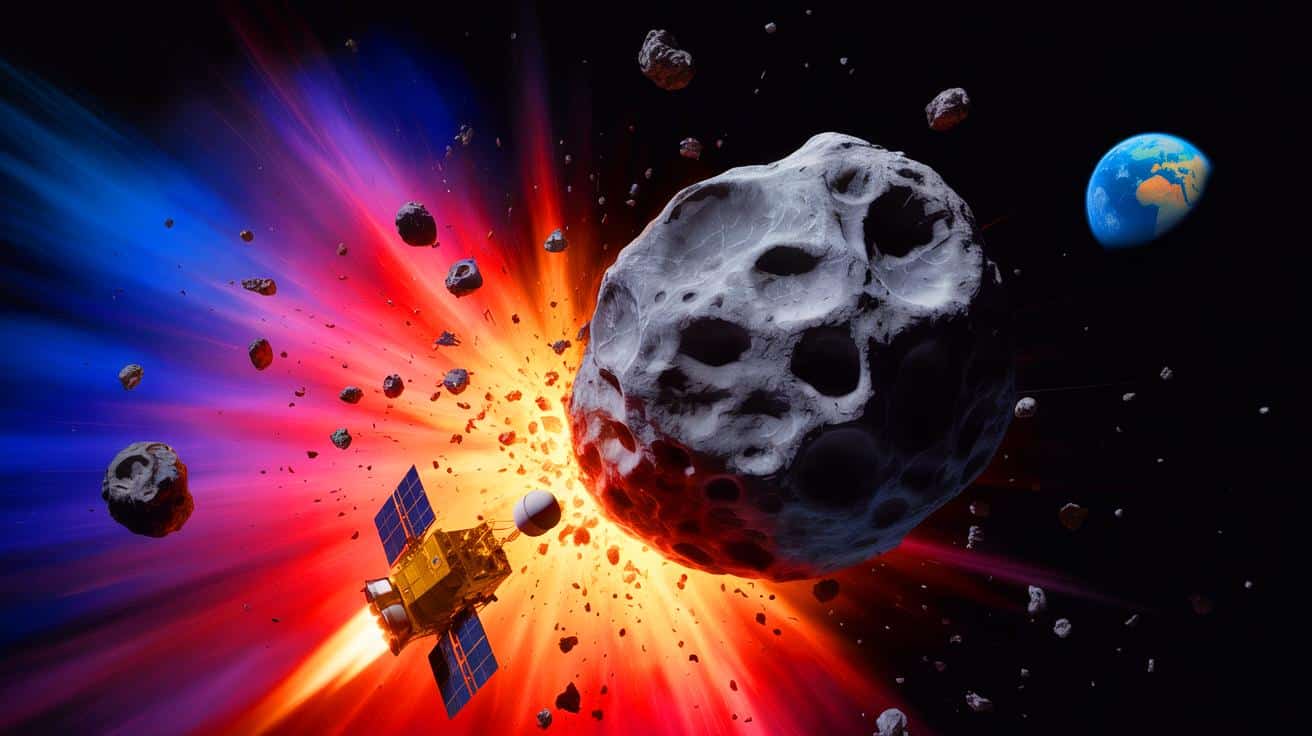
## Earth’s Defense Demonstrated: DART mission Ejects Millions of Pounds of Rock, Redefining Asteroid Deflection Strategies
the Double Asteroid Redirection Test (DART) mission, a landmark achievement in planetary defense, successfully altered the orbit of asteroid Dimorphos by impacting it at high speed. The experiment, conducted in September 2022, yielded crucial data about asteroid composition and the effectiveness of kinetic impact as a deflection method. Recent analysis reveals the impact ejected an astonishing 35.3 million pounds (approximately 16,000 metric tons) of material from Dimorphos’ surface, substantially contributing to the orbital change.
The asteroid Dimorphos is categorized as a “rubble pile” – a loosely consolidated body composed of boulders and dust. Scientists found its strength to be less than 50 pascals,making it even softer than compacted snow. This fragility explains the substantial amount of material ejected during the impact. The Italian Space Agency’s LICIACube,deployed shortly before DART’s impact,captured detailed images of the ejecta plume,providing unprecedented insight into the aftermath of the collision.
“The additional push from the ejecta must be considered in future deflection strategies,” explained Dave Glenar of the University of Maryland, highlighting the importance of accounting for this phenomenon in future mission planning. This realization underscores the necessity of understanding the composition of asteroids to design effective planetary defense systems.
The DART mission demonstrated that kinetic impactors *can* alter an asteroid’s path. Crucially, the ejected material amplified the deflection effect, creating a dual mechanism for course correction. This finding has significant implications for planetary defense, as asteroids frequently pass near Earth, and even a small alteration in trajectory can prevent a potentially devastating impact.
Future missions will need to account for varying asteroid compositions. While Dimorphos,a rubble pile,ejected a large amount of debris,a solid rock asteroid would likely react differently to a similar impact,absorbing the energy instead of releasing it as ejecta.As Timothy Stubbs noted, each interaction with an asteroid reveals new and unexpected details, emphasizing the need for continued research.
the success of DART represents a major step forward in our ability to protect Earth from hazardous impacts. The data collected will inform the advancement of spacecraft capable of deflecting potential threats, ensuring the planet’s safety. The mission’s conclusion marks the begining of a new era in planetary defense and space science, driven by the insights gained from observing the aftermath of an asteroid collision and validating a potential strategy for safeguarding our planet.
This article is based on verified sources and supported by editorial technologies.
Did you like it? 4.7/5 (27)
