
Pulsar’s Roar Driven by Cosmic Winds, Not Stolen Matter
New Study Reveals True Source of Intense Radiation from Spinning Neutron Star
Astronomers have pinpointed the origin of a pulsar’s intense radiation, attributing it not to the material it siphons from a stellar companion, but rather to powerful particle winds emanating from the neutron star itself. This groundbreaking discovery sheds new light on the energetic processes powering these cosmic titans.
Unraveling the Secrets of a Transitional Pulsar
The celestial object under scrutiny is PSR J1023+0038, or J1023, a neutron star located 4,500 light-years away. This star, a “dead star” spinning at an astonishing 600 times per second, resides in a binary system with a smaller, less massive star. J1023 belongs to a rare category known as “transitional millisecond pulsars” due to its unique ability to cycle between active and dormant phases.
During its active periods, J1023 feeds on its companion, expelling beams of radiation from its poles. This intermittent behavior makes it an exceptionally valuable subject for scientific study. As Maria Cristina Baglio, the team leader and researcher at the National Institute for Astrophysics (INAF), stated,
“Transitional millisecond pulsars are cosmic laboratories that help us understand how neutron stars evolve in binary systems. J1023 is a particularly valuable source of data because it clearly transitions between its active state, in which it feeds on its companion star, and a more dormant state, in which it behaves like a standard pulsar, emitting detectable radio waves.”
A Multi-Wavelength Investigation
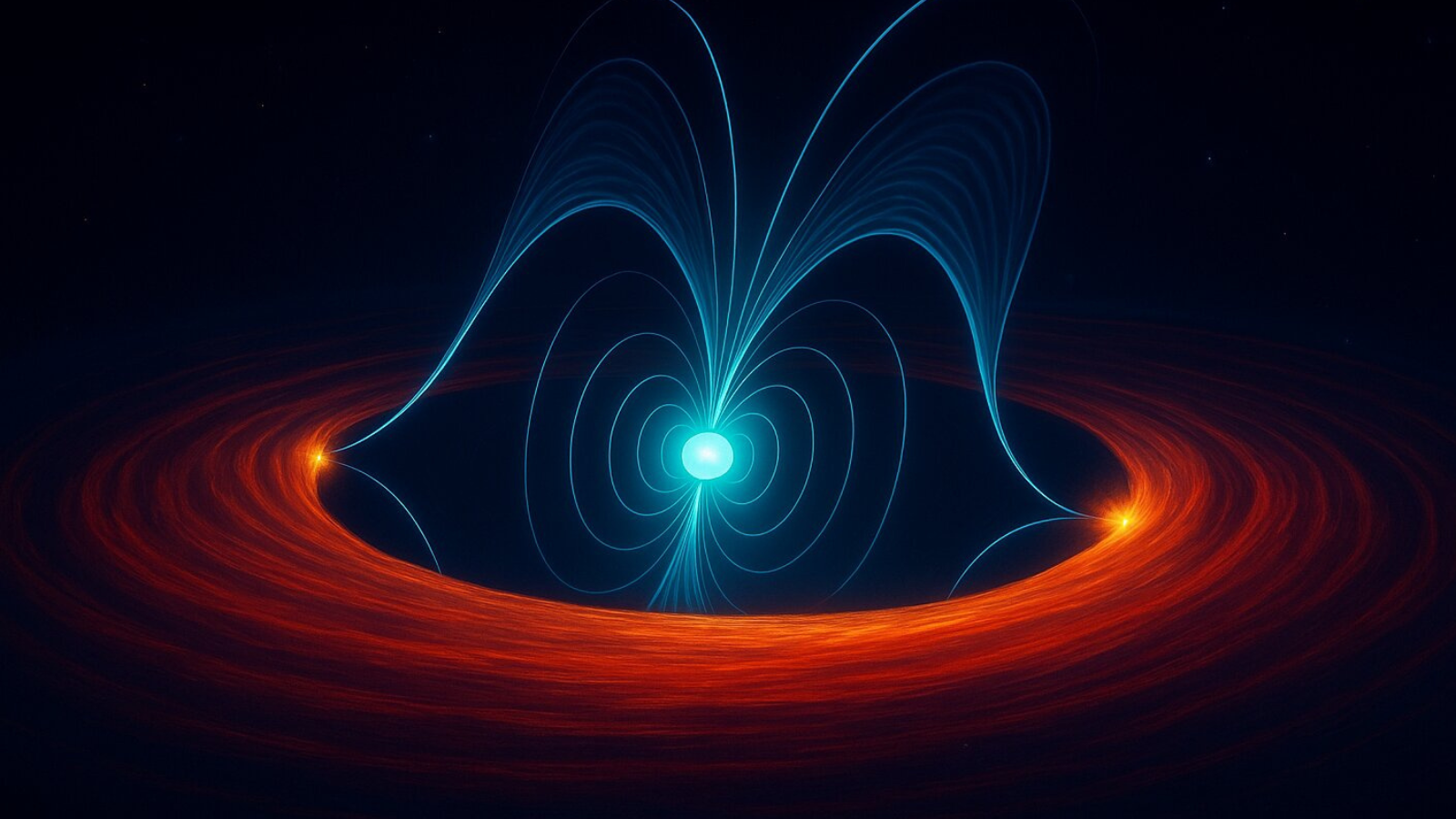
The matter drawn from the companion star doesn’t directly hit the neutron star. Instead, it forms a flattened structure known as an accretion disk, which spirals around the dense stellar remnant. This disk, as it gradually feeds the neutron star, generates significant radiation across the electromagnetic spectrum. To decipher this complex interplay, researchers utilized data from NASA’s Imaging X-ray Polarimetry Explorer (IXPE), the European Southern Observatory’s Very Large Telescope (VLT), and the Karl G. Jansky Very Large Array (VLA). This marks the first comprehensive survey of such a binary system across X-ray, optical, and radio wavelengths.
Baglio further elaborated on the observations, noting, “During the observations, the pulsar was in a low-luminosity active phase, characterized by rapid changes between different X-ray brightness levels.”
Unprecedented Polarization Alignment
By examining J1023 across these different spectral bands, the team could analyze the polarization of its emissions. Polarization describes the orientation of light waves. IXPE’s observations revealed that 12% of the X-rays from J1023 were polarized—the highest level ever recorded from a similar binary system. The radio wave and optical light emissions showed lower polarization levels of 2% and 1%, respectively. Intriguingly, the optical polarization aligned with the X-ray polarization, suggesting a shared origin for both phenomena.
These findings corroborate a long-standing theory suggesting that the polarized emissions observed in binary systems like J1023 are a consequence of pulsars’ energetic particle winds colliding with the surrounding accretion disks. This research is critical for understanding pulsar mechanics and was made possible by IXPE’s remarkable sensitivity. Alessandro Di Marco, a team member and researcher at INAF, commented on the achievement:
“This observation, given the low intensity of the X-ray flux, was extremely challenging, but the sensitivity of IXPE allowed us to confidently detect and measure this remarkable alignment between optical and X-ray polarization. This study represents an ingenious way to test theoretical scenarios thanks to polarimetric observations at multiple wavelengths.”
The team’s detailed findings were published on July 1 in The Astrophysical Journal Letters. This discovery enhances our understanding of extreme astrophysical phenomena, with similar neutron star systems like the one powering the Crab Nebula continuing to be subjects of intense scientific interest.
