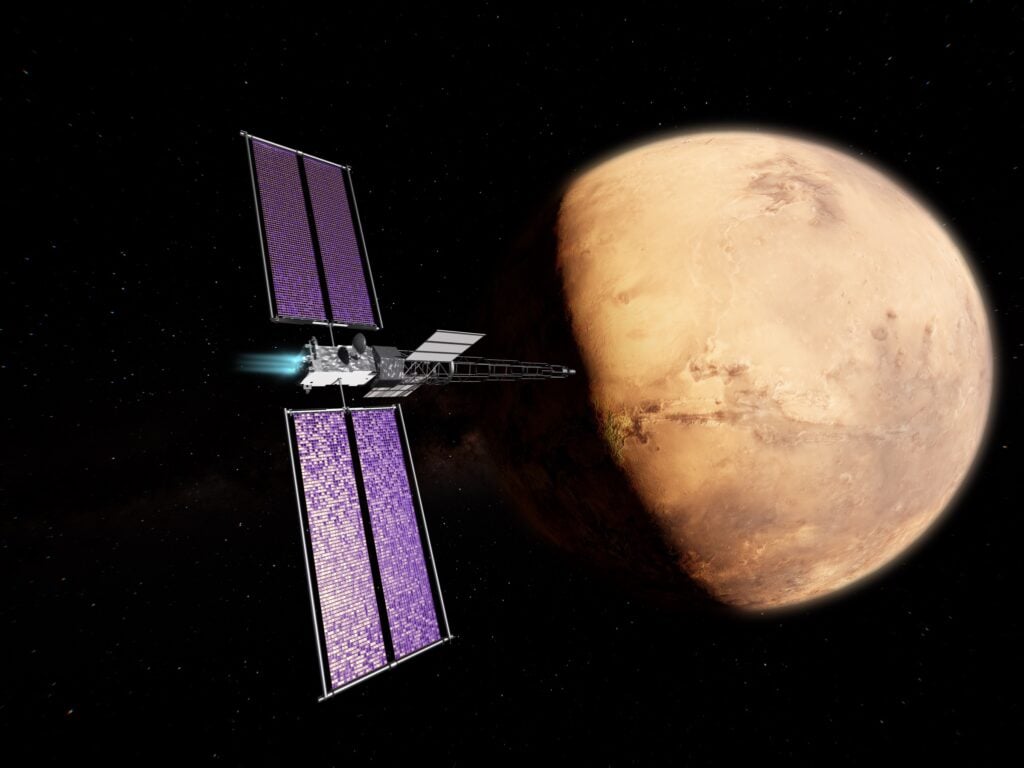
NASA to Launch Nuclear-Powered Space Reactor-1 Freedom to Mars in 2028
NASA Targets 2028 for Space Reactor-1 Freedom Launch
NASA has scheduled the launch of Space Reactor-1 (SR-1) Freedom for late 2028, marking the agency’s first deployment of a nuclear fission reactor designed for deep space propulsion. According to official mission documentation, the spacecraft aims to validate nuclear electric propulsion (NEP) capabilities, creating a foundational architecture for future human exploration missions to Mars and sustainable lunar operations.
The Tech TL;DR:
- Propulsion Shift: SR-1 utilizes a 20-kilowatt closed Brayton cycle reactor to power an advanced Hall-effect thruster system, moving away from traditional chemical combustion.
- Payload Integration: The mission will deploy three “SkyFall” helicopters, evolved from the Ingenuity platform, equipped with ground-penetrating radar for subsurface water-ice detection.
- Infrastructure Scaling: The mission serves as a technical precursor for the Lunar Reactor-1 (LR-1) project, intended to provide continuous power for lunar base operations during periods of darkness.
Architectural Specifications and Propulsion Logic
The SR-1 Freedom vehicle is engineered with a total mass of approximately 26,455 pounds (12,000 kilograms). The core power system, as detailed in NASA’s mission overview, centers on a 20-kilowatt electric closed Brayton cycle conversion system. This architecture is designed to feed an advanced 12-kilowatt Hall-effect thruster, providing sustained, fuel-efficient thrust that is significantly more effective for deep-space transit than chemical rockets, particularly in regions beyond Jupiter where solar flux is insufficient for photovoltaic arrays.
The Power and Propulsion Element (PPE) is rated for 48 kilowatts of total electrical output, utilizing High-Assay Low-Enriched Uranium (HALEU) as the primary fuel source.
Industrial Base and Regulatory Precedents
The development of SR-1 Freedom is not merely a propulsion test; it is an attempt to jumpstart a domestic nuclear-space industrial base. Per reports from Space Daily and InSmart, the project aims to establish regulatory and launch precedents that have historically hindered nuclear-powered space hardware. The cancellation of previous collaborative efforts, such as the DARPA-Lockheed Martin DRACO project, highlighted the volatility of costs and regulatory hurdles. However, NASA officials noted that the rapid reduction in launch costs driven by commercial providers has shifted the feasibility of nuclear-space hardware deployment.

Data Collection and the SkyFall Deployment
Upon reaching the Martian intercept, the mission will trigger the SkyFall deployment sequence. These three autonomous aerial vehicles represent an evolutionary step from the Ingenuity platform, incorporating an advanced instrument suite. According to NASA, the helicopters will utilize ground-penetrating radar to characterize subsurface features. This data, when fused with high-resolution imagery, will enable researchers to map potential water ice deposits and understand regional dust transport mechanisms through meteorological measurements of wind speed, direction, and elevation-based temperature gradients.
Operational Trajectory and Future Scaling
SR-1 Freedom is intended to lower the flight risk profile for future lunar and Martian surface operations. By validating the reactor in deep space first, NASA avoids the complexities associated with immediate landing requirements. This sequential rollout—from SR-1 to the proposed LR-1—is designed to qualify the supply chain and build the workforce necessary for sustained presence on the Moon. As the agency moves toward the 2028 launch window, the focus remains on leveraging existing flight hardware to maximize reliability while pushing the boundaries of current nuclear fission integration in vacuum environments.

Disclaimer: The technical analyses and security protocols detailed in this article are for informational purposes only. Always consult with certified IT and cybersecurity professionals before altering enterprise networks or handling sensitive data.