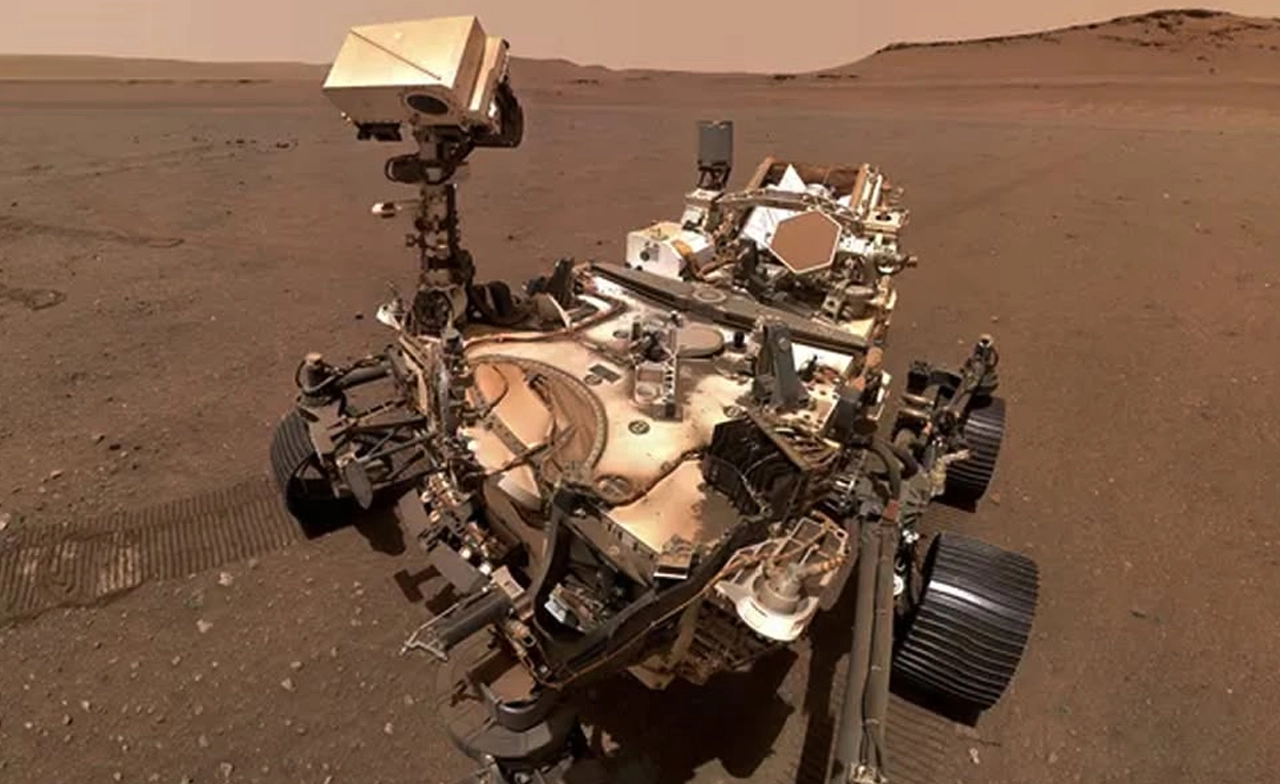
NASA Perseverance Rover Breaks Mars Driving Distance Record
NASA’s Perseverance Mars rover has shattered the planetary distance record, logging a cumulative 45.22 kilometers across the Martian surface to eclipse the previous milestone held by the Opportunity rover, according to an October 11 report.
The 5.5-Year Sprint Past Opportunity
The record fell just 5.5 years after Perseverance touched down on the Red Planet in February 2021.
Opportunity, by contrast, required 14 years to accumulate its 45.16-kilometer total.
Outpacing Engineering Projections
Today, the rover’s total distance has already more than doubled the original engineering projections mapped out for the mission.
Mark Maimone, a rover navigation system specialist at NASA’s Jet Propulsion Laboratory (JPL), stated that Perseverance was originally planned for a driving range of about 20 kilometers.
Maimone noted that improved wheel technology and fast-processing autonomous navigation software allowed the vehicle to navigate obstacles efficiently and exceed its baseline goals.
JPL engineering teams now estimate the hardware remains in sound condition, with an operational capacity that could potentially reach a total range of 100 kilometers.

Mission Heritage Ensures Continuous Science Operations
Alongside its mobility systems, the science payload aboard Perseverance continues to operate without interruption.
Vivian Sun, deputy project scientist at JPL, attributed the five-year operational success to accumulated mission heritage spanning back through the Sojourner, Spirit, Opportunity, and Curiosity projects, paired with continuous coordination between engineering, driving, and science teams.
Hunting Biosignatures at Rainbow Falls
Perseverance is currently traveling southward along the rim of Jezero Crater, a 46-kilometer-wide impact basin that held an ancient lake billions of years ago.
The crater rim exposes diverse rock strata unearthed from early Martian crust, providing access to environments distinct from the rest of the planet’s surface.
The rover’s next primary target is Rainbow Falls, a location where scientists have detected deposits of the clay mineral kaolinite. Kaolinite forms through past interactions between liquid water and rock, making the site a key focus for evaluating ancient habitability, water evolution, and potential biosignatures on Mars.
Worth a look