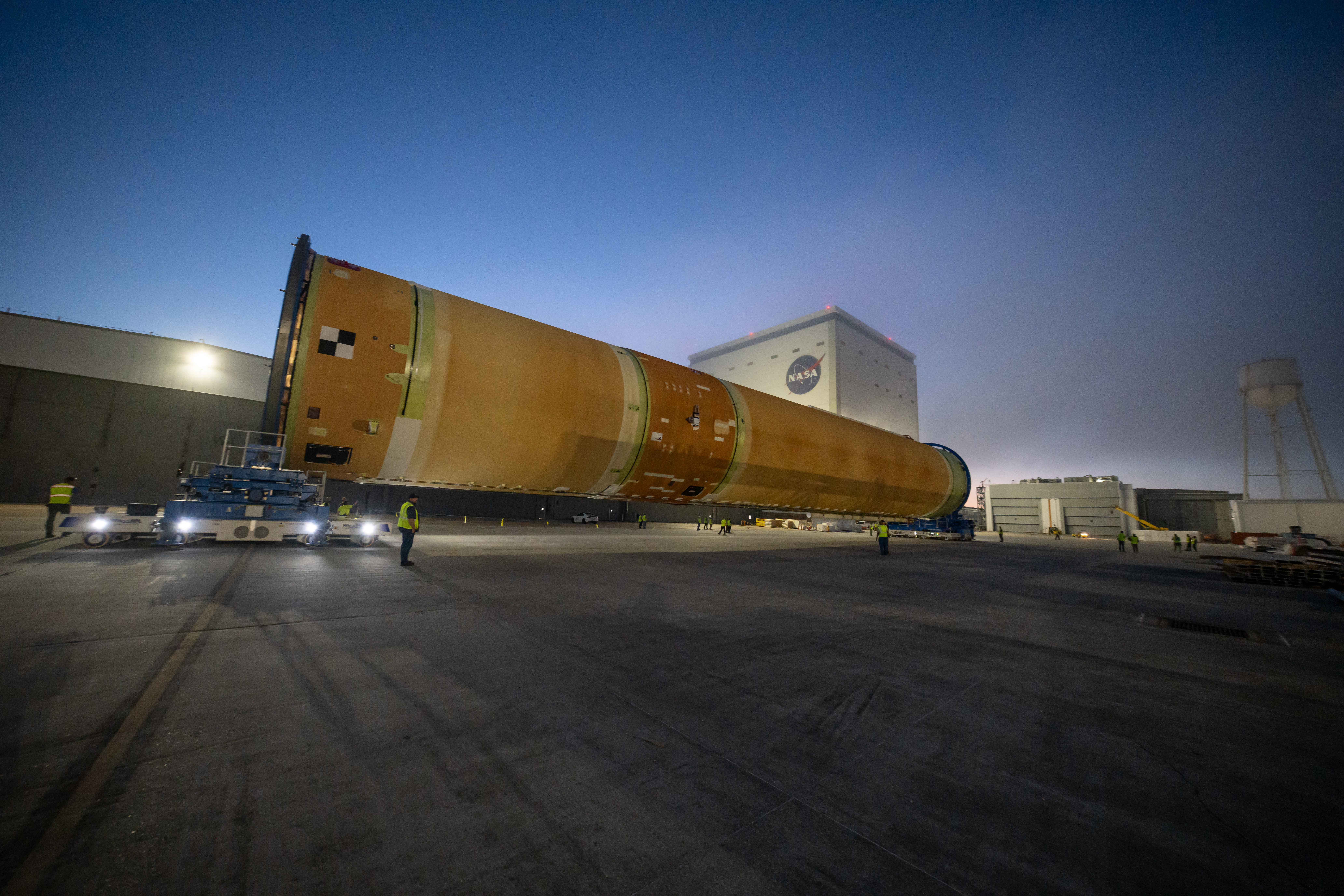
NASA Invites Media to Artemis III Moon Rocket Stage Rollout Event
NASA is rolling out the hardware for the Artemis III moon rocket stage, but the mission profile has undergone a massive architectural pivot. What was marketed as a triumphant return to the lunar surface has been downgraded to a Low Earth Orbit (LEO) docking trial—essentially a high-stakes integration test for commercial hardware.
The Tech TL;DR:
- Mission Downgrade: Artemis III is no longer a lunar landing mission; it is now a LEO rendezvous and docking test between Orion and commercial landers (SpaceX/Blue Origin).
- Hardware Bottlenecks: The Space Launch System (SLS) is plagued by helium flow issues and hydrogen leaks, while Orion faces heat shield concerns.
- Timeline Shift: Lunar landings are pushed to 2028 via Artemis IV and V, with the SLS rocket slated for retirement following the Artemis III mission.
From a systems engineering perspective, this shift is a classic case of critical path failure. When your primary dependencies—in this case, the Orion heat shield and the SpaceX Starship HLS—fail to meet deployment benchmarks, you don’t ship the full feature set. You pivot to a Minimum Viable Product (MVP). Artemis III has become that MVP: a mission to verify that the Orion spacecraft can actually talk to and dock with private commercial assets in orbit. For those of us used to agile sprints, this is a “feature freeze” on the lunar landing, moving the actual delivery to a later release cycle (Artemis IV/V).
The Hardware Spec Breakdown: Original vs. Rejiggered
The original mission architecture assumed a seamless transition from LEO to the lunar surface. The current reality is a segmented test of integrated operations. The following table breaks down the shift in deployment goals based on recent agency updates.
| Metric/Goal | Original Artemis III Spec | Current “Rejiggered” Spec |
|---|---|---|
| Primary Objective | Crewed Lunar Landing | LEO Rendezvous & Docking |
| Target Date | 2025-2026 (Initial) | Mid-2027 (Planned) |
| Operational Orbit | Lunar Surface / Cislunar | Low Earth Orbit (LEO) |
| Key Hardware Test | Surface EVA/Landing | Orion-to-HLS Docking & AxEMU Suit Test |
| Success Criteria | Human Footprint on Moon | Successful Docking with SpaceX/Blue Origin |
The mission is now broadly comparable to Apollo 9, focusing on the orchestration of components rather than the final destination. This suggests a significant lack of confidence in the current “stack,” specifically regarding the thermal protection systems of the Orion capsule and the readiness of the Human Landing Systems (HLS). When the core infrastructure is this unstable, enterprise-level projects require certified hardware auditors to perform root-cause analysis on the failures before proceeding to the next phase.
The HLS Dependency and Vendor Lock-in
NASA is effectively outsourcing the most critical part of the landing sequence to SpaceX’s Starship HLS and Blue Origin’s Blue Moon. This creates a dangerous vendor dependency. If the commercial provider’s development cycle slips—as has been the case with Starship—the entire federal timeline collapses. The mission now requires testing rendezvous capabilities with “one or both” of these providers, indicating a redundant but fragmented architecture.
“NASA will not land astronauts on the moon in 2027,” announced Administrator Jared Isaacman. “Instead the agency will rejigger its planned Artemis III mission to test in-orbit capabilities… And rendezvousing with at least one of the spacecraft that NASA hopes to use as a lunar lander.”
This admission highlights a massive latency issue in the procurement and development pipeline. Relying on third-party commercial landers means NASA is no longer the sole architect of its mission; it is now a systems integrator. For organizations facing similar third-party bottlenecks, deploying enterprise systems integrators is the only way to synchronize disparate development velocities across multiple vendors.
The SLS Bottleneck: Helium, Hydrogen, and Technical Debt
The Space Launch System (SLS) is showing signs of severe technical debt. Recent reports indicate the rocket has encountered helium flow issues and hydrogen leaks, which have already forced the scrapping of a target March launch for Artemis II. In the world of high-performance computing or aerospace, these aren’t just “bugs”—they are fundamental architectural flaws that threaten the entire deployment.

To visualize how a telemetry system would flag these specific SLS failures, consider the following conceptual Python snippet used to monitor propellant flow stability. In a production environment, this would be integrated into a real-time monitoring dashboard to trigger an automatic abort sequence if thresholds are breached.
import time def monitor_sls_telemetry(helium_flow, hydrogen_pressure): # Critical thresholds for SLS Stage 1 HE_FLOW_MIN = 45.0 # kg/s H2_PRESSURE_MAX = 110.0 # bar if helium_flow < HE_FLOW_MIN: return "CRITICAL_FAILURE: Helium flow below threshold. Abort sequence initiated." if hydrogen_pressure > H2_PRESSURE_MAX: return "CRITICAL_FAILURE: Hydrogen leak/overpressure detected. Emergency venting." return "STATUS_OK: Telemetry within nominal parameters." # Mock telemetry stream telemetry_data = {"he_flow": 42.1, "h2_pressure": 115.2} print(monitor_sls_telemetry(telemetry_data["he_flow"], telemetry_data["h2_pressure"])) When these failures occur repeatedly, it indicates a systemic issue with the hardware’s reliability engineering. The fact that the budget now proposes retiring the SLS and Orion capsule after the Artemis III mission suggests that NASA has recognized the SLS as a legacy system—a “monolith” that is too expensive and brittle to maintain. The transition toward a fully commercial architecture is not just a budget move; it is a necessary migration to a more flexible, iterative development model.
Managing this level of volatility requires more than just engineering; it requires technical risk management consultants who can map out the blast radius of a single component failure across a multi-billion dollar program.
The rollout event for the Artemis III stage is a PR exercise, but the technical reality is a rescue operation. NASA is attempting to salvage the program by redefining success. By shifting the goalposts to LEO, they buy time to fix the heat shield and hope the commercial landers stop slipping. The trajectory of the Artemis program is a cautionary tale for any CTO: if you build your roadmap on unstable dependencies and legacy hardware, your “moonshot” will eventually be downgraded to a docking test.
Disclaimer: The technical analyses and security protocols detailed in this article are for informational purposes only. Always consult with certified IT and cybersecurity professionals before altering enterprise networks or handling sensitive data.
Worth a look
- Subaru Reveals Limited WRX GD25 and BRZ ZC15 Anniversary Editions
- In a test published by goodhousekeeping.com, food producers and editors evaluated how to improve
- Han Kuo-yu Credits Semiconductor Growth and Past Leaders at National Day Event (time.news)
- What the PERM Suspension Means for Workers at Each Green Card Stage (daybreakwire.com)