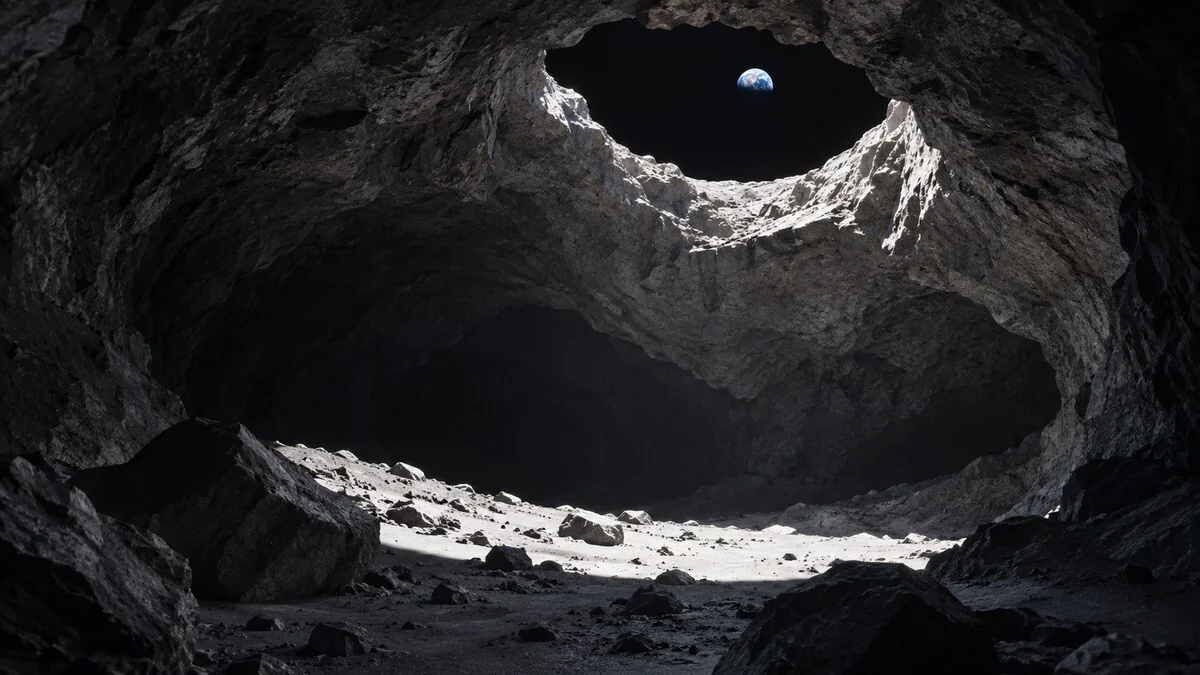
NASA Gravity Data Suggests Four Massive Lava Tunnels Beneath the Moon’s Surface
Four massive lava tunnels may exist beneath the lunar surface, according to new gravity data analyzed by researchers, Forschung und Wissen reported.
The potential voids, some exceeding one kilometer in width, were identified by Juan M. Losarcos and Andrew J. Dombard from the University of Illinois Chicago. Their study, published in the journal Icarus, uses data from NASA’s GRAIL mission to locate four specific regions where gravity measurements suggest missing mass.
These natural structures could serve as protective shelters for future astronauts by providing a barrier against cosmic radiation and extreme temperature shifts. While surface photography shows mostly closed plains on the near side of the Moon, the researchers looked for clues in the lunar gravity field rather than visible openings.
The team identified four candidate sites located in volcanic landscapes: one near Vallis Schröteri on the Aristarchus Plateau, one at Rima Mairan, and two others near the Wollaston crater, according to Forschung und Wissen. reported that the researchers used height data from the Lunar Reconnaissance Orbiter’s LOLA instrument to account for surface terrain.
By calculating Bouguer anomalies, they isolated mass distribution differences from the visible landscape to match them against mathematical models of hypothetical tunnels.
One specific candidate near Vallis Schröteri shows a significant gravity anomaly that follows a surface rille. Modeling suggests this particular section could be at least 30 kilometers long and approximately 1.7 kilometers wide.
| Dimension | Estimated Value |
| Minimum Length | 30 kilometers |
| Approximate Width | 1.7 kilometers |
| Estimated Height | 550 to 850 meters |
| Overlying Rock Thickness | 100 meters |
The researchers said that while some previous calculations suggested tunnels up to nine kilometers wide, such large structures would require a rock ceiling of more than 600 meters to remain stable. The current findings of tunnels covered by roughly 100 meters of rock are more consistent with the mechanical limits of lunar geology.
The study suggests these large tubes might have formed as lava flowed through smaller underground paths, gradually widening the channels through heat and mechanical erosion.
To confirm these findings, the researchers state that radar measurements are necessary to check for actual interfaces that match an open passage.