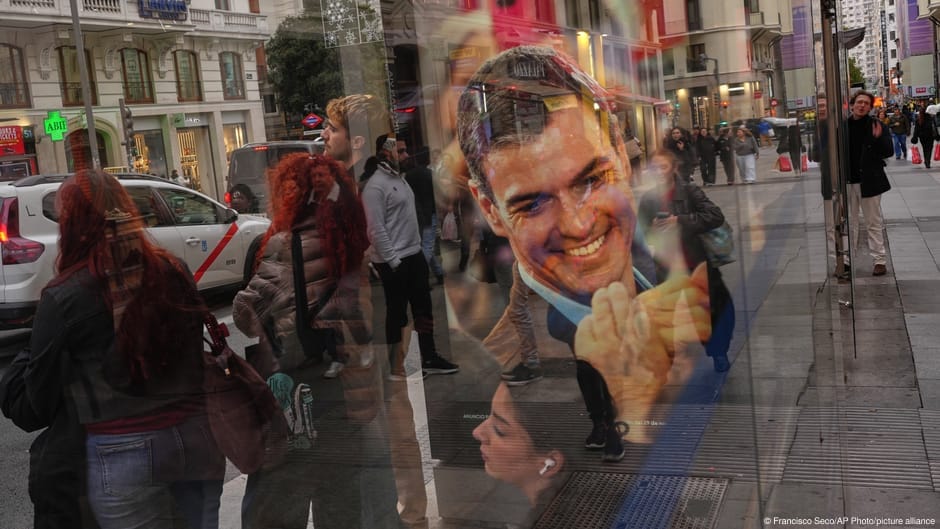
Spain Election Could Silence Key Center-Left Voice and Shift EU Policy Direction
Spain’s upcoming election threatens to remove one of the European Union’s most prominent center-left leaders, potentially signaling a significant shift in the bloc’s political direction.
Pedro Sanchez called the snap election for this weekend following the collapse of his minority government’s legislative agenda in early October.
The vote follows the rejection of two emergency decrees intended to address national housing costs, a failure that triggered widespread protests and a general strike on November 11, dw.com reported. Sanchez, who has led the country for more than eight years, also faces pressure from corruption allegations involving his party and his wife, both of which they have denied.
Polling on Monday indicated a close contest, with the conservative People’s Party (PP) at approximately 32% and Sanchez’s Socialists at 31%.
If these projections hold, the PP and the right-wing populist Vox party—polling at 17%—could secure an absolute majority, though it remains unclear if they would choose to govern as a coalition.
A change in leadership could silence a key voice within European institutions, according to Javier Carbonell, a policy analyst at the European Policy Centre in Brussels.
“This voice might now be silenced,” Carbonell told dw.com. He said that Sanchez has distinguished himself by challenging U.S. President Donald Trump, advocating for Palestinian statehood, and defending immigration as a necessity for labor markets and economic growth.
| Indicator | 2024 | 2025 | 2027 (Proj.) |
|---|---|---|---|
| GDP Growth | 2.6% | 2.6% | 2.2% |
| Defense Spending | 1.24% of GDP | 2.0% of GDP | N/A |
The conservative opposition has taken a different stance on several of these issues. While the PP supports higher defense spending, it has campaigned on stricter immigration controls, while Vox has proposed sharper cuts to migration and the prioritization of Spanish citizens for social benefits.
“With a PP-Vox government, Spain would join the general European trend towards an anti-immigration policy,” Carbonell told dw.com. Camino Mortera-Martinez, an associate fellow at the Centre for European Reform, suggested that such a transition in Madrid would reflect broader voter sentiment across the continent.
“This anti-migration tendency doesn’t come from European leaders, but from voters,” she told dw.com. Sanchez formally recognized a Palestinian state in May 2024 and previously pushed for the suspension of the European Union’s agreement with Israel over human rights concerns.
Analysts expect a conservative government would likely adopt a less vocal position on the Middle East. A change of government in Madrid would cost Europe’s center left one of its most influential voices, according to Javier Carbonell, a policy analyst at the European Policy Centre in Brussels.