
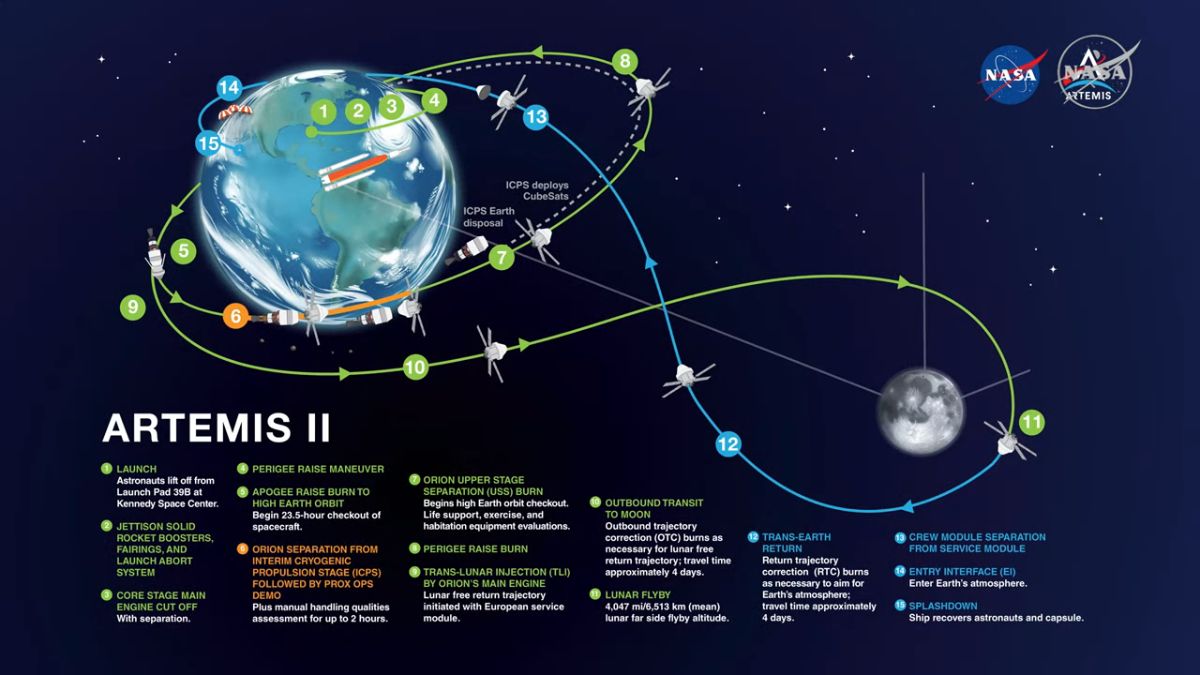
NASA Artemis II Mission: Astronauts Begin Journey Home After Lunar Flyby
NASA’s Artemis II is currently in the “return” phase of its deployment cycle. After launching on April 1, 2026, the crew is executing the final leg of a 10-day flight test designed to stress-test the Space Launch System (SLS) and Orion spacecraft in a live deep-space environment.
The Tech TL;DR:
- Hardware Validation: First crewed flight test of the SLS rocket and Orion capsule to verify deep-space system stability.
- Mission Scope: A 10-day lunar flyby (no landing) to establish the baseline for human surface missions slated for 2028.
- Crew Diversity: Deployment includes the first woman, first Black man, and first Canadian to participate in a moon mission.
From a systems engineering perspective, Artemis II isn’t a voyage of discovery; it’s a high-stakes production push. The mission serves as the ultimate integration test for the Orion spacecraft’s life support, navigation, and communication stacks. When you’re operating in the actual environment of deep space, “it worked in the simulator” is a dangerous assumption. The objective is to confirm that every subsystem operates as designed with human operators on board, identifying any critical bugs before NASA attempts a lunar landing in 2028.
The Hardware Stack: SLS and Orion Specifications
The mission architecture relies on the Space Launch System (SLS) for initial lift and the Orion capsule for the transit and return. Unlike previous Apollo-era hardware, this stack is designed for long-term exploration and science, requiring a level of redundancy and fault tolerance that mirrors mission-critical enterprise infrastructure. For firms specializing in software QA and testing agencies, the Artemis II flight profile represents the pinnacle of “edge case” testing—where a single unhandled exception can result in total system failure.
| Role | Personnel | Primary Objective | System Responsibility |
|---|---|---|---|
| Commander | Reid Wiseman | Mission Management | Crew communication, final decision-making, Mission Control liaison. |
| Pilot | Victor Glover | Flight Operations | Spacecraft maneuvering and piloting. |
| Mission Specialist | Christina Koch | Systems/Science | Deep space capability verification. |
| Mission Specialist | Jeremy Hansen (CSA) | Systems/Science | Deep space capability verification. |
The Human Interface: System Managers in Deep Space
The crew composition is less about exploration and more about operational redundancy. Commander Reid Wiseman, a 50-year-old Navy aviator and test pilot selected in 2009, functions as the “team manager.” His role is to ensure all facets of the mission work seamlessly and to resolve conflicts—essentially acting as the lead architect for the mission’s real-time execution. Wiseman is the primary interface between the crew and the engineers at Mission Control, ensuring that telemetry data is translated into actionable decisions.
The inclusion of Victor Glover, Christina Koch, and Jeremy Hansen expands the operational footprint of the mission. By integrating the first Black man, first woman, and first Canadian into the lunar flight path, NASA is diversifying the human element of its deep-space capabilities. However, from a technical standpoint, their roles as Mission Specialists are centered on verifying the Orion capsule’s systems in the actual environment of deep space, ensuring the hardware can sustain human life during the 10-day transit.
Addressing the Latency Bottleneck
One of the primary IT bottlenecks in lunar missions is the signal latency between the Orion capsule and Earth. Unlike Low Earth Orbit (LEO) operations, deep space communications face significant round-trip time (RTT) delays that create real-time “remote control” impossible. This necessitates a high degree of onboard autonomy and robust local decision-making protocols. For organizations managing global networks, this is the ultimate latency challenge, often requiring the expertise of network infrastructure consultants to optimize ground-station handoffs.

To illustrate the telemetry delay, a developer can calculate the theoretical minimum RTT for a signal traveling from Earth to the Moon and back using the speed of light:
import math def calculate_lunar_latency(distance_km): # Speed of light in km/s LIGHT_SPEED = 299792.458 # One-way latency one_way = distance_km / LIGHT_SPEED # Round-trip time (RTT) rtt = one_way * 2 return one_way, rtt # Average distance to the moon avg_distance = 384400 one_way, rtt = calculate_lunar_latency(avg_distance) print(f"One-way Latency: {one_way:.3f} seconds") print(f"Round-trip Time (RTT): {rtt:.3f} seconds") # Expected Output: One-way ~1.28s, RTT ~2.56s While a 2.5-second delay seems negligible in a standard web app, in a critical descent or reentry phase, it is an eternity. This is why the Orion’s flight software must be capable of autonomous correction without waiting for a “ping” from Houston.
Architectural Implications for 2028
The Artemis II mission is the prerequisite for the 2028 lunar surface missions. By verifying that the SLS and Orion can successfully transport a crew around the Moon and back, NASA is effectively validating its “minimum viable product” (MVP) for deep space exploration. The mission confirms that the spacecraft’s systems operate as designed in the actual environment, paving the way for the establishment of long-term lunar science capabilities.
As we scale toward permanent lunar presence, the reliance on terrestrial support will diminish, shifting the burden to onboard compute and automated maintenance. This shift will likely drive a demand for more resilient, radiation-hardened hardware and decentralized command-and-control systems. Enterprise IT departments looking to implement similar levels of high-availability and disaster recovery for their own critical infrastructure may find value in consulting with managed IT services providers who specialize in zero-downtime architectures.
The return of the Artemis II crew marks the end of a critical test phase. The data harvested from this 10-day sprint will be the primary driver for the iterative improvements needed for the 2028 landing. We are moving from the “proof of concept” stage to a deployment phase where the goal is no longer just to visit, but to sustain.
Disclaimer: The technical analyses and security protocols detailed in this article are for informational purposes only. Always consult with certified IT and cybersecurity professionals before altering enterprise networks or handling sensitive data.