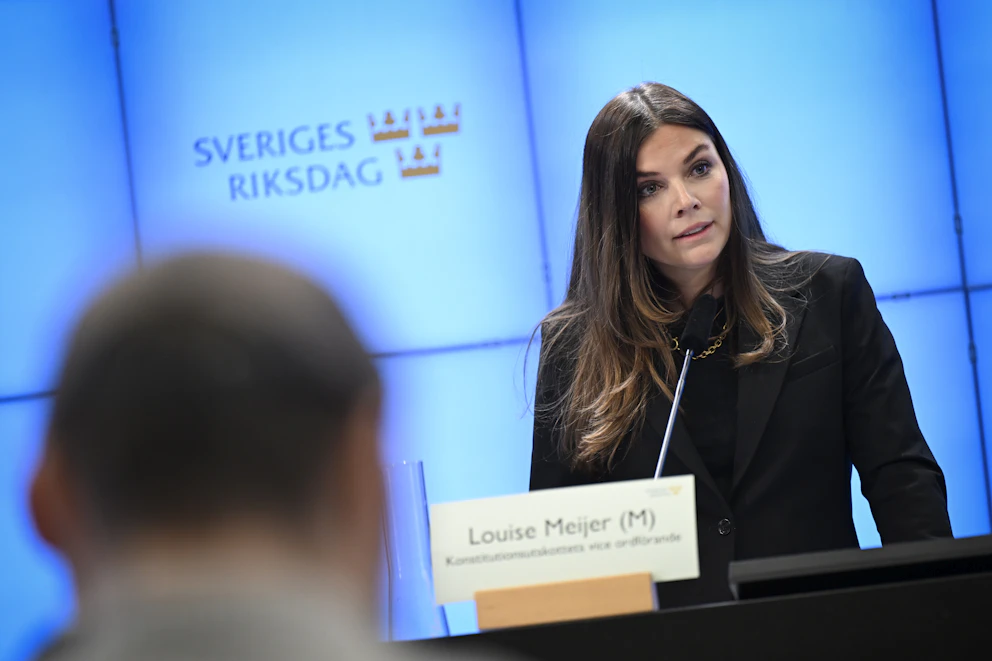
Moderate Party lawmaker Louise Meijer proposed a ten-year Swedish citizenship requirement for
Moderate Party lawmaker Louise Meijer proposed a ten-year Swedish citizenship requirement for anyone seeking election to the Riksdag.
The Push for a Ten-Year Citizenship Requirement in the Riksdag
Louise Meijer submitted an individual motion to the Riksdag demanding a complete overhaul of the current regulations governing parliamentary eligibility. Under existing Swedish laws, every individual holding voting rights in national elections is simultaneously eligible to stand for election. Meijer argues that holding a seat in the national parliament demands a deeper baseline of integration and familiarity with domestic institutions.
International comparisons form a core part of the justification outlined in the motion. Meijer highlighted that equivalent restrictions exist in several other democratic nations. The United States requires seven years of citizenship to enter the House of Representatives and nine years for the Senate. Argentina enforces a four-year threshold for its Chamber of Deputies and six years for its Senate.

The Controversy Surrounding Mohamed Ali and Preferential Voting
The legislative proposal responds directly to the sudden political rise of Mohamed Ali for the Left Party, who achieved a breakthrough in Dalarna. Migrationsverket initially denied Ali citizenship in 2024 before reversing the decision and granting it in February 2026. By September, preferential voter backing carried him into the national legislature. Ali has been absent from parliamentary duties since late September while his campaign faces an ongoing investigation concerning suspected electoral fraud in Borlänge, though law enforcement has not named him as a suspect in any crime, Bulletin noted.
Alongside the citizenship duration motion, Meijer submitted a secondary legal proposal targeting parliamentary accountability. The second motion argues that a conviction for electoral fraud—specifically violations under chapter 17, section 8 of the Swedish Penal Code regarding improper voting influence or taking undue advantages during elections—should suffice to strip a lawmaker of their mandate, even if courts classify the offense as less than gross.

Constitutional Reviews Hinder Proposed Citizenship and Mandate Changes
Because these proposed changes directly impact the Instrument of Government—one of Sweden’s fundamental laws—they cannot be enacted through standard legislative votes alone. Implementing a ten-year citizenship rule or altering mandates following minor criminal convictions requires a formal constitutional review. Meijer is officially urging the government to appoint a dedicated constitutional inquiry to examine the framework.
Meanwhile, political alliances remain unsettled following the recent election results. Elisabeth Marmorstein, domestic political commentator for SVT Nyheter, noted that while the initial vote outcomes held no major surprises, the identity of the person tasked with leading the upcoming government probes remains unclear. Marmorstein stated that Ulf Kristersson is expected to accept a exploratory mandate if offered by the Speaker, while simultaneously highlighting that he will likely acknowledge the lack of a clear parliamentary majority. Analysts also point out that Centerpartiet leader Elisabeth Thand Ringqvist could potentially receive an exploratory assignment later in the process, echoing a similar political deadlock from 2018 when Annie Lööf was tapped to sort through gridlocked party negotiations. No fixed timeline currently dictates when the Speaker must distribute the next exploratory mandate, though observers anticipate an announcement.