
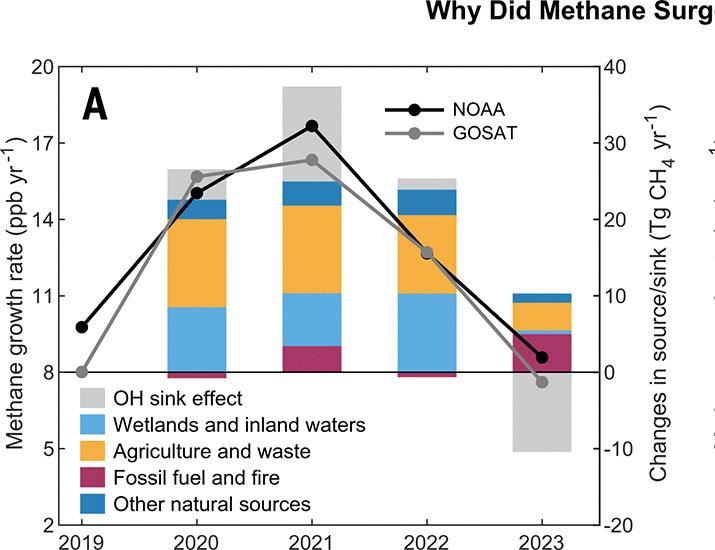
Global methane levels surged in the early 2020s, reaching record highs despite pandemic-related economic slowdowns, according to data released this week by Boston College researchers and confirmed by NASA observations. The annual growth rate peaked in 2020 at 16.2 parts per billion (ppb) per year, before declining to 8.6 ppb per year in 2023, but remains significantly elevated compared to previous decades.
Scientists attribute the unexpected increase to a combination of factors: a temporary slowdown in the atmosphere’s ability to chemically remove methane, and increased emissions from wetlands, rivers, lakes, and agricultural areas due to unusually wet conditions. A prolonged La Niña phase from 2020 to 2023 brought wetter-than-average weather to large parts of the tropics, fueling methane production in these environments.
The primary chemical responsible for breaking down methane in the atmosphere is the hydroxyl radical. Research indicates a dramatic slowdown in this atmospheric “clean-up” process during 2020-2021, accounting for approximately 80 percent of the year-to-year changes in methane accumulation. This decline coincided with changes in air pollution patterns linked to COVID-19 lockdowns, indirectly weakening the atmosphere’s natural methane removal capacity.
Methane is a potent greenhouse gas, considered the second-most important contributor to anthropogenic warming after carbon dioxide. While it remains in the atmosphere for a shorter period than carbon dioxide, it traps significantly more heat – approximately 28 times more over a 100-year period. Scientists estimate that methane has contributed 15 to 45 percent of the 1.1°C (2°F) of warming experienced since 1880.
Prior to 2007, atmospheric methane concentrations had plateaued between 2000 and 2006. However, the growth rate began to accelerate between 2007 and 2019, averaging around 9 ppb per year. The surge in 2020, reaching 15 ppb, exceeded previous records established since systematic measurements began in 1983. The increase in 2020 was described as “large, unexpected, and alarming” by Ben Poulter, an earth scientist at NASA’s Goddard Space Flight Center.
Researchers are continuing to investigate the complex interplay of factors driving methane emissions. The findings, published in the journal Science, highlight the necessitate for a more comprehensive understanding of both natural and human-induced sources of methane to effectively mitigate its impact on climate change. No immediate policy responses have been announced following the release of the findings.
