
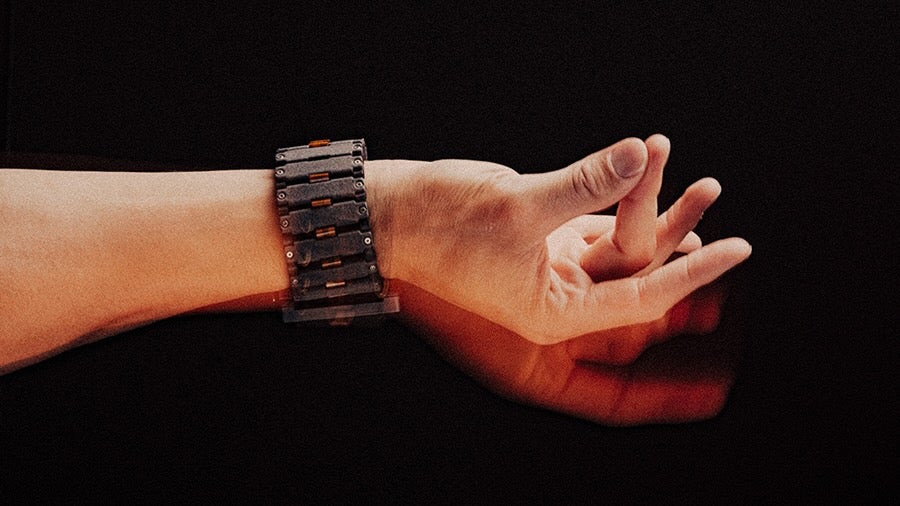
Meta Unveils Minority Report-Style Gesture Control Wristband
Sci-Fi Tech Moves from Screen to Reality, Promising New Interaction Avenues
The futuristic gesture control seen in the cyberpunk film Minority Report is no longer confined to the silver screen. Meta has unveiled a revolutionary wristband capable of decoding intricate finger movements through subtle electrical signals, potentially transforming how we interact with technology.
Decoding the Digital Language of the Body
This cutting-edge device translates familiar smartphone actions like pinching, swiping, and tapping into digital commands. An integrated computer interprets these signals, allowing users to manipulate screens without physical contact. In initial tests, participants, without prior training, successfully navigated tasks, played games, and even wrote words by simply drawing motions with their fingers on a surface.
Imagine controlling your devices with just a flick of your wrist. Meta’s new EMG wristband brings the sci-fi future of Minority Report to life. https://t.co/sWJ1jB004E #Meta #ARVR #HCI #Innovation
— World Today News (@WorldTodayNews) May 1, 2024
Meta has been developing this muscle-reading technology, with earlier versions capable of translating simple computer clicks. The latest iteration boasts significantly broader functionality. Powered by neural networks and trained on data from over 6,000 volunteers, the wristband has achieved up to 90% accuracy in specific tests. Participants averaged about 21 words per minute for text input, with performance improving with familiarity.
“To our knowledge, this is the highest level of cross-participant performance achieved by a neuromotor interface.”
—The Meta Research Team
The prototype’s consumer-friendly design, featuring off-the-shelf components and multiple sizes, signals its potential for widespread adoption. Meta envisions integrating this device into its augmented and virtual reality headsets, while also recognizing its profound impact for individuals with motor impairments, such as those experiencing hand paralysis or spinal cord injuries, by offering a new gateway to the digital realm.
The Evolutionary Leap in Human-Computer Interaction
Throughout computing history, interfaces have consistently evolved. From mechanical knobs and the ubiquitous keyboard to the intuitive touchscreen, each advancement has reshaped user interaction. Even voice commands, enabled by AI and sophisticated recognition, have offered hands-free control.
Meta’s innovation leverages surface electromyography (sEMG), a technology that captures and amplifies the electrical signals produced by muscles. These signals, the very messengers that tell our fingers to move, can be decoded to infer intent. While sEMG is already utilized in advanced prosthetic limbs and stroke rehabilitation, its widespread consumer application has been hindered by the need for extensive individual calibration.
However, Meta’s research team aimed to create a more accessible and seamlessly integrated experience. They focused on designing a wearable that felt natural and unobtrusive, capable of handling diverse tasks from app switching to document editing.
Harnessing Collective Data for Universal Design
The wristband features flexible electrode blocks connected to a compact processor. This modular design ensures optimal contact with wrist muscles, enhancing comfort and ease of use. Real-time data processing allows for immediate translation of decoded commands, transmitted wirelessly to a computer via Bluetooth.
To ensure broad applicability, Meta trained its neural network using data from thousands of individuals performing various tasks. Subsequent testing with new volunteers demonstrated significant improvement with practice. Participants, on average, could write about 21 words per minute, a rate that is expected to increase as the technology matures and becomes more personalized.
While current speeds may trail familiar input methods like smartphone keypads, the potential for personalization is substantial. Adding just 20 minutes of an individual’s data can boost performance by approximately 16 percent, a gain that would require thousands of minutes of generic data. Future iterations could potentially learn and adapt to a user’s unique motor patterns over time.
The sEMG approach also opens doors to capturing the force of gestures, adding another layer of control. Furthermore, incorporating haptic feedback could create a more immersive experience, making the wristband feel like a true extension of the user’s body, enhancing interaction with smartphones, laptops, and advanced AR/VR systems. This technology could fundamentally change how we interface with the digital world, foster greater independence for individuals with disabilities, and unlock entirely new realms of human-computer interaction. The global market for wearable technology is projected to reach over $186 billion by 2027, highlighting the growing demand for innovative interfaces like Meta’s wristband (Fortune Business Insights 2024).
