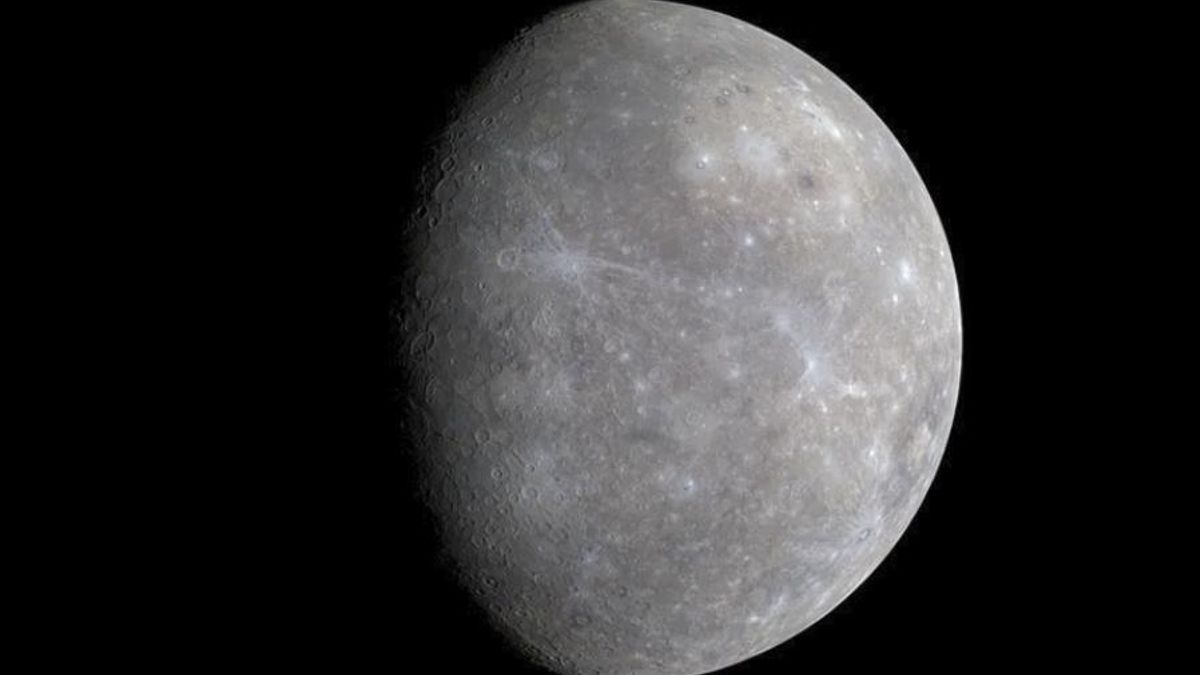
Mercury shrinking faster than previously calculated, study finds
Planetary scientists have discovered that Mercury is shrinking much faster than previously calculated, with a historical reduction in diameter of up to 23 kilometers. Led by Gaku Nishiyama of the German Aerospace Center (DLR), researchers used global surface roughness mapping to reveal that hundreds of contraction wrinkles remain hidden beneath impact craters, correcting previous volumetric estimates by up to 30 percent.
Uncovering Hidden Tectonic Structures Across Planetary Plains
Mercury has been steadily losing the intense internal heat generated during its formation roughly 4.5 billion years ago. As the interior cools, the planet reduces its volume, forcing the outer rocky shell to fracture, buckle, and form massive tectonic scarps and ridges. Previous estimates—largely derived from observations by NASA’s MESSENGER spacecraft between 2011 and 2015—suggested a total reduction in diameter ranging between 4 and 16 kilometers. However, those measurements struggled to account for regions heavily altered by subsequent asteroid impacts.
By comparing tectonic structures with a new global cartography of surface roughness, Nishiyama’s team found that less-altered smooth plains exhibited significantly more contraction wrinkles than heavily cratered regions. The study, published in Geophysical Research Letters, adjusts the historical global contraction upward by 10% to 30%. This correction brings observational data closer to theoretical physics models of planetary cooling.
“More encogimiento means that Mercury could have a larger metallic core, fewer light elements like silicon mixed in the metal core, or a higher initial temperature,” Nishiyama notes regarding the broader thermal evolution of the inner solar system’s smallest rocky world.
Deep Mantle Melting and Crustal Silicon Composition
The internal mechanics driving this contraction are closely tied to the planet’s mineralogy. In a separate recent study published in Planetary Research, researcher Christian Renggli utilized laboratory-calibrated infrared radiation models on tiny silicon glass beads to analyze Mercury’s surface composition in the absence of physical samples.
The analysis determined that silicon dioxide makes up roughly 37% of the crust’s mass, a figure up to 25% lower than earlier calculations. This lower silicon concentration indicates that volcanic rocks on the surface originate from material melted far deeper within the mantle than previously theorized.
While MESSENGER provided unprecedented global coverage before its intentional impact in 2015, its instruments were primarily optimized for features exceeding five kilometers in diameter. Smaller fractures and micro-scarps continue to evade complete inventory, suggesting that even the newly revised contraction estimates may represent a baseline rather than the absolute total reduction.
BepiColombo Prepares for High-Resolution Planetary Mapping
Further clarity on Mercury’s geological contraction depends on upcoming high-resolution observations. The joint European Space Agency (ESA) and Japan Aerospace Exploration Agency (JAXA) mission, BepiColombo, is currently journeying toward the innermost planet following the separation of its Transfer Module on September 3.
BepiColombo’s planned orbital insertion is scheduled for November 21, 2026, after which its two constituent science probes will separate. The mission’s intensive scientific phase is set to begin in April 2027. Researchers anticipate that the spacecraft’s advanced imaging systems will successfully identify smaller escarps, ridges, and craters that escaped MESSENGER’s cameras, offering a measurement of how much the planet has shrunk over billions of years.