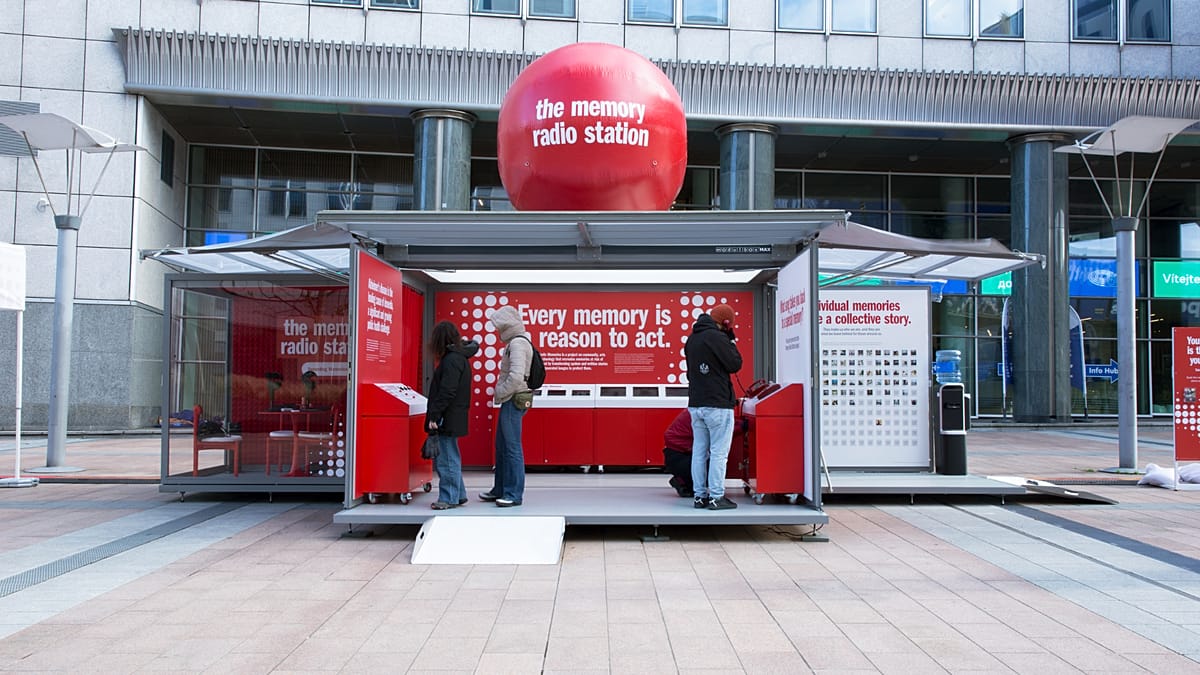
MEP Vautmans Opens AI Exhibition Reconstructing Memories to Boost Dementia Awareness
“That is something that hurts so much that you can barely describe it,” said Hilde Vautmans, a member of the European Parliament, recalling how her father eventually stopped recognizing her.
This week, she stood in Brussels before images generated from her own childhood memories — part of a traveling exhibition using artificial intelligence to reconstruct personal recollections and, its organizers hope, to push conversations about Alzheimer’s disease into public view.
- The Synthetic Memories project, developed by the Barcelona creative studio Domestic Data Streamers, uses generative AI to turn spoken memories into images as a support tool for reminiscence therapy in people living with dementia.
- The exhibition carrying the project across Europe, The Memory Radio Station, launched in partnership with pharmaceutical company Eli Lilly and is showing at the European Parliament in Brussels this November.
- More than 12 million people in Europe live with dementia today, a figure that could reach 20 million by 2050, and Alzheimer’s disease accounts for 60 to 80 percent of cases.
The exhibition invites visitors — with or without memory loss — to share spoken or written stories, which AI models translate into visual representations. In a one-hour session with a person experiencing memory loss, an interviewer and an AI prompter guide participants through their recollections before the generative models produce the images.
The project’s work with people living with dementia began in 2023 in nursing homes across Spain, alongside social workers and neurotherapists, including residents with Alzheimer’s and other forms of dementia.
Organizers are explicit about the clinical limits. Synthetic Memories does not claim to offer a cure; it positions itself as a tool that supports reminiscence therapy, a long-established approach that traditionally uses familiar objects, photographs and music to prompt people to recount and share experiences from their lives. Advocates of the method are now adding virtual reality, interactive platforms and artificial intelligence to make the interventions more personal.
Why Early Diagnosis Decides the Course
The therapeutic stakes extend beyond memory preservation. Researchers say an earlier diagnosis can bring people into treatment while the disease is still mild. Evidence shows that people with an early and accurate diagnosis achieve better psychosocial outcomes — less anxiety and greater independence — according to the Alzheimer’s Society in its latest report.
An early diagnosis also opens access to treatments and measures matched to a patient’s medical and care needs, and some therapies work best in the earliest stages of the disease.
Vautmans’s own family experience shows how often that window is missed. “For us, it took a long time. It was a real search, it was denial,” she told the radio station. “That’s not Alzheimer’s, that’s just stress, that’s just too much work. That’s how we all talk when we see someone forgetting things.”
Public knowledge gaps compound the delay. In a recent Europe-wide survey of 681 respondents across twelve countries, fewer than half knew that Alzheimer’s is the most common form of dementia, and many believed Alzheimer’s cannot be prevented and is simply a normal part of aging.
“Without sufficient knowledge, it is difficult to recognize the signs of the different dementia subtypes,” the survey’s authors wrote, adding that better public education could help people recognize symptoms and seek a diagnosis earlier.
There is no guaranteed way to prevent Alzheimer’s disease, but lifestyle factors — diet, exercise and smoking — influence the risk. That places the burden on recognition: families and clinicians who can distinguish early pathological memory decline from ordinary aging are the practical gateway to the specialists, and disease-modifying treatment now available in the mild stage.
For Vautmans, the session in Brussels reached back to her childhood in the Belgian city of Sint-Truiden, and to mornings at the livestock market with her father. “Those were wonderful moments with my father, when I could go to the market with him and was allowed to try to sell the cows and then put them on the scale to weigh them,” she told the radio station.
“This is an opportunity for encounter that shows what makes us unique as human beings — the power of our brain,” said Frederic Destrebecq, executive director of the European Brain Council, at the opening of the exhibition in Brussels.
The epidemiological backdrop gives the project its urgency. More than 12 million people in Europe currently live with dementia, and that number could climb to 20 million by 2050. Alzheimer’s disease, the most common form of dementia, involves a progressive decline in mental capacity — problems with remembering, thinking and communicating — and accounts for 60 to 80 percent of cases.
The funding behind the touring exhibition deserves scrutiny as much as its imagery does. The Memory Radio Station launched in partnership with Eli Lilly, the pharmaceutical company. The project itself, developed by Domestic Data Streamers, frames its images as memory aids rather than medical claims — a distinction that matters for families weighing whether the tool belongs in a care plan.
Where the Technology Meets the Clinic
Reminiscence therapy has decades of clinical use behind it, and the AI-augmented version does not replace the clinician in the room. The sessions run with social workers and neurotherapists, and the project’s own framing — a support tool, not a treatment — keeps it on the supportive-care side of dementia management, where non-pharmacological interventions sit alongside the drug therapies that work best early in the disease course.
What the exhibition changes is reach. By staging memory reconstruction in a public space — the European Parliament this month, with earlier stops across Europe — it targets the awareness gap that the survey identified as one of the chief barriers to early diagnosis. A visitor who recognizes a parent’s forgotten names as something more than stress has, in principle, a path to an earlier clinical conversation than the Vautmans family had.
Families confronting persistent memory loss in a relative can ask a primary care physician for a referral to a cognitive disorder specialist or memory assessment service, where formal diagnostic evaluation determines whether treatment should begin while the disease remains mild.
“That is something that hurts so much that you can barely describe it,” Vautmans told the radio station, describing the moment her father no longer recognized her.
Vautmans, born in 1972, has been a Member of the European Parliament since January 2015, representing the Dutch-speaking electoral college of Belgium for the party Anders, formerly Open Flemish Liberals and Democrats. Before entering European politics, she sat in the Belgian Chamber of Representatives from 2003 to 2010, chairing its Committee on Foreign Affairs, and earlier worked in the cabinet of Prime Minister Guy Verhofstadt, helping to legalise same-sex marriage in Belgium.
In Brussels, she sits on the Committee on Foreign Affairs and the Subcommittee on Security and Defence, and in September 2020 was elected President of the European Liberal Forum. In 2022, she received the Economic, Monetary Affairs, Tax and Budget Award at The Parliament Magazine’s annual MEP Awards.
Disclaimer: The information provided in this article is for educational and scientific communication purposes only and does not constitute medical advice. Always consult with a qualified healthcare provider regarding any medical condition, diagnosis, or treatment plan.