
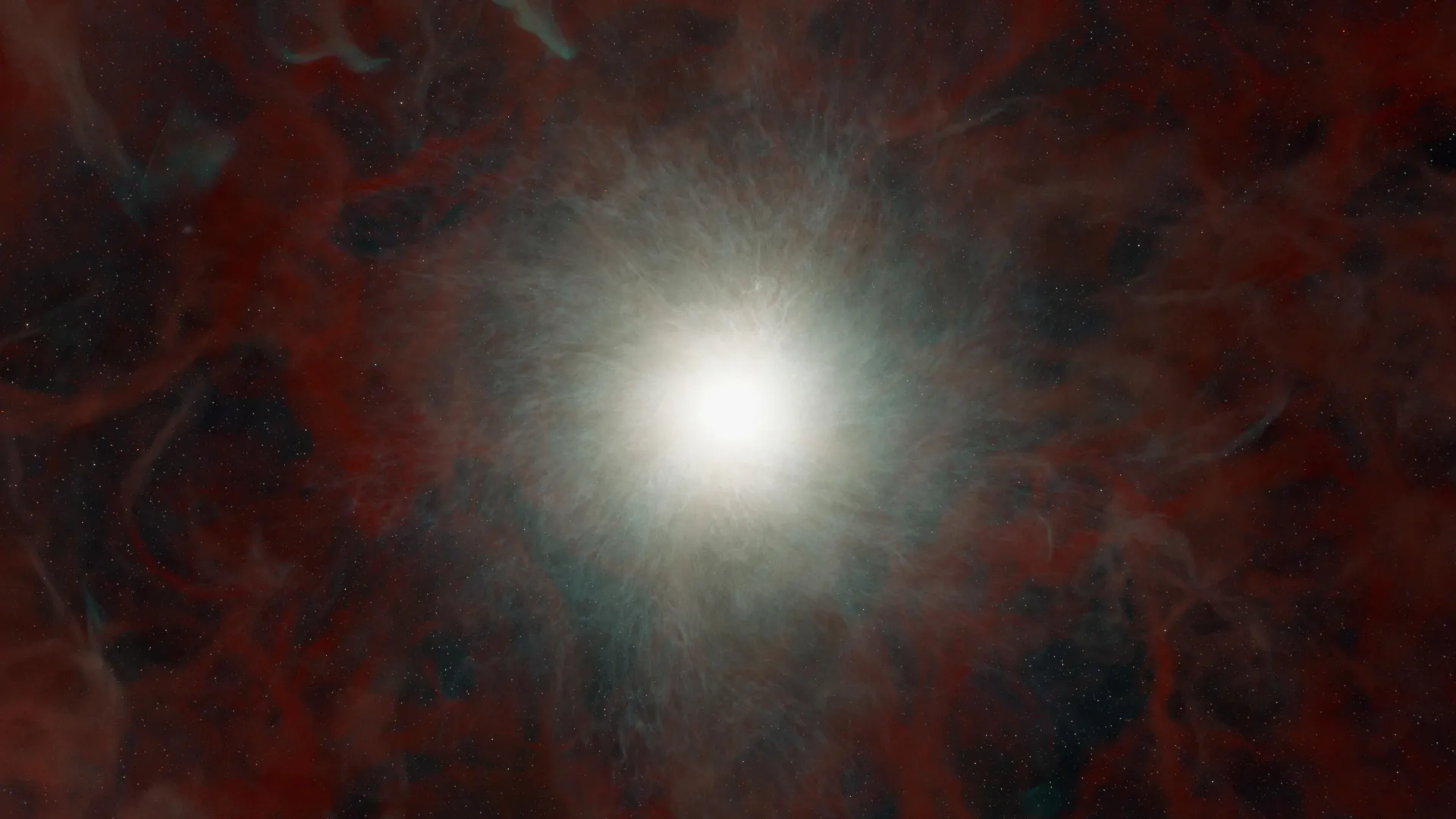
Astronomers have, for the first time, directly observed a massive star collapsing into a black hole without undergoing a supernova explosion. The event, occurring in the Andromeda Galaxy, provides an unprecedented opportunity to study the formation of stellar black holes and challenges existing theories about the deaths of massive stars.
The star, designated M31-2014-DS1, was located approximately 2.5 million light-years away. Researchers, led by Kishalay De of the Simons Foundation’s Flatiron Institute, analyzed data spanning from 2005 to 2023, collected by NASA’s NEOWISE mission and other ground and space-based telescopes. Their findings, published February 12 in the journal Science, detail a star that began brightening in infrared light in 2014 before experiencing a dramatic dimming in 2016.
By 2022 and 2023, M31-2014-DS1 had faded to one ten-thousandth of its original brightness in visible and near-infrared wavelengths. Currently, This proves only detectable in mid-infrared light, emitting roughly one-tenth of its initial intensity. “This star used to be one of the most luminous stars in the Andromeda Galaxy, and now it was nowhere to be seen,” said De. “Imagine if the star Betelgeuse suddenly disappeared. Everybody would lose their minds! The same kind of thing was happening with this star in the Andromeda Galaxy.”
The observed dimming strongly suggests the star’s core collapsed directly into a black hole, bypassing the typical supernova explosion. For decades, theoretical models have proposed that massive stars can sometimes collapse directly into black holes if the shock wave generated by the core collapse is insufficient to expel the surrounding material. This “fallback” scenario, where much of the star falls inward, had remained largely unobserved until now.
The research builds upon previous observations of another star, NGC 6946-BH1, identified as having undergone a similar process a decade ago. Reanalyzing both cases revealed the critical role of convection – the circulation of gas driven by temperature differences within the star – in determining the fate of the star’s outer layers.
According to models developed at the Flatiron Institute, convection prevents the outer material from immediately plunging into the newly formed black hole. Instead, the churning motion causes inner layers to orbit the black hole, while the outermost layers are gradually pushed outward. This expelled material cools and forms dust, which absorbs energy and re-emits it in infrared wavelengths, creating a lingering reddish glow that can persist for decades.
“The accretion rate – the rate of material falling in – is much slower than if the star imploded directly in,” explained Andrea Antoni, a research fellow at the Flatiron Institute and co-author of the study. “This convective material has angular momentum, so it circularizes around the black hole. Instead of taking months or a year to fall in, it’s taking decades. And due to the fact that of all this, it becomes a brighter source than it would be otherwise, and we observe a long delay in the dimming of the original star.”
Researchers estimate that only about one percent of the star’s original outer envelope ultimately contributes to the black hole, producing the faint infrared signal still detectable today. De stated, “This is just the beginning of the story,” adding that light from the surrounding dusty debris is expected to remain visible for decades, offering continued opportunities for observation with telescopes like the James Webb Space Telescope. He anticipates this event will serve as a benchmark for understanding stellar black hole formation throughout the universe.
The team’s findings suggest that direct collapse events, previously considered rare, may be more common than previously thought, contributing to a broader understanding of how black holes are born.
