
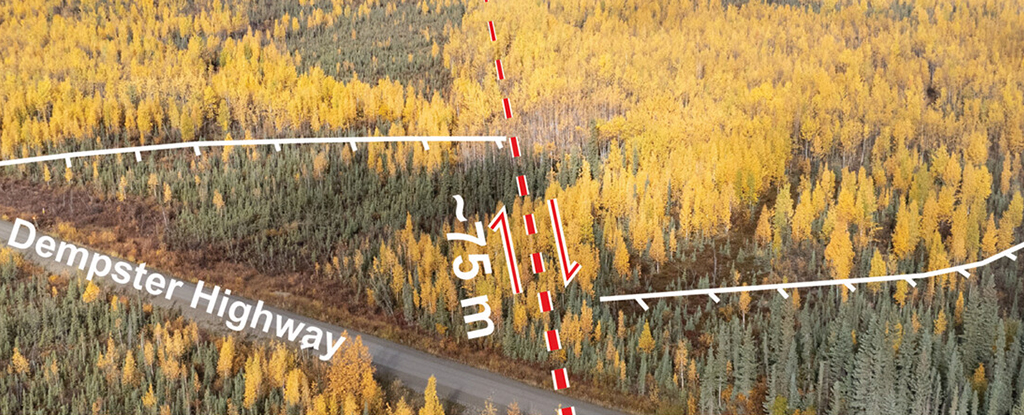
A meaningful geological fault line in Canada, known as the Tintina fault, might potentially be on the verge of a major seismic event, according to new research. While previously thought to be relatively inactive, a recent study utilizing advanced satellite imagery and LIDAR technology has revealed evidence of prehistoric earthquakes, suggesting a substantial build-up of strain.
Geologists have re-examined the Tintina fault, which runs near Dawson City, Yukon, after detecting minor tremors in recent decades. These smaller quakes did not indicate the fault’s capacity for large ruptures.However, the application of high-resolution data, including LIDAR, allowed researchers to identify subtle surface ruptures and fault scarps that are typically hidden by the region’s dense forests.These findings point to past seismic activity, but crucially, there’s a notable absence of major slips in the more recent geological past. Calculations suggest that the fault should have moved approximately 6 meters (nearly 20 feet) over this period, but it hasn’t. This lack of movement indicates a significant accumulation of pressure.
When this pent-up energy is eventually released, it could trigger an earthquake exceeding magnitude 7.5 on the Richter scale. The researchers have highlighted the Tintina fault as a previously underestimated seismic hazard for the region. They note that if over 12,000 years have passed since the last major earthquake, the fault could be in an advanced stage of strain accumulation.
While the area is not densely populated, the potential impact on communities like Dawson City, with its 1,600 residents, and also on infrastructure and ecosystems, is a serious concern. The study’s authors are calling for further investigations into the Tintina fault and similar geological structures. Gathering more data on ancient seismic activity will improve the accuracy of computer models used to predict future earthquakes.
The researchers emphasize the need for more paleoseismic studies to determine the frequency of past earthquakes and to understand if slip rates have changed over time due to shifts in tectonic forces or glacial rebound.This research has been published in the journal Geophysical Research Letters.
