
Lightsail Breakthrough: New Tech Could Slash Interstellar travel Time
Researchers at Brown University and Delft University of Technology (TU Delft) have unveiled a revolutionary lightsail design that could dramatically reduce the time it takes to reach distant star systems. This breakthrough, announced on March 27, 2025, brings interstellar travel closer to reality than ever before.
By world-Today-News.com Expert Journalism Team | Published: March 28, 2025
the Interstellar Challenge
Space exploration faces a fundamental hurdle: the vast distances between stars. Even NASA’s Voyager 1,one of our fastest spacecraft,would take tens of thousands of years to reach Alpha Centauri,the nearest star system. To truly explore beyond our solar system, we need propulsion systems that can achieve far greater speeds.
Lightsails offer a promising solution. These ultra-thin, highly reflective membranes use the momentum of photons – light particles – to propel spacecraft. Imagine a sailboat using the wind, but instead of wind, it’s harnessing the power of lasers or even the sun itself.
This technology could possibly reduce interstellar travel times from millennia to mere decades, opening up unprecedented opportunities for exploration and discovery [[3]].
A New Dawn for Lightsails
The collaborative research team from brown University and TU Delft has achieved a notable milestone in lightsail technology. Their new design and fabrication method, detailed in a recent study, focuses on creating ultra-thin, ultra-reflective membranes capable of withstanding the rigors of space travel [[1]].
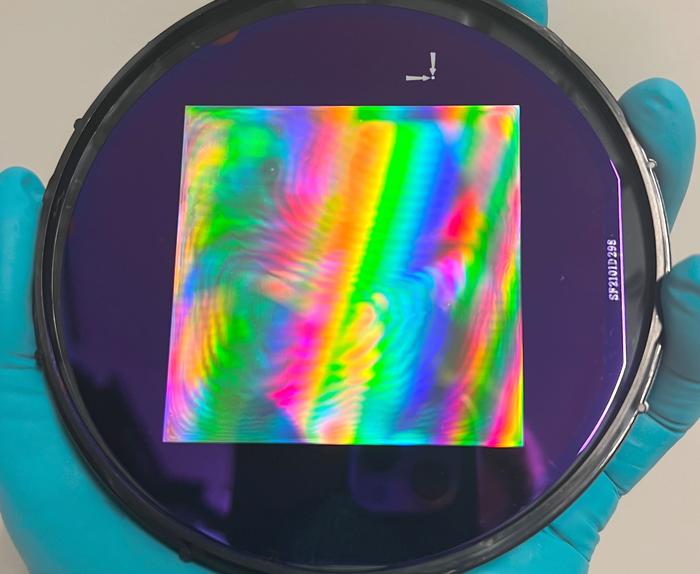
The prototype lightsail measures just 60 millimeters by 60 millimeters, yet it’s a mere 200 nanometers thick – thinner than a strand of human hair.This extreme thinness is crucial for maximizing acceleration.
To further enhance performance, the lightsail’s surface is meticulously patterned with billions of nanoscale holes. These strategically placed holes reduce the sail’s weight while concurrently increasing its reflectivity. Think of it as an exercise in extreme engineering, optimizing every square nanometer for peak efficiency.
AI and Advanced Materials: A Winning Combination
The team chose single-layer silicon nitride for the lightsail’s construction,a material prized for its lightweight nature and extraordinary durability in the harsh environment of space. Silicon nitride is already used in various applications, from high-performance engine components to microelectronics, showcasing its versatility and resilience.
Balancing reflectivity and weight was a key challenge. Higher reflectivity translates to greater thrust, while lower mass enhances acceleration.To navigate this complex trade-off, the researchers turned to artificial intelligence (AI) and machine learning.
The AI algorithm optimized the shape and placement of the nanoscale holes, meticulously fine-tuning the design to achieve the perfect balance between weight reduction and reflectivity. this AI-driven approach represents a paradigm shift in materials science, allowing researchers to explore design possibilities far beyond human intuition.
Revolutionizing Lightsail Manufacturing
Conventional nanofabrication techniques are frequently enough expensive and time-consuming. some designs can take over a decade to produce, making them impractical for large-scale deployment. The TU Delft team overcame this hurdle by developing a groundbreaking gas-based etching technique.
This innovative method allows for rapid and cost-effective manufacturing of lightsail membranes. What onc took years can now be accomplished in a single day, at a fraction of the cost. This scalability is essential for realizing the vision of interstellar travel.
The resulting lightsails exhibit remarkable durability,a critical factor for long-duration space missions. By combining advanced fabrication techniques with AI-driven optimization, the researchers have created a lightsail with an unprecedented aspect ratio – centimeter-scale dimensions with nanoscale thickness.
Toward Interstellar Shores
this research has profound implications, aligning with the goals of the aspiring Starshot Breakthrough Initiative. Founded by entrepreneur Yuri Milner and the late physicist Stephen Hawking,Starshot aims to deploy meter-scale lightsails propelled by ground-based laser arrays,carrying microchip-sized spacecraft on interstellar voyages.
The Brown and TU Delft team’s design could be scaled up for use in these missions, potentially revolutionizing our approach to interstellar exploration. The scalability of their fabrication process makes large-scale production feasible, bringing the dream of reaching other stars within our grasp.
“The lightsail will travel faster than any previous spacecraft,with potential to eventually open interstellar distances to direct spacecraft exploration that are now only accessible by remote observation,” explains Harry Atwater,the Otis Booth Leadership Chair of the Division of Engineering and Applied Science and the Howard Hughes Professor at Caltech [[2]].
Consider the implications for the U.S. space program. A accomplished lightsail program could revitalize American leadership in space exploration, inspiring a new generation of scientists and engineers. It could also lead to breakthroughs in related fields, such as laser technology, materials science, and artificial intelligence, boosting the U.S. economy and creating new jobs.
Addressing the Challenges Ahead
While this lightsail breakthrough is significant, challenges remain. One potential counterargument is the immense power required to propel lightsails to interstellar speeds. Ground-based laser arrays would need to be incredibly powerful and precisely aimed, requiring significant infrastructure investment.
Another challenge is protecting the lightsails from space debris and radiation. The harsh environment of space could degrade the sail’s performance over time,requiring robust shielding and self-repair mechanisms.
Despite these challenges, the potential rewards of interstellar travel are too great to ignore.With continued research and development, lightsails could unlock a new era of space exploration, allowing us to study exoplanets, search for extraterrestrial life, and expand our understanding of the universe.
the Future is Shining
The development of this highly efficient, cost-effective, and scalable lightsail represents a major step forward in interstellar propulsion. By leveraging AI-driven design, cutting-edge materials, and innovative fabrication techniques, researchers are paving the way for humanity to venture beyond our solar system.
As the United States looks to the future of space exploration,lightsail technology offers a compelling vision of what’s possible. With continued investment and innovation, we can unlock the secrets of the universe and secure our place among the stars.
