
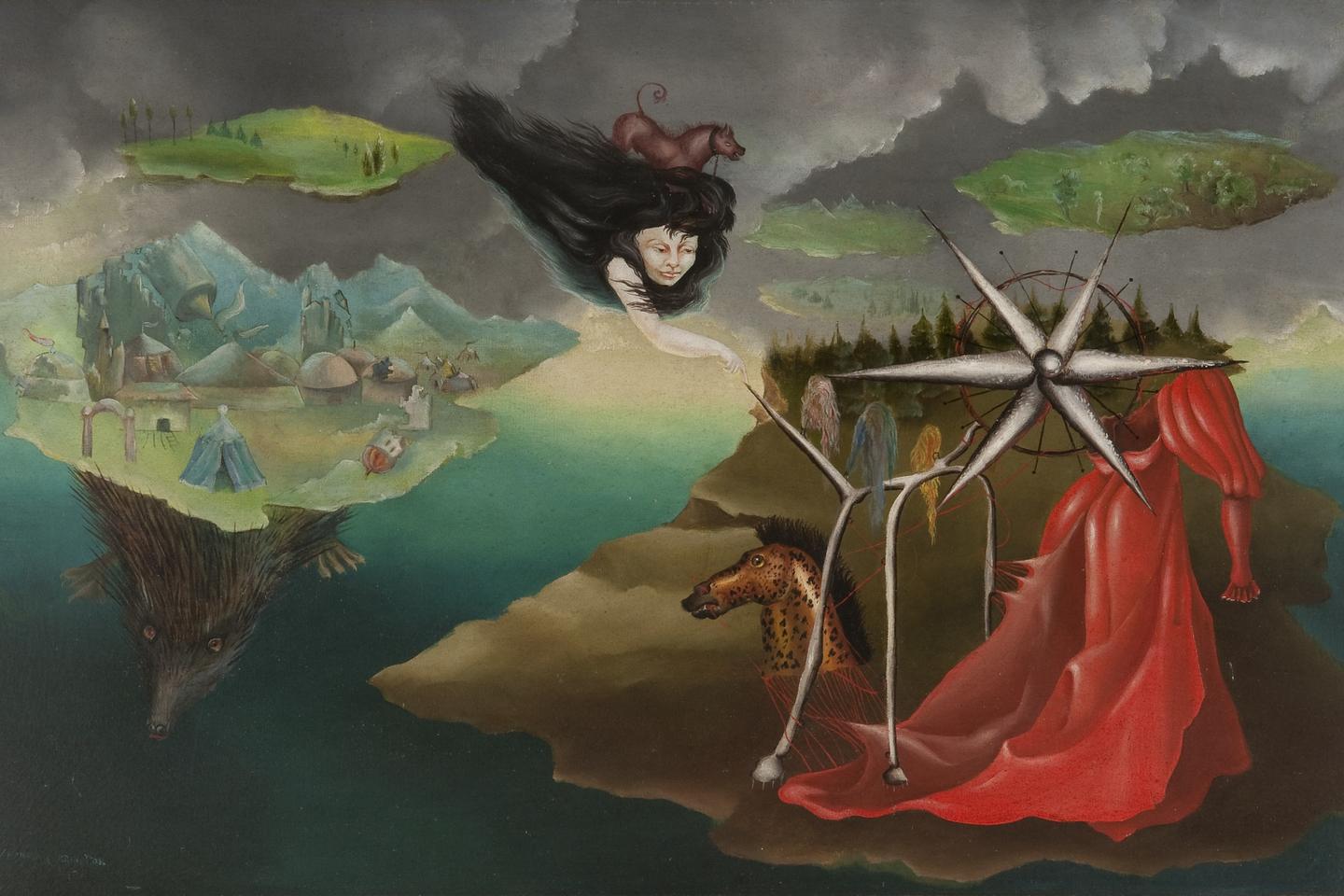
A major retrospective of the work of British-born Surrealist painter Leonora Carrington opened this week at the Musée du Luxembourg in Paris. The exhibition, the first of its scale in France, brings together over one hundred works and documents, offering a comprehensive look at an artist whose recognition has grown significantly in recent years.
For decades, Carrington (1917-2011) was often viewed through the lens of her early relationship with fellow Surrealist Max Ernst, whom she met in London in 1937. While acknowledging this period in her life, the exhibition aims to establish Carrington as a significant artist in her own right, one who continued to paint, draw, and write for over half a century after her time with Ernst. Her work gained renewed attention in 2022 when the Venice Biennale took its title, “The Milk of Dreams,” from one of Carrington’s books of stories and drawings, and included several of her paintings.
The Paris exhibition showcases a number of lesser-known pieces, though This proves not a complete retrospective. Several key works are absent, including “The Inn of the Dawn Horse” (1937-1938), currently held by the Metropolitan Museum of Art in New York, and “Summer” (1942), which resides in the Tel Aviv Museum of Art. Notably missing is “Dagobert’s Distractions” (1945), which fetched $28.5 million (24 million euros) at auction in 2024, purchased by an Argentinian collector.
The growing interest in Carrington’s work is reflected not only in rising auction prices but also, unfortunately, in an increase in forgeries. This surge in attention underscores the need for careful authentication and scholarship surrounding her oeuvre, as highlighted by Christie’s in a recent assessment of the art market.
The exhibition at the Musée du Luxembourg arrives as Carrington’s reputation continues its ascent, a trajectory confirmed by both the art market and critical reappraisal, as evidenced by a recent review in FRAC Corsica, where Carrington’s work was described as leading a “chimérique dance.”
