Laser-Powered Drones: New Technology for Mid-Air Charging
Researchers at the Civil Aviation University of China in Tianjin and Tsinghua University in Pekín developed a prototype receiver that converts a green laser into electricity, offering a potential solution to the short battery life limiting modern drone inspections, rescue missions, and long-distance cargo delivery.
Overcoming the Battery Barrier in Modern Aviation
Battery limitations dictate the operational limits of contemporary unmanned aerial vehicles. Most commercial platforms remain airborne for less than an hour before operators must land them to recharge or swap power cells. This constraint heavily impacts critical infrastructure inspections, search and rescue operations over wide geographical expanses, and commercial cargo delivery routes.
According to findings published on July 29 in the journal Matter & Light, a research team led by Civil Aviation University of China associate professor Jianhua Han tackled this endurance problem using a targeted laser energy transmission system. Instead of carrying heavy energy reserves onboard, an aircraft could theoretically receive continuous power from a remote transmitter located on the ground or aboard a secondary vehicle.
How Laser Energy Transformation Works in Lab Tests
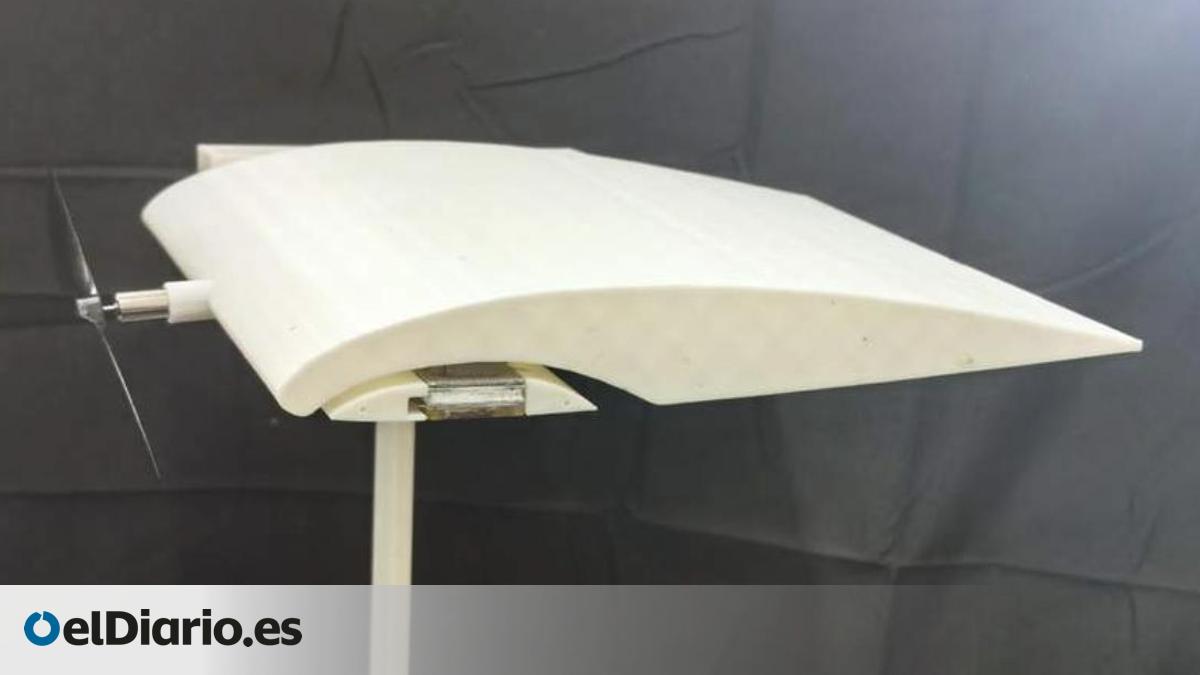
In laboratory demonstrations, the engineering team tested a receiver occupying just two square centimeters with an active area of 12 square millimeters. The device was compact enough to mount beneath the wing of a fixed-wing model without hindering its motor functionality.
The receiver’s top layer consists of a cesium lead bromide perovskite material. This substance exhibits high optical absorption while requiring less complex, more affordable manufacturing than traditional photovoltaic options. Designed explicitly to capture laser light rather than broad solar radiation, the perovskite converts incoming photons into an electrical current.
That current passes through a carbon electrode before reaching a thermoelectric component, which generates additional electricity from the thermal gradient between its opposing faces. Because the electrode also converts unused optical energy into waste heat, the receiver can reach temperatures of 85.3 degrees Celsius and lose efficiency under intense illumination. To protect the active layer, the research group incorporated antimony selenide nanobars measuring between 50 and 80 nanometers. Their low thermal conductivity successfully curbs heat transfer, minimizes material defects, and smooths electrical charge movement.
Aerodynamic Cooling and Bench Test Results
Managing internal thermal buildup proved vital for moving the technology out of the laboratory. The research team integrated open internal channels within the wing structure to direct ambient airflow across the cold face of the thermoelectric component.
Simulations confirmed that this aerodynamic design improved heat evacuation while simultaneously increasing lift and reducing aerodynamic drag. During comparative bench testing, a conventional photovoltaic cell achieved 5,260 revolutions per minute on a model propeller, whereas the new configuration incorporating the thermoelectric generator reached 7,660 revolutions per minute.
In initial bench trials, a propeller mounted on a 3D-printed wing remained stationary until a green laser struck the receiver positioned underneath. The propeller began spinning roughly five seconds later, climbing from approximately 1,200 to 1,450 revolutions per minute. The movement sustained itself for nearly a minute before power output dropped. A separate laboratory test pushed a 6.7-centimeter propeller up to 7,820 revolutions per minute with an energy conversion efficiency of 38.49 percent.
Safety, Scaling, and Integration Challenges Ahead
Despite promising bench metrics, current trials remain strictly tethered to controlled laboratory settings. Natural wind patterns, ambient temperature fluctuations, solar interference, and physical vibrations can all disrupt system performance outside a controlled room. Furthermore, keeping a tight laser beam aligned with a tiny receiver on a moving aircraft presents a formidable tracking challenge.
Outdoor tests involving a lightweight drone will also need to address safety concerns regarding accidental laser exposure to civilian aircraft or ground-based wildlife and humans. Independent engineering groups are currently developing automated tracking architectures and millisecond emergency shut-off protocols to cut the beam if an obstruction enters the line of sight.
Municipal authorities and commercial operators watching these developments understand that integrating laser-beamed energy transmission into public airspace will require rigorous oversight.
As research teams transition from static bench models to dynamic outdoor flight tests, the prospect of perpetual aerial persistence draws closer to reality. Yet bridging the gap between a controlled laboratory laser and a fully self-sustained drone staying aloft indefinitely will demand rigorous advancements in optical tracking, atmospheric stability, and safety interlocks.