
Hubble Reveals the largest Protoplanetary Disk Ever Observed: A “cosmic Sandwich” Giving Birth too Planets
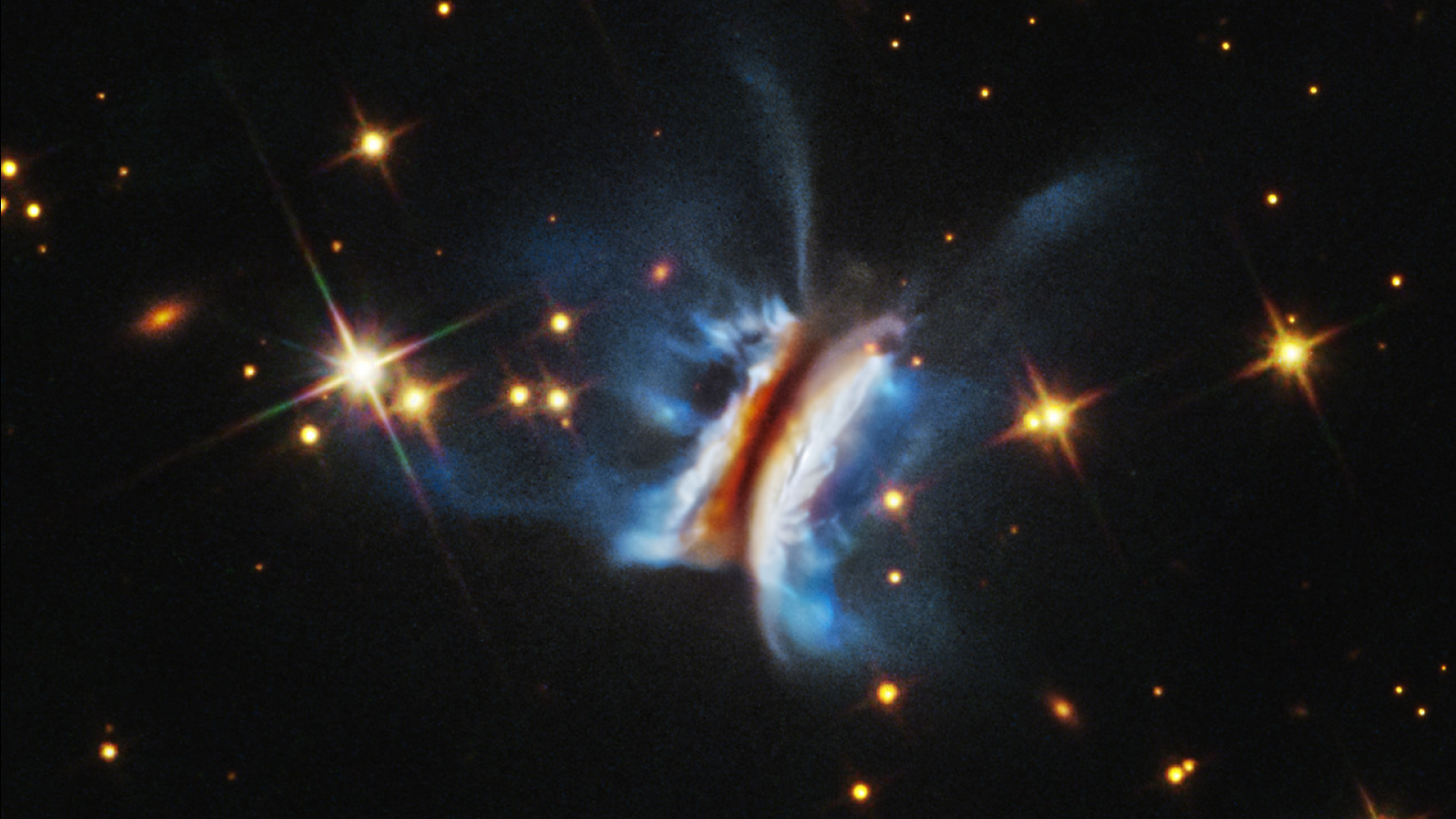
January 12, 2026 – In a groundbreaking finding, the Hubble Space Telescope has unveiled the largest and most unusual protoplanetary disk ever observed, orbiting a single star designated IRAS 23077+6707. Nicknamed “Dracula’s Chivito” due to its sandwich-like appearance and the international collaboration of its discoverers, this colossal disk offers unprecedented insights into the chaotic processes of planet formation.
A Protoplanetary Disk Unlike Any Other
Protoplanetary disks are swirling clouds of gas and dust that surround young stars, acting as the birthing grounds for planets. Thes disks provide the raw materials for both rocky planets like Earth and gas giants like Jupiter. IRAS 23077+6707, located 978 light-years away in the constellation Cepheus, stands out due to its immense size and peculiar structure. Astronomers estimate the disk spans a staggering 400 billion miles (640 billion kilometers), exceeding the diameter of our own solar system by more than 100 times according to research published in The Astrophysical Journal.
The name ”Dracula’s Chivito” is a playful nod to the diverse origins of the research team – scientists from Transylvania, Romania, and Uruguay, the latter being the origin of the “chivito,” a popular sandwich filled with sliced beef, ham, mozzarella, tomatoes, and olives, mirroring the layered structure of the disk.
Unveiling the Chaotic Nature of Planet Formation
What truly sets IRAS 23077+6707 apart is its asymmetry and chaotic structure. Unlike many protoplanetary disks, which appear relatively symmetrical, this disk exhibits striking differences between its two sides. Luminous, vertically stretched filaments of gas erupt from one side, while the opposite side features a sharp, well-defined edge. This unexpected morphology has surprised astronomers and is forcing a reevaluation of current planet formation theories.
“The level of detail we’re seeing is rare in protoplanetary disk imaging,” explains Kristina Monsch, an astronomer at the Harvard and Smithsonian Center for Astrophysics (cfa) and lead author of the study, in a NASA statement. “These new Hubble images show that planet nurseries can be much more active and chaotic than we expected.”
The Role of a Central Star (or Stars)
Scientists believe a hot, massive star, or potentially a binary star system, resides at the center of this enormous disk. The intense radiation and gravitational forces from the central star(s) sculpt the surrounding material, driving the observed asymmetry and chaotic features. The bright filaments are thought to be material being ejected and sculpted by the star’s radiation, while the sharp edge on the opposite side may be due to the influence of an unseen companion or a especially dense region of the disk.
Co-investigator Joshua Bennett lovell, also from the CfA, adds, “We were stunned to see how asymmetric this disk is. hubble has given us a front row seat to the chaotic processes that are shaping disks as they build new planets—processes that we don’t yet fully understand but can now study in a whole new way.”
Implications for Understanding Planetary systems
The discovery of IRAS 23077+6707 challenges our understanding of how planetary systems evolve. The sheer scale of the disk suggests that it could potentially host a vast array of planets, far exceeding the number found in our solar system. However, the chaotic environment also implies that planet formation may be a more turbulent and unpredictable process than previously thought.
Studying this unique protoplanetary disk provides a valuable prospect to observe planet formation in action.By analyzing the distribution of gas and dust within the disk, astronomers can gain insights into the conditions necessary for planet formation and the factors that influence planetary system architecture. Further observations with Hubble and the James Webb Space Telescope will undoubtedly reveal even more secrets about this remarkable cosmic structure.
Key Takeaways
- IRAS 23077+6707 is the largest protoplanetary disk ever observed, spanning over 100 times the diameter of our solar system.
- Its unique asymmetry and chaotic features challenge existing theories of planet formation.
- The disk likely contains a massive star or binary star system at its center, driving the observed structures.
- This discovery provides a crucial opportunity to study planet formation in a dynamic and extreme environment.
The unveiling of “Dracula’s Chivito” is a testament to the power of the Hubble Space Telescope and a important step forward in our quest to understand the origins of planets and the diversity of planetary systems in the universe.
