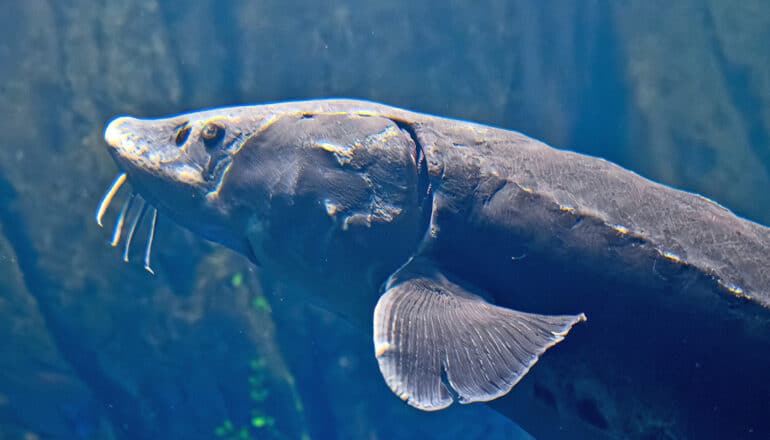
Lake Sturgeon Can Live Up to 300 Years, Research Finds
Recent longitudinal research published by Michigan State University indicates that lake sturgeon may possess a biological lifespan reaching nearly 300 years, significantly exceeding previous scientific estimates. This analysis, supported by the Michigan Department of Natural Resources, suggests that individual fish currently inhabiting the Great Lakes may have already been alive when the Declaration of Independence was signed in 1776.
- Advanced mathematical modeling confirms that lake sturgeon growth patterns allow for a lifespan extending well beyond 200 years.
- Traditional age-estimation methods, such as counting growth rings in fin spines, often underestimate the longevity of older specimens because those rings become increasingly difficult to interpret in older fish.
- The findings underscore the necessity of multi-decadal monitoring programs to accurately assess population recovery and habitat sustainability for long-lived species.
Biological Mechanisms of Extreme Longevity
For decades, fisheries biologists relied on the interpretation of growth rings found within the fin spines of sturgeon to determine age. However, as these fish reach advanced maturity, the internal structure of the spine often becomes obscured, leading to a systematic underestimation of age. To address this gap in data, researchers led by Scott Colborne, an assistant professor in the Michigan State University fisheries and wildlife department, utilized a robust longitudinal dataset. By analyzing iterative growth measurements from tagged individuals, the team applied complex mathematical models similar to those used to estimate the age of Greenland sharks.
The lake sturgeon exhibits a life history strategy characterized by slow maturation and infrequent reproductive cycles, necessitating a long-term view of population dynamics.
Integration of Traditional Ecological Knowledge
The study’s findings align with observations held by Indigenous communities for generations. During the research process, investigators noted that some tribal community members had long believed that lake sturgeon could live for as long as 400 years. This convergence of modern quantitative analysis and traditional knowledge provides a more comprehensive understanding of the species’ potential. The validation of these indigenous insights through rigorous methodology emphasizes the value of cross-disciplinary collaboration in ecological science.
Implications for Population Recovery and Conservation
The discovery that lake sturgeon live significantly longer than previously documented has immediate implications for conservation policy. Because these fish mature slowly, reproduce infrequently, and can take decades to replace themselves, the impact of historical overharvesting or habitat degradation is magnified.
The research, which was funded by a State Wildlife Grant awarded through the Michigan Department of Natural Resources, highlights the critical role of sustained data collection. Without the decades of tagging and monitoring efforts conducted by tribal nations, university researchers, and state partners, the statistical models required to confirm this longevity would not have been possible.
Future Directions in Age-Estimation Research
The methodology developed by Colborne and his colleagues may prompt a broader re-evaluation of age-estimation protocols for other long-lived fish species. The resilience shown by these fish over millions of years suggests that, when provided with stable environmental conditions, they possess an inherent capacity for survival that remains a primary subject of ongoing biological inquiry.

Ensuring that conservation efforts are backed by accurate, long-term empirical data is the only way to safeguard such ancient, resilient connections to the natural history of North America.
Disclaimer: The information provided in this article is for educational and scientific communication purposes only and does not constitute medical advice. Always consult with a qualified healthcare provider regarding any medical condition, diagnosis, or treatment plan.