
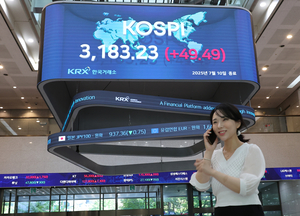
South Korean Stocks Surge Past $2 Trillion
Kospi rally fuels market capitalization growth; rate cut still on the table.
South Korea’s stock market capitalization exceeded 3,000 trillion won for the first time on Thursday, propelled by a strong rally in the Kospi index, even as the central bank held steady on interest rates.
Kospi’s Record-Breaking Performance
The total market capitalization of stocks listed on the local bourse reached 3,020.8 trillion won. The Kospi accounted for 2,603.7 trillion won of this, with the Kosdaq at 413.9 trillion won and Konex at 3.2 trillion won.
In recent months, the Kospi has seen substantial growth, increasing by over 600 trillion won from approximately 1,963 trillion at the close of 2024. The Kospi closed at 3,183.23, a rise of 49.49 points, or 1.58 percent, surpassing the previous year-high of 3,133.74. This marks the first time the Kospi has closed above 3,180 since September 2021.
Foreign investors and institutional investors bought shares worth 445.8 billion won and 41.6 billion won, respectively, while retail investors sold 560 billion won worth of shares.
Market Optimism Amidst Trade Tensions
According to Kim Ji-won, an analyst at KB Securities, “While US President Donald Trump continues to exert pressure through tariffs, the market placed more weight on the possibility of a trade deal.”
Kim added, “The Korean government’s policy momentum continues. Expectations for a boost in undervalued stocks have been steadily growing, as measures such as mandatory treasury share cancellations and separate taxation on dividend income are being pushed forward faster than anticipated, aimed at enhancing shareholder value.”
Investor sentiment is also buoyed by anticipation of relaxed monetary policy. Even though the Bank of Korea (BOK) maintained its base rate at 2.5 percent on Thursday, there remains a prevailing expectation for a future rate cut. As a comparison, the U.S. Federal Reserve also held interest rates steady in June 2025, but projections suggest a possible rate cut later in the year (Federal Reserve).
Bank of Korea’s Balancing Act
BOK Gov. Rhee Chang-yong stated at a press conference that “The rate freeze is necessary to temper excessive expectations for a rate cut.”
The decision to freeze the rate was also influenced by concerns over rising household debt amid a recovering property market.
“Housing prices, especially in the Seoul metropolitan area, are rising faster than they did in August last year,”
said Rhee.
Rhee emphasized, “The policy priority lies in stabilizing market expectations and managing household loans to prevent a rise in housing prices.”
Rhee further indicated that four out of six members of the Monetary Policy Board, excluding himself, were open to a potential rate cut within the next three months. The views of the other two members were more cautious, and Rhee’s personal stance was not revealed.
Since October, the central bank has alternated between rate cuts and holds, reducing the policy rate by a cumulative 1 percentage point to stimulate the sluggish economy.
Ahn Ye-ha, an analyst at Kiwoom Securities, noted, “While financial stability must be prioritized, at the same time, stimulus policies remain necessary due to the low-growth environment.”
Ahn also suggested that “While the rate cut could be delayed until October as the BOK assesses the impact of the real estate policies, the possibility of a rate cut in August remains high, provided the low-growth trend does not change significantly.”
