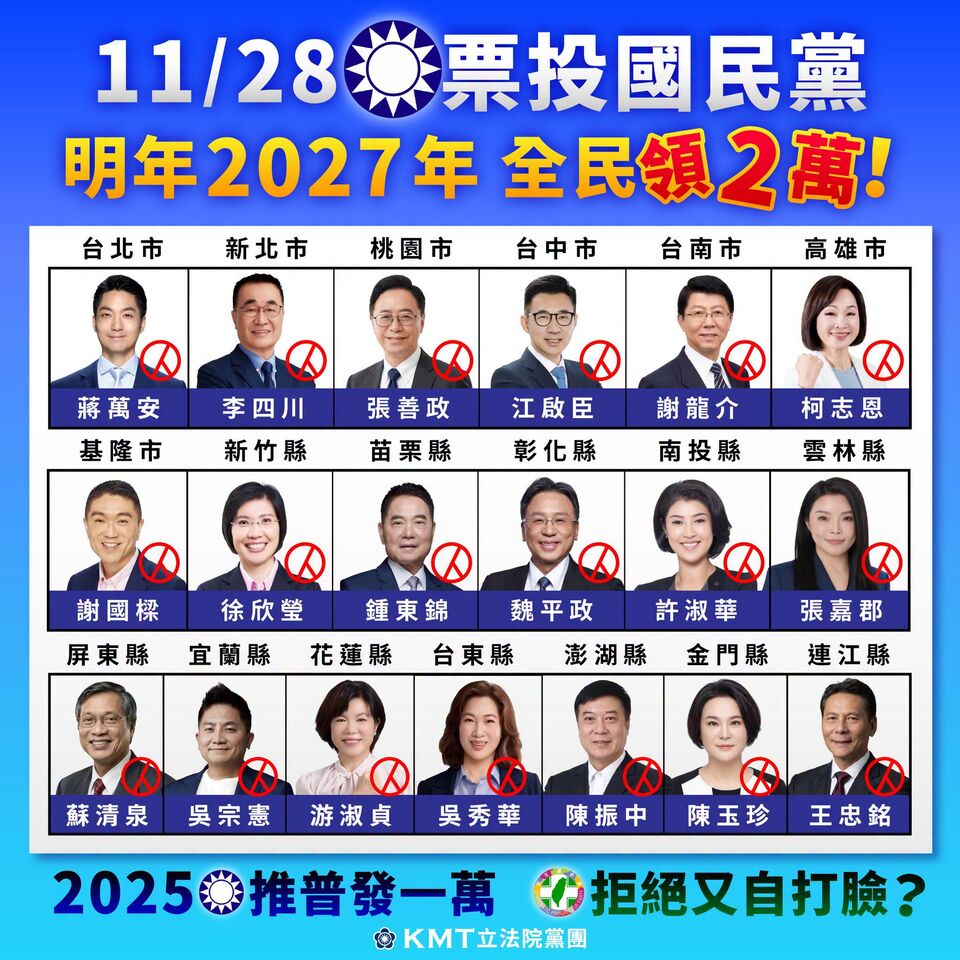
KMT NT$20,000 Cash Plan Collapses as TPP Refuses Support
Taiwan’s opposition plan to pay every citizen NT$20,000 in cash collapsed in cross-party talks at the Legislative Yuan on Friday, after the Taiwan People’s Party caucus declared it would vote the bill down.
Legislative Speaker Han Kuo-yu convened the negotiation between caucuses on Friday morning in Taipei, 聯合新聞網 reported. The Kuomintang caucus had pushed its “Special Act on Sharing Economic Achievements and Stabilizing People’s Livelihoods” — doubling President Lai Ching-te’s promised NT$10,000 payout — toward a third and final reading before the November 28 local elections.
With the TPP refusing, 聯合新聞網 reported that the KMT is unlikely to force the vote through before Friday’s balloting.
“Today’s red envelope must not become the next generation’s bill,” Chen Ching-lung, the TPP caucus convener, said at the negotiation. “Distributing cash through borrowing is unfair to the young generation and irresponsible.”
Why the money math broke down
The dispute turns on how much of this year’s tax windfall the central government can actually spend. Hsu Yu-chen, the KMT caucus secretary-general, argued central tax revenue collected through the end of October reached NT$2.8579 trillion — NT$790.7 billion above the budget target — and that full-year over-collection could approach NT$1 trillion. On her arithmetic, the roughly NT$470 billion cost of the NT$20,000 payout could be covered without borrowing.

Finance Minister Chuang Tsui-yun, attending the same negotiation, gave a different ledger. Through the end of October, national tax revenue ran about NT$840 billion above the same period last year, but nearly NT$470 billion of that increase went to local governments under the revised financial allocation law, leaving the center with about NT$390 billion in added revenue, she said, according to 聯合新聞網.
Audited, unallocated central surplus stands at just NT$85.7 billion — leaving a gap of roughly NT$385.7 billion that would have to be borrowed.
DPP caucus whip Chuang Jui-hsiung pressed the same point: rising national tax totals cannot all be treated as money the central government controls. He also questioned the timing. With eight days left before the elections, he said, opposition parties’ repeated red-envelope pledges looked electoral, and he called for a national fiscal policy conference instead, 聯合新聞網 reported.
How the standoff built, date by date
August 17 — President Lai Ching-te announced the government would pay every citizen NT$10,000 from next year’s central budget, on a balanced-revenue, effectively no-borrowing basis, 自由時報 reported.
October 16 — The KMT caucus responded by proposing NT$20,000 per person. Using its majority with the TPP, the chamber voted to send the special act straight to second reading, bypassing committee review, and assigned the KMT caucus to lead cross-party negotiations, 自由時報 reported.

November 17-18 — Negotiations produced no consensus on the payout or on the Executive Yuan’s supplementary budget, which includes NT$101.431 billion for CPC Corporation, NT$71.104 billion for Taipower and NT$233.834 billion in CPC capital injections, 經濟日報 reported.
On November 18, Lai — speaking at a Democratic Progressive Party Central Standing Committee meeting — warned that forcing the special act through raised constitutional concerns, since the Constitution and the Budget Act bar the legislature from proposing spending increases without identifying funding, 台視新聞網 and FTNN reported.
November 20 — Han convened the final negotiation. The TPP caucus announced it would vote as a bloc against the KMT bill. Chen said the party supports sharing AI-driven economic gains but on three conditions: fiscal discipline, no borrowing, and legal procedure.
The party has proposed amending the Budget Act so surplus-revenue rebates become institutionalized “rather than the ruling party’s momentary favor,” Chen said, according to Yahoo News. Han ruled that with no consensus reached, the bill would proceed under normal floor procedure.
What Friday’s floor fight decides
Friday’s session was set to take up both the supplementary budget and the special act. The KMT could still call a vote using its numbers, but 聯合新聞網 reported the party does not expect to complete the third reading before the November 28 elections — leaving the payout, in any form, unresolved until after voters go to the polls.

The economics behind the fight are real. Taiwan’s economy grew 4.59 percent and 8.76 percent over the past two years, with the Directorate-General of Budget, Accounting and Statistics forecasting 11.05 percent growth this year, Yahoo News reported. Roughly 70 percent of salaried employees earned below the average wage in the first half of this year — the figure Hsu cited to argue the payout would ease living pressure, 聯合新聞網 reported.
An analysis published by ETtoday noted a NT$20,000 payment to Taiwan’s roughly 23 million people runs about NT$460 billion before administrative costs, and argued that without a clear funding source, one-off cash payments risk crowding out long-term spending on defense, energy and an aging society.
The Executive Yuan has separately estimated that welfare bills passed recently in the chamber — free health insurance for seniors, higher farm and pension allowances — add about NT$600 billion in new obligations, the analysis in Liberty Times’ opinion section noted.
The Taiwan People’s Party, founded on 6 August 2019 by Ko Wen-je, styles itself as a “third” alternative to both the Democratic Progressive Party and the Kuomintang, and it has often said it wants to push both camps aside so “the people can be in the center.”
Its Chinese-language name echoes the Taiwanese People Party of colonial-era activist Chiang Wei-shui, a resemblance that drew objections from the Chiang Wei-shui Cultural Foundation. After winning five at-large seats in the 2020 legislative election, the party took eight in 2024 — its best result yet, denying both major parties a legislative majority.
For now, the next dated decision sits with the chamber itself. As Han Kuo-yu put it in closing the negotiation: “The caucuses and the executive branch have fully expressed their views, but consensus could not be reached. The matter will proceed according to floor procedure.”